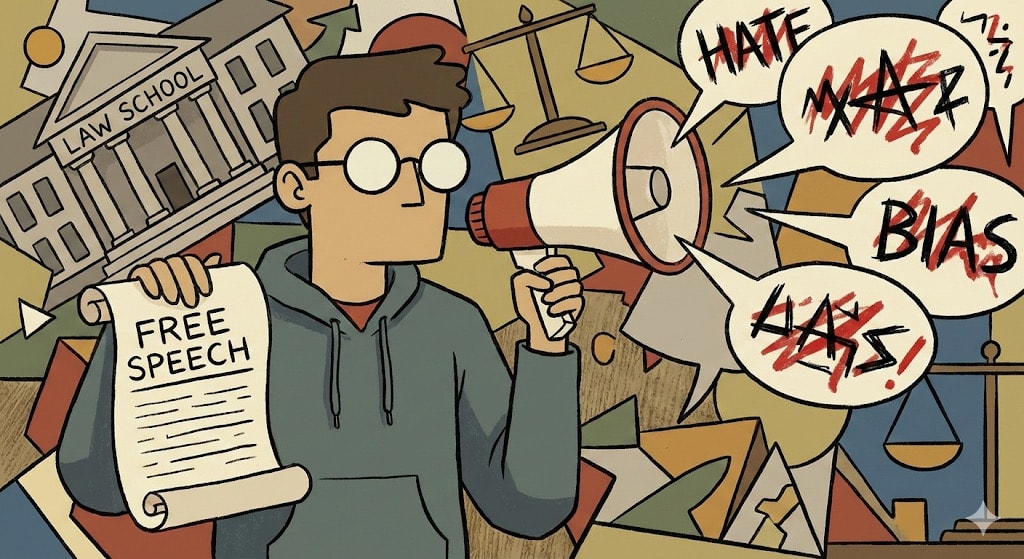
Preston Damsky v. Chris Summerlin, in his official capacity as Dean of Students, University of Florida, No. 1:25-cv-275-AW-MAF (N.D. Fla. Nov. 24, 2025)
Decision link: https://s3.documentcloud.org/documents/26314056/954597806-damsky-order.pdf
THE DAMSKY DECISION: WHY ANYONE WITH A PULSE SHOULD CARE
(And why writing this feels like sticking my hand into a live fuse box.)
Covering Damsky v. Summerlin is like wrestling a malfunctioning electrical cable. The facts jump. The rhetoric burns. The whole case pulses with the kind of unstable energy that makes you check your surroundings before continuing. But a federal judge has issued a ruling that sits dead center in the clash between speech and safety in 2025.
And because this happened at a public institution — the University of Florida — the First Amendment hits with full constitutional force. Private universities can restrict more. Public ones face strict limits. That difference shaped everything that followed.
THE SEISMIC RUMBLINGS BEFORE THE EXPLOSION
Before the infamous post, Preston Damsky was already generating academic tremors. His seminar papers read like ideological fever dreams. One praised “fighting, killing, and dying” to reclaim America’s racial inheritance. Another warned that White America might need to invoke a “revolutionary right to dismember or overthrow” the government, resolved by “the gruesome slashing of [Justice’s] sword.”
Professors gave him high marks.
Students stared at him like exposed wiring.
Administrators braced quietly.
The ground was already shaking.
THE MARCH 21 DETONATION
Then, the post that sent the law school into crisis:
“My position on Jews is simple: whatever Harvard professor Noel Ignatiev meant by his call to ‘abolish the White race by any means necessary’ is what I think must be done with Jews. Jews must be abolished by any means necessary.”
It hit the campus atmosphere like a chemical spill.
Students panicked.
A professor locked her doors and later slept with a baseball bat.
Security tightened.
Police were brought in.
Final exams required secure rooms.
This wasn’t debate. It was alarm.
THE IGNATIEV FIG LEAF
To justify his post, Damsky pointed to Noel Ignatiev, a Marxist scholar who argued that the “white race” should be abolished. But Ignatiev meant whiteness as a social structure, not people, and stated repeatedly that he opposed violence.
His work lived inside academic journals.
Damsky dragged it into the public square, swapped “white race” with “Jews,” and detonated it in front of classmates already wary of his rhetoric.
Then a Jewish professor confronted him:
“Are you saying you would murder me and my family?”
He didn’t deny it.
He didn’t clarify.
He tossed Ignatiev back at her.
This wasn’t interpretation.
It was provocation.
CAMPUS MELTDOWN
Students recognized the pattern.
Extremist rhetoric.
Escalation.
Ambiguous denials.
A digital-age sequence that often precedes disaster.
The law school responded like a community bracing for the worst.
THE JUDGE DESCENDS FROM THE STRATOSPHERE
Chief Judge Allen Winsor evaluated the situation from the high orbit of constitutional doctrine.
His findings:
No true threat.
No named target.
No explicit intent.
No imminence.
Ignatiev reference creates ambiguity.
Speech is protected.
Reinstatement required.
And because the University of Florida is a state actor, the First Amendment tied the court’s hands tighter than it would at a private institution.
The judge ordered full reinstatement by December 1.
WHY THIS CASE MATTERS
This is the American dilemma distilled:
A legal system forced to treat speech as an abstract category,
versus
A population trained by grim reality to treat certain speech as danger.
Public universities must honor constitutional protections even when the speech is abrasive, vile, or destabilizing. Students must navigate the very real anxiety of living in a society where online rhetoric sometimes precedes actual violence. Courts must apply doctrine even when it offends common sense.
No one in this story is imagining things.
They are simply operating inside different realities.
FINAL WRAP: THE NECESSARY, AWFUL BURDEN OF FREE SPEECH
Protecting speech like this is part of the American bargain. It forces institutions to stand still while speech rattles the walls. It demands that discomfort, fear, and disgust be endured for the sake of a principle that doesn’t always feel worth defending in the moment.
Free speech protection is essential. It prevents power from crushing dissent, minority views, and truth itself. But the darker truth, the one no one likes to admit, is that free speech always carries the seeds of its own undoing. The same freedom that allows ideas to flourish also allows the ones that corrode, destabilize, or drive people into panic. The system relies on restraint that will not always come.
Free speech is vital.
Free speech is dangerous.
And in cases like this, free speech feels like an exercise necessary for democracy yet awful in its execution.
Whether it survives its own contradictions is the question no ruling can settle.
Source: ReligiousLibertyTV on Substack