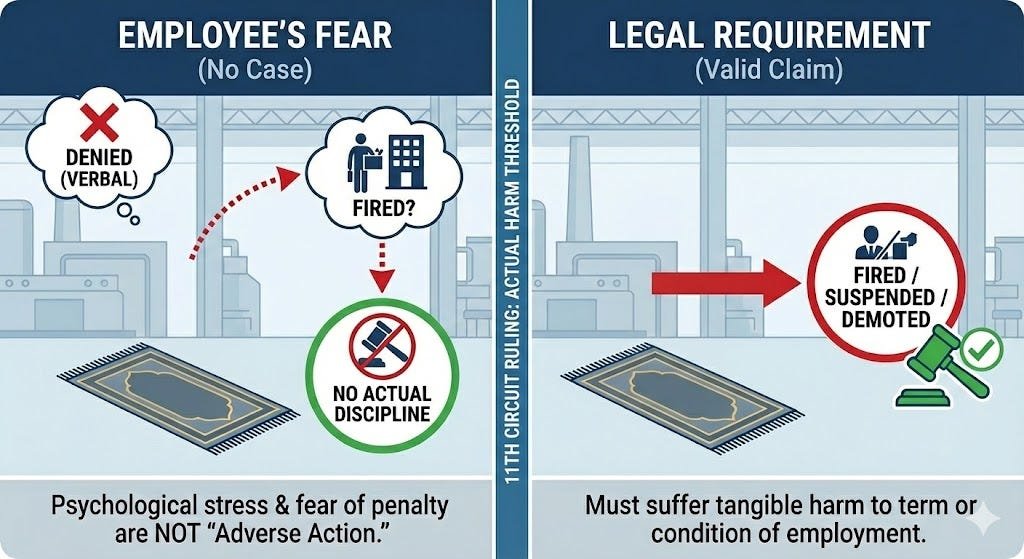
The 11th Circuit Court of Appeals ruled that an employee cannot sue for religious discrimination if they never faced actual discipline. Mouatasem Zienni, a Muslim assembly line worker at Mercedes-Benz, was told he could not take unscheduled breaks to pray. He prayed anyway and was never punished. The court held that without a firing, demotion, or formal reprimand, Zienni suffered no “adverse employment action.” Even under the Supreme Court’s new Muldrow standard—which lowered the bar for proving harm—fear of discipline or psychological stress is not enough to sustain a lawsuit. This decision clarifies that employees essentially must suffer a tangible penalty before they can claim a violation of their rights in court.
Case Caption: Mouatasem Zienni v. Mercedes-Benz U.S. International, Inc., No. 24-13932 (11th Cir. Dec. 22, 2025). Link: Read the Opinion
Can you sue your employer for denying a religious accommodation if they never actually punish you for taking it? No. The 11th Circuit Court of Appeals ruled last week that an employee who continued to pray despite being told not to—and faced no discipline—suffered no “adverse employment action,” effectively dismissing his Title VII lawsuit.
This ruling is critical because it defines the limits of the Supreme Court’s recent Muldrow decision. While Muldrow made it easier to show harm in discrimination cases, the 11th Circuit clarified that you still need to prove actual harm happened. Mere fear of being fired, or the stress of conflicting instructions, does not count as a violation of federal law if the employer never pulls the trigger.
Mouatasem Zienni worked on the assembly line at Mercedes-Benz U.S. International (MBUSI) in Alabama. As a practicing Muslim, he needed to pray five times a day at specific times determined by the position of the sun.
Continue Reading
This article was originally published on Substack. Subscribe to get updates directly to your inbox.
Holding: An employee cannot sue for religious discrimination under Title VII without suffering an actual adverse employment action such as firing, demotion, or formal reprimand; fear of discipline or psychological stress alone is insufficient.
