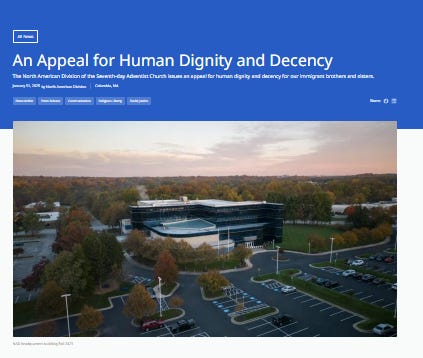
The North American Division (NAD) of the Seventh-day Adventist Church issued a formal appeal on January 31, 2025, calling for the protection of human dignity for immigrants. The statement grounds its position in Fundamental Belief No. 14, asserting that all humans are equal in Christ and that dehumanization by law is contrary to scripture. While the church encourages its facilities to remain “warm and welcoming,” the document is a descriptive moral appeal rather than a prescriptive political manifesto. It addresses the climate of fear surrounding deportation threats at churches and schools but directs leaders to a separate “Office of General Counsel” guidance for practical legal protocols. This strategy allows the denomination to advocate for “decency” in policy implementation while maintaining strict compliance with federal law and its own non-partisan tax-exempt status.
The NAD statement is a descriptive moral appeal that focuses on the theological “wholeness” of individuals rather than a political challenge to federal authority. It uses internal church doctrine to justify its stance on immigration while relying on professional legal counsel to handle the practicalities of enforcement.
This story matters because it illustrates how a major denomination can voice concern over “human dignity” without violating the Johnson Amendment. By framing the issue as a “Human Relations” matter, the NAD maintains its moral voice while steering clear of partisan campaigning.
What is the theological basis for the NAD appeal?
The NAD appeal is rooted in the biblical principle of “One Humanity.” The leadership cites Galatians 3:28 and Matthew 25:40 to argue that the treatment of the “least of these” is a direct reflection of a believer’s relationship with Christ.
-
Fundamental Belief No. 14: Asserts that fellowship in Christ is without partiality.
-
Equality and Dignity: The church “deplores” prejudice and the use of origin as a pretext for “oppressive behavior.”
-
The Image of God: The statement emphasizes that every person possesses an “inherent dignity” that laws and policies should respect. These points move the conversation away from political debate and into the realm of religious duty and congregational care.
Does the statement interfere with federal enforcement?
The appeal does not “step on the toes” of federal enforcement because it does not advocate for the obstruction of law. It is descriptive of the church’s values and the social impact of enforcement—specifically that people are “afraid to go to church.” The statement asks policymakers to treat people with “decency,” which is a form of civic petitioning protected by the First Amendment.
It does not:
-
Instruct members to hide individuals from agents.
-
Suggest that church property is a legal “sovereign zone.”
-
Encourage the violation of valid judicial warrants. Instead, it requests that the implementation of laws reflects the dignity of the individuals involved.
How does the NAD avoid the “bandwagon” of partisan politics?
The leadership avoids the bandwagon effect by relying exclusively on Adventist-specific language and sources. The appeal quotes the “Seventh-day Adventist Church Manual” and official “Human Relations Statements” rather than using secular political slogans. This ensures the message is an extension of the church’s existing mission rather than a reaction to a national political trend. By focusing on “human dignity and decency,” the NAD addresses the moral core of the issue while remaining neutral on specific legislative proposals.
What is the role of the General Counsel in this appeal?
The document explicitly points pastors and school leaders to a separate “Guidance on Immigration Enforcement” provided by the NAD Office of General Counsel. This is a critical legal “safety valve.”
-
The President’s Role: To provide the moral and spiritual vision.
-
The General Counsel’s Role: To provide the “rules of engagement” for legal encounters. This separation ensures that the church’s “welcoming” stance does not translate into illegal activity. The General Counsel provides the technical protocols on warrants and property rights, which protects local leaders from “harboring” or “obstruction” charges.
Does this represent a shift toward the “Sanctuary Movement”?
The document carefully avoids joining the radical “Sanctuary Movement,” which often encourages civil disobedience or the violation of law. Instead, the NAD has changed its approach by creating what can be called “Legal Sanctuary.” This means the church is not breaking the law to hide people, but it is using the law to its fullest extent to protect the privacy and dignity of those within its care. This is a subtle but vital distinction that allows the church to remain a safe place without becoming a criminal target.
How does this affect the church’s relationship with its immigrant members?
The most significant internal change is the message of active solidarity. By issuing a formal appeal signed by the top three officers of the division, the church is signaling to its immigrant members that they are not alone. This changes the internal culture from one of quiet ministry to one of visible support. It reassures the membership that the institution is using its legal resources to protect the spaces where they worship and learn.
Why is the timing of this statement significant?
Issued on January 31, 2025, the statement responds to a period of heightened enforcement and the removal of “Sensitive Locations” protections. The NAD identifies that the threat of deportation at “church and school” is a specific concern for its community. By addressing this now, the church leadership provides a framework for its members to “lift up their voices” in a way that is consistent with their faith while acknowledging the legal realities of the current administration.
Analysis
The North American Division’s appeal is a study in “prophetic neutrality.” As a legal analyst would observe, the church is careful to define its support as “the rights of all persons… provided in the U.S. Constitution.” This is a masterstroke of legal positioning. By anchoring its support in the Constitution, the church is not asking for special treatment; it is asking for the government to be consistent with its own founding principles.
The statement is also a defense of the “Free Exercise” of religion. If congregants are too afraid to attend church because of enforcement tactics, the church can argue that its core religious function is being burdened. However, the NAD does not make this as a legal threat; it makes it as a “human decency” appeal. This keeps the conversation in the realm of public discourse rather than courtroom litigation, which is a safer path for a 501(c)(3) organization.
Furthermore, the document avoids the “traps” of the harboring statute. It encourages being “warm and welcoming,” which is a traditional religious activity. It does not encourage “concealing” or “shielding.” In the eyes of the law, a church that holds an ESL class or a food pantry is performing a charitable act. A church that builds a “secret room” is committing a felony. The NAD appeal stays firmly in the “charitable act” category.
Ultimately, this statement allows the Adventist Church to lead its members through a volatile social period with clarity. It provides a moral compass that points toward the “dignity of the individual” while the General Counsel provides the map to navigate the legal landscape.
Citations
-
North American Division of Seventh-day Adventists. “An Appeal for Human Dignity and Decency.” NAD News, 31 Jan. 2025, https://www.nadadventist.org/news/north-american-division-seventh-day-adventist-church-appeal-human-dignity-and-decency/.
-
General Conference of Seventh-day Adventists. “One Humanity: A Human Relations Statement Addressing Racism, Casteism, Tribalism, and Ethnocentrism.” Adventist.org, https://www.adventist.org/official-statements/one-humanity-a-human-relations-statement/.
Join the Conversation Like, share, and subscribe to ReligiousLiberty.TV for breaking news and case info. Subscribers get access to breaking news and case information on the intersection of faith and the law.
Disclaimers This does not constitute legal advice. Readers are encouraged to talk to licensed attorneys about their particular situations.
Tags: NAD Adventist, Immigration Reform, Human Dignity, Church Law, 2025 Enforcement
