The Court applies the same “Major Questions” logic to Trump’s tariffs that it previously used to dismantle Biden’s pandemic mandates and student debt relief.
TLDR
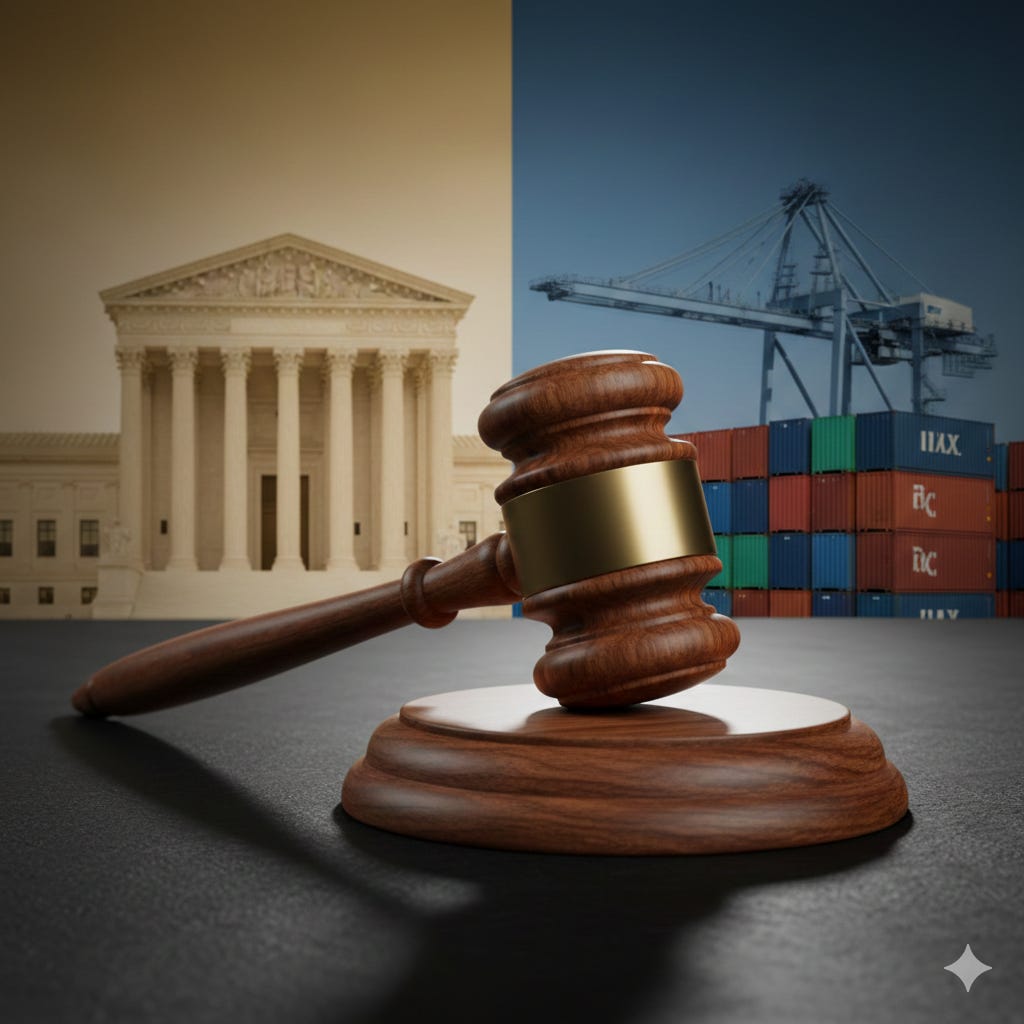
The Supreme Court ruling in Learning Resources v. Trump solidifies a new era of judicial skepticism regarding executive emergency powers. By striking down the administration’s unilateral tariffs, the Court demonstrated that the “Major Questions Doctrine”—which requires clear congressional permission for actions of vast economic or political significance—applies regardless of the President’s party or the specific emergency claimed. This follows a pattern set during the Biden administration, where the Court invalidated the OSHA vaccine mandate, the CDC eviction moratorium, and the $400 billion student loan forgiveness plan. In each instance, the Court held that vague or broad language in decades-old statutes cannot be used as a “blank check” for the Executive Branch to seize Congress’s power of the purse or its legislative authority.
Case Info
• Case Caption: Learning Resources, Inc. v. Trump (consolidated with Trump v. V.O.S. Selections, Inc.)
• Date: February 20, 2026
• Link: 607 U.S. ____ (2026)
The Supreme Court has consistently ruled that the President cannot use emergency statutes to bypass Congress, whether the goal is public health, debt relief, or international trade. Chief Justice Roberts, who authored the opinions striking down both Biden’s student loan plan and Trump’s tariffs, emphasized that “the Constitution does not permit the Executive to find a power to tax or spend hidden in a mousehole of a regulatory statute.”
This decision marks a rare moment where the Court’s conservative majority has used the same legal hammer against a Republican president’s “America First” agenda that it used against the previous Democratic administration’s domestic policies. It signals to all future presidents that “national emergencies” do not grant them the right to unilaterally rewrite the national budget or impose multi-trillion-dollar economic shifts without a new law from the Capitol.
How does this ruling mirror the Biden student loan case?
In Biden v. Nebraska (2023), the Court struck down the use of the HEROES Act to cancel $400 billion in student debt. The Biden administration argued that the power to “waive or modify” student aid rules during a national emergency allowed for total debt cancellation. In Learning Resources v. Trump, the current administration argued that the power to “regulate importation” during an emergency allowed for the imposition of tariffs.
• In both cases, the Court ruled that the verbs used (waive/modify vs. regulate) were too narrow to support such massive economic impacts.
• In both cases, the Court invoked the Major Questions Doctrine, noting that if Congress wanted to hand over the “power of the purse,” it would have done so explicitly.
What other “emergencies” did the Court strike down?
The Court’s recent history is a graveyard of executive overreach based on emergency claims:
• The Vaccine Mandate: In NFIB v. OSHA (2022), the Court ruled that a 50-year-old workplace safety law did not give the Biden administration the power to mandate vaccines for 84 million workers, calling it a “broad public health matter” rather than a specific workplace hazard.
• The Eviction Moratorium: In Alabama Association of Realtors v. HHS (2021), the Court stopped the CDC from using an old public health statute to prevent evictions, ruling that the agency was “claiming a power that it does not have” to manage the housing market.
Does this mean the President has no emergency powers left?
No. The Court has been careful to leave specific, narrow delegations intact. For example, it upheld Biden’s vaccine mandate for healthcare workers (Biden v. Missouri) because that statute specifically gave the Secretary of Health authority over the administration of healthcare facilities. Similarly, the Court noted today that the President can still use the Trade Expansion Act of 1962 to impose tariffs if he follows the specific procedural requirements (such as a report from the Secretary of Commerce), rather than relying on the “unbounded” emergency language of IEEPA.
The Learning Resources decision completes a judicial arc that began in 2021. Whether the President is attempting to forgive loans, mandate medical procedures, or tax foreign goods, the Supreme Court has made it clear: the greater the economic impact, the clearer the congressional authorization must be. The “emergency” label is no longer a shortcut around the separation of powers.
Commentary
The Supreme Court has finally achieved a consistent “checks and balances” rhythm that transcends partisan politics. For years, critics of the Major Questions Doctrine argued it was a weapon used only to stymie Democratic regulation. Today’s ruling proves that theory wrong. By stripping the current administration of its primary economic weapon—the unilateral tariff—the Court has shown it is just as concerned with executive overreach on the right as it was on the left.
The legal logic is refreshingly plain: if a policy is “big,” it belongs to the people’s representatives in Congress. The Biden administration learned this lesson when it tried to use a post-9/11 statute to wipe away student debt. The current administration is learning it now as it tries to use a 1970s banking law to start a global trade war. In both instances, the Executive Branch tried to “hide an elephant in a mousehole,” and in both instances, the Court refused to look the other way.
This is a victory for the structural Constitution. By forcing the President back to the bargaining table with Congress, the Court is protecting the taxpayer from the whims of a single individual. It does not matter if the goal is “protecting public health” or “protecting American workers.” The ends do not justify the means if the means involve seizing a power that the Constitution expressly gave to someone else.
Expect the administration to grumble about “judicial interference” in foreign policy, just as the previous administration complained about “judicial interference” in a pandemic. But the reality is that the Court is merely holding the line. If the President wants to change the way America does business with the world, he must do what every other president in history has done: convince a majority of the House and Senate to sign on.
Citations
• Supreme Court of the United States. Learning Resources, Inc., et al. v. Trump, President of the United States, et al., No. 24-1287, 20 Feb. 2026. https://www.supremecourt.gov/opinions/25pdf/24-1287.
• Biden v. Nebraska, 600 U.S. 477 (2023). https://www.supremecourt.gov/opinions/22pdf/22-506_nmip.pdf.
• NFIB v. OSHA, 595 U.S. 109 (2022). https://www.supremecourt.gov/opinions/21pdf/21a244_hgci.pdf.
• Alabama Assn. of Realtors v. Department of Health and Human Servs., 594 U.S. 758 (2021). https://www.supremecourt.gov/opinions/20pdf/21a23_ap6c.pdf.
Subscription Call
Stay informed on the legal battles that define our era. Like, share, and subscribe to ReligiousLiberty.TV for breaking news and case info. Our subscribers receive priority access to case documents and expert analysis.
Disclaimer
This does not constitute legal advice. Readers are encouraged to talk to licensed attorneys about their particular situations.
Tags: Supreme Court, Executive Power, Major Questions Doctrine, Emergency Powers
Holding: The President cannot use emergency statutes to bypass Congress for actions of vast economic or political significance without clear congressional permission under the Major Questions Doctrine.
