The Currency of Conviction: Why Bold Faith Statements Are Christian Higher Ed’s Strongest Survival Strategy
The institutions positioned to survive are rediscovering theological and operational boldness—treating their public statements as their primary competitive and legal advantage.
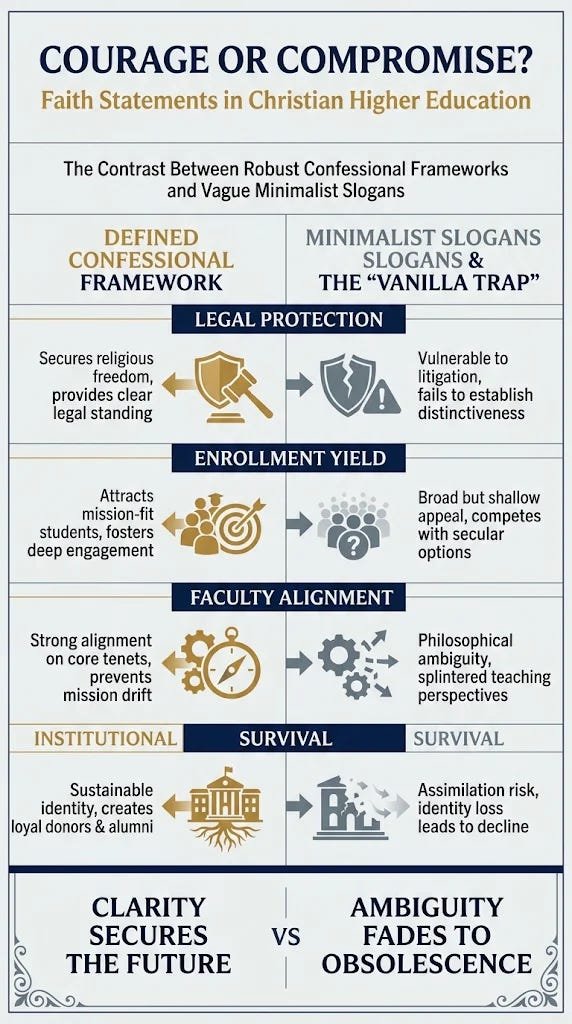
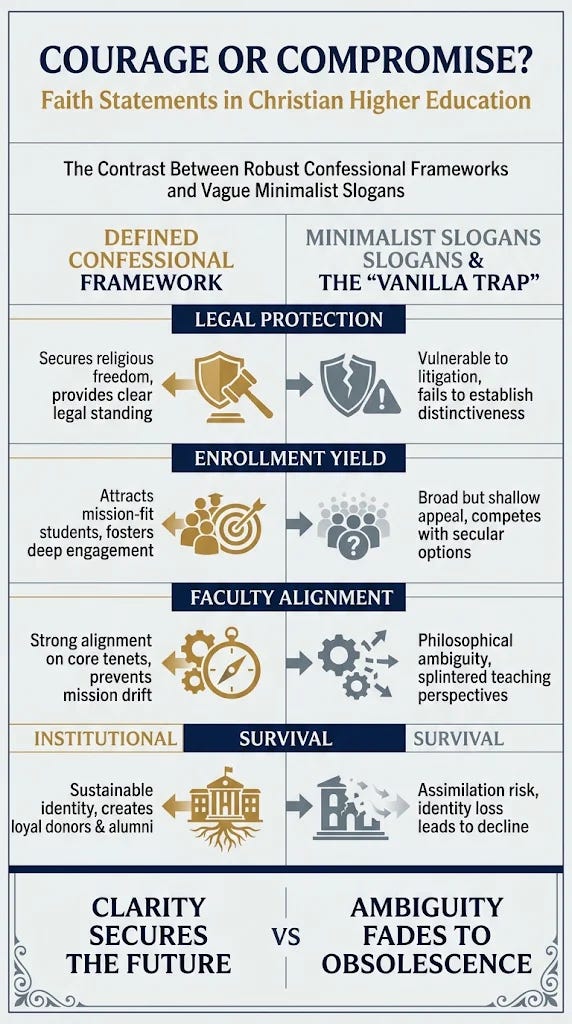
For the past thirty years, boardrooms across faith-based higher education operated under an unspoken marketing dogma: file down the theological edges, shorten the doctrinal statements, and emphasize generic humanitarian ideals to keep prospective applicants from running away.
Staring down a demographic cliff, skyrocketing operational overhead, and a cultural landscape increasingly suspicious of traditional religion, many Christian college administrators concluded that long-term survival required becoming as unobjectionable as possible. The goal was to build a mission statement that could double as the mission statement for the local community foundation or credit union: “fostering excellence, community, integrity, and global service.”
It is a comfortable strategy, but it is built on a fatal misunderstanding of modern higher education economics.
When an independent college dilutes its defining convictions into vanilla platitudes, it does not widen its market. It destroys its core value proposition. In a landscape crowded with subsidized public universities and prestigious secular research hubs, private Christian institutions cannot endure as second-rate, overpriced imitations of their state-run neighbors.
The institutions positioned to survive the coming shakeout are doing the exact opposite. They are rediscovering what can only be termed theological and operational boldness—treating their public statements not as corporate risk liabilities to be concealed, but as their primary competitive and legal advantage.
The Digital Front Porch
In an earlier era of American higher education, a college’s spiritual life lived inside physical spaces and human relationships: chapel attendance, dorm devotions, faculty mentorship, and organic denominational pipelines. Parents and prospective students learned who a school was through alumni pastors, camp meetings, and word of mouth.
Today, a university’s website is its digital front porch, its binding admissions disclosure, and its most scrutinized legal record. Long before an applicant attends a campus tour or a prospective faculty member relocates their family, they check what the institution says in black and white on its “About” page.
Administrators often justify brief, watered-down statements by arguing that “our faith runs deeper than a web page.” That sentiment sounds pastoral, but in modern corporate and academic governance, it is a perilous evasion. What a university chooses to display—or deliberately downplay—on its primary landing page reveals whether it treats its heritage as an active operational compass or as an embarrassing heirloom it hopes nobody notices.
A look across four faith-based universities reveals four strikingly different models of digital, theological disclosure.
A Spectrum of Four Institutions
1. The Explicit Doctrinal Blueprint: California Baptist University
At California Baptist University, there is no ambiguity about what guides the institution. Rather than summarizing its faith in vague generalities, CBU publishes the Baptist Faith and Message in comprehensive detail.
The university lays out explicit doctrinal positions on the inerrancy and authority of Scripture, the triune nature of God, humanity’s fallen condition, the exclusivity of Jesus Christ for salvation, the sanctification of the believer, and social principles addressing the family, the sanctity of human life, and religious liberty.
CBU makes no effort to hide behind anodyne slogans. It provides total operational transparency: if you attend, teach, or invest here, this is the theological framework governing the classroom, the dormitories, and the administration.
2. The Structured Epistemological Integration: Andrews University
At Andrews University, the flagship institution of the Seventh-day Adventist Church, the approach pairs a memorable public-facing motto with deliberate institutional grounding. The university’s guiding banner—“Seek Knowledge. Affirm Faith. Change the World.”—might look like a standard marketing slogan on the surface, but the university refuses to leave it untethered.
Andrews anchors this triad directly to an articulated theological epistemology. It explicitly connects academic inquiry to a biblical worldview, charges undergraduate and doctoral faculties with critiquing and enriching secular research through an Adventist theological lens, and insists that personal spiritual transformation is inseparable from professional training. It models how a memorable public identity can remain directly accountable to its founding confessional framework.
3. The Fortified Governance Charter: Pepperdine University
At Pepperdine University, the framework crystallized in Pepperdine Believes addresses head-on the legal and corporate realities of modern university life. Pepperdine candidly explains why a defined statement is essential:
“As an educational institution, we have a legal and operational necessity to define our corporate identity and educational mission. This document does not govern a believer’s standing before God; it defines the theological framework of Pepperdine University. Pepperdine Believes provides truth-in-advertising for prospective students, faculty, and donors, ensuring they understand the nature of the institution they are joining or supporting. It serves as a safeguard against ‘mission drift,’ ensuring that Pepperdine remains distinctly Christian for generations to come. It gives our schools, deans, and vice presidents a clear framework for aligning their programs, hiring practices, and student life initiatives with our foundational identity.”
Notice what Pepperdine did here. They openly separated individual, personal salvation before God from the corporate responsibility of the institution. They acknowledged that without an objective, written theological boundary, an institution inevitably secularizes through administrative drift.
4. The Low-Barrier Pastoral Welcome: La Sierra University
By contrast, La Sierra University illustrates the minimalist model that has become common among institutions nervous about appearing rigid. Rather than publishing an explicit confessional framework or an operational charter, La Sierra condenses a comprehensive, historically complex Seventh-day Adventist heritage into five short bullets:
-
Believe in the Bible as the inspired word of God
-
Trust in Jesus as our Savior
-
Worship on Saturdays
-
Emphasize healthy living
-
Are committed to serving others worldwide
The page immediately pivots away from governance, hiring standards, or academic worldviews to list campus worship options: MidnightCafé, Rendezvous, Dorm worships, and Tuesday Tunes.
While motivated by a desire to provide a warm, low-barrier welcome to students of all backgrounds, the structural consequence is significant: it relocates institutional faith from the academic core, the faculty handbook, and the boardroom into the student lounge. Faith is framed primarily as an optional co-curricular activity rather than the intellectual foundation of the entire institution.
The “Vanilla Trap”: How Ambiguity Destroys Enrollment
The standard administrative argument for keeping faith statements short and vague has always been enrollment protection: “If we state our theological convictions too boldly, we will alienate potential applicants and drive down enrollment.”
In the modern marketplace, this fear-based calculus has backfired. Ambiguity leads straight into the Vanilla Trap.
First, it eliminates market differentiation and destroys pricing power. When a private Christian university presents a cultural and ideological atmosphere indistinguishable from a secular regional campus, parents and students make a simple financial calculation: Why pay $45,000 to $60,000 in private tuition and room-and-board for an experience that mimics the local public university down the freeway for $9,000?
Second, it forfeits geographic reach. A Christian institution that softens its distinctives ceases to be a destination. Families in Texas, Ohio, or Florida will not send their children across the country to California or Michigan if the institution will not boldly defend the spiritual and intellectual values that justified the distance.
Third, it trades yield for empty inquiries. A vague statement might attract casual, top-of-funnel clicks, but it produces low commitment, high summer melt, and weak retention. Conversely, institutions that double down on their historic identities—such as CBU, Cedarville, Franciscan University of Steubenville, or Baylor through its intentional Christian research initiatives—routinely defy national enrollment drops. Families are eager to sacrifice for an authentic, counter-cultural educational environment that knows what it believes.
Philanthropic support follows the same path. Major donors, foundation boards, and alumni do not write transformational checks to institutions that seem embarrassed by their own founding mission. Capital flows toward clarity, institutional spine, and moral purpose.
The Legal Shield: Clarity as Risk Management
Beyond market economics, defining an institutional faith framework is a non-negotiable legal shield.
Christian colleges operate in an increasingly contentious regulatory environment. Between recurring disputes over Title IX religious exemptions, state-funded tuition grant eligibility, non-discrimination ordinances, and regional accreditation reviews, vague institutions are the most legally exposed.
Under the First Amendment’s Free Exercise Clause and the ministerial exception affirmed in Hosanna-Tabor and Our Lady of Guadalupe, courts provide robust autonomy to religious institutions to manage their hiring, internal governance, and community standards. But that judicial deference is predicated on sincerity, continuity, and clear public documentation.
When an institution relies on a two-paragraph statement claiming merely to support “spiritual discovery” and “ethical values,” opposing litigants and administrative agencies can easily argue that specific behavioral policies, hiring criteria, or curriculum requirements are arbitrary, pretextual, or discriminatory rather than rooted in core religious doctrine.
A comprehensive, published framework—like CBU’s adoption of the Baptist Faith and Message or Pepperdine’s Pepperdine Believes—creates an unassailable evidentiary record. It proves that institutional conduct is directly derived from published corporate purpose, protecting the school from claims that it is making up rules after the fact to justify an administrative decision.
Truth-in-Advertising as Authentic Hospitality
The most common objection to explicit faith statements is that they are inhospitable. Critics worry that defining boundaries makes outsiders feel unwelcome.
In truth, ambiguity is the enemy of authentic hospitality.
When an institution obscures its convictions to attract students or faculty who would not otherwise choose it, it violates the basic principle of informed consent. A student who arrives on campus expecting an open-ended secular liberal arts college, only to encounter mandatory worship credits, traditional lifestyle covenants, or confessionally guided coursework, understandably feels misled. A professor hired under a generic “commitment to Christian values” who later faces tenure denial because of an unwritten theological test is the victim of institutional bad faith.
True hospitality requires an honest host. An institution that knows exactly who it is does not need to compromise its identity to welcome others with radical generosity. It can invite students of different faiths, diverse backgrounds, and varying personal convictions into a vibrant, intellectual community precisely because its own foundation is stable.
A university’s website is not a casual digital flyer. It is a public covenant with students, parents, faculty, donors, and the courts. In a cultural moment marked by ideological confusion and intense economic headwind, Christian higher education has no future in the comfortable middle of the road.
The institutions that flourish will not be those that master the art of administrative evasion, but those with the courage to declare their convictions clearly, boldly, and without apology.