

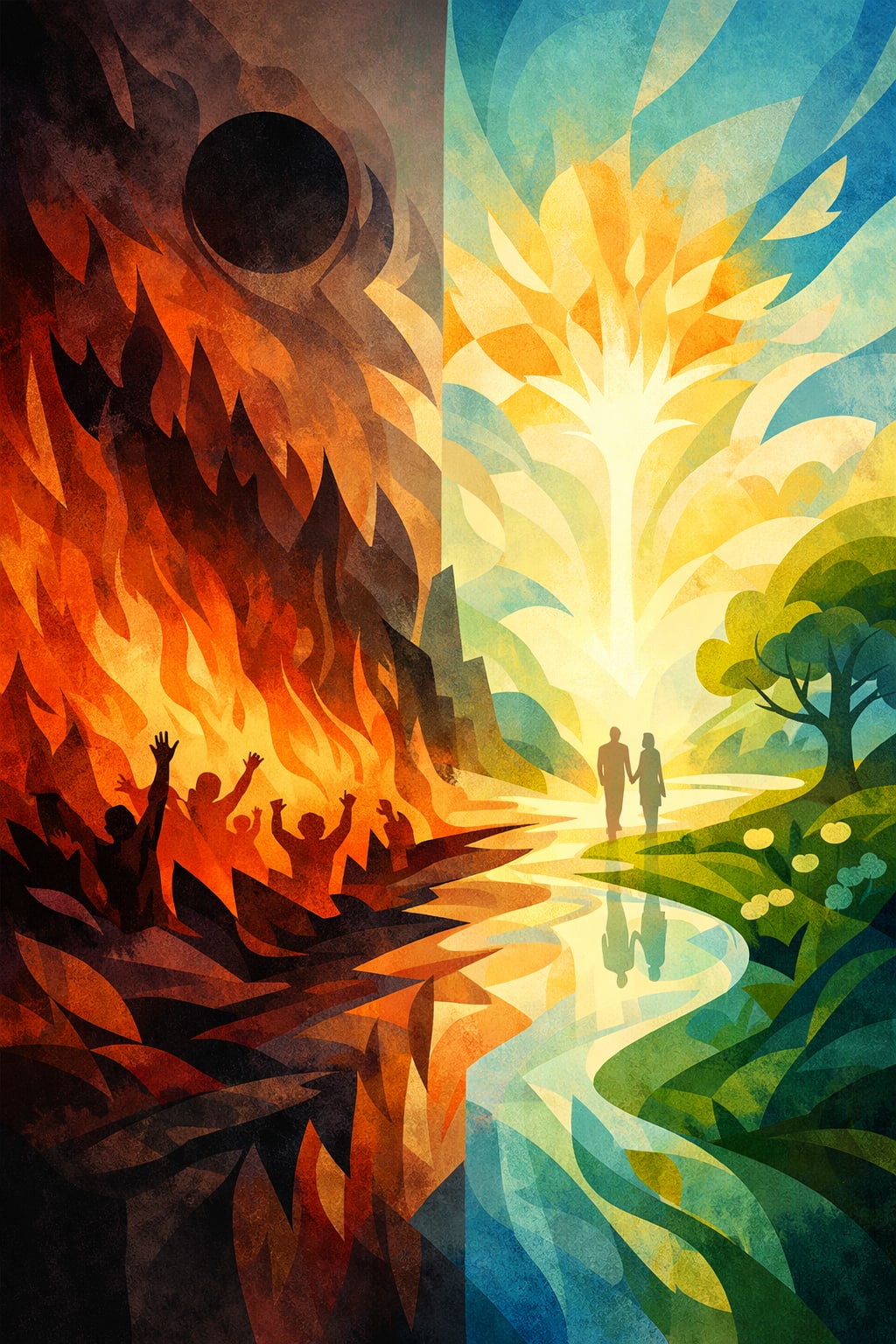
The Old Tale That Still Haunts People
There is a story passed down in many churches, the kind where you sit stiff in a wooden pew while the preacher shouts about fire and smoke and souls that scream forever. It isn’t told as a parable or a metaphor. It’s told straight: God loves you, but if you don’t respond the right way, He’ll send you to burn for eternity. The fire never goes out. The pain never stops. You live on forever, but in torment.
Somehow, that was supposed to be comforting. Or motivating. But for many, it was terrifying. And for more than a few, it was the beginning of the end of faith. Because if God is really like that, then what kind of love is He offering?
Fear-Based Religion and the Culture Wars
This idea of eternal torment isn’t just about what happens after death. It shapes the way people act while they’re alive. It creates a kind of high-pressure, high-anxiety religion, where everything must be said just right and believed exactly, because the consequences are unthinkably severe.
It feeds into culture wars. It fuels crusades. It tells believers that if someone is wrong, it’s their job to fix them—or else. And it turns faith from an invitation into a campaign of moral enforcement. If you believe your neighbor might burn forever unless you make them think like you do, then every disagreement becomes urgent. Every wrong step must be corrected. Compassion becomes weakness. Mercy looks like compromise.
But Jesus didn’t operate that way. He spoke the truth, but He never used it as a club. He warned of judgment, but He drew people in with kindness. He never once used fear to manipulate. He invited. He loved.
Calvinism, Predestinationism, and the Distorted Picture of God
In some theological systems, like Calvinism, the situation becomes even more troubling. Calvin taught that before the foundation of the world, God chose who would be saved and who would not. Some are elected to eternal life. Others are passed over. They are not offered salvation, and they never had a real chance.
Now if that judgment ends in death, it is still heartbreaking. But if it ends in eternal conscious torment, then the picture becomes unbearable. God creates people for the express purpose of punishing them. Forever. Without hope. Without end.
Predestinationism takes this view and locks it into stone. You are either in or out before you’re born. Nothing you do changes that. And if eternal hell is your destination, then so be it. You were created for that fate.
This is not the God Jesus revealed. This is not the God who weeps over Jerusalem (Luke 19:41–44). This is not the God who says He is not willing that any should perish but that all should come to repentance (2 Peter 3:9).
Universalism: A Gentle Idea That Overreaches
In response to the harshness of Calvinism and the terror of eternal hell, some have turned to universalism. This is the belief that, eventually, everyone will be saved. Maybe not right away. Maybe not even in this life. But somehow, in the end, love wins.
Universalism feels kind. It avoids the cruelty of endless torment. It promises restoration for all.
But it also stretches past what Scripture allows. The Bible is full of warnings about judgment, separation, and consequences. Jesus said, “Not everyone who says to Me, ‘Lord, Lord,’ will enter the kingdom of heaven, but only the one who does the will of My Father in heaven” (Matthew 7:21). He spoke of weeping and gnashing of teeth (Luke 13:28), of doors shut (Matthew 25:10–12), and choices made that could not be undone.
Universalism also removes the reality of choice. If everyone ends up saved, whether they want to be or not, then love is no longer chosen. It is imposed. And it makes no room for justice. Evil is not judged. It is simply washed away.
What the Bible Really Says About Hell
The consistent teaching of Scripture is that the wages of sin is death. Not torment. Not unending pain. Death. Real, final, total death.
Romans 6:23 could not be clearer. “The wages of sin is death, but the gift of God is eternal life in Christ Jesus our Lord.”
John 3:16 does not say that whoever believes in Him shall not suffer forever. It says they shall not perish. Perishing is not eternal life in torment. It is the opposite of eternal life. It is an end.
Jesus said God can destroy both body and soul in hell (Matthew 10:28). He did not say God would preserve the soul in flames. He said He would destroy it.
The lake of fire in Revelation is called the second death (Revelation 20:14). Malachi says the wicked will be like ashes under the soles of the feet of the righteous (Malachi 4:1–3). Paul said the enemies of God will be punished with everlasting destruction and shut out from the presence of the Lord (2 Thessalonians 1:9). Peter said the present heavens and earth are reserved for fire, and that the ungodly will be destroyed (2 Peter 3:7).
Psalm 37:10 says, “A little while, and the wicked will be no more; though you look for them, they will not be found.” Obadiah 1:16 says, “They will be as though they had never been.”
This is not eternal conscious torment. This is death.
Conditional Immortality and the Justice of God
The Bible teaches Conditional Immortality. That means eternal life is not the default for everyone. It is a gift given to those who are in Christ. The soul is not naturally immortal. Only God is (1 Timothy 6:16).
Those who reject God are raised for judgment (John 5:28–29), face that judgment, and then die the second death. They do not suffer forever. They are not kept alive in torment. They perish.
This is just. It is fair. It is final. It does not mock justice by punishing more than the crime deserves. It does not mock love by keeping people alive for eternal pain.
Heaven as the Restoration of Eden
In the beginning, God created a garden. Eden. A place of peace, beauty, and presence. God walked with humanity. There was no sin. No shame. No death (Genesis 1–2).
Sin broke that world. But God’s plan has always been to restore it.
Revelation ends where Genesis began. A garden. A tree of life. A river. God dwelling with His people. No more curse. No more death. No more tears (Revelation 21:1–4, 22:1–5).
Heaven is not a city in the clouds. It is Eden renewed. Earth restored. The home we were meant for, returned to us. Evil does not get a corner of that new world to burn forever. It is gone. Judged. Removed (Nahum 1:9).
This Matters Because It Shapes How We Live Now
If you believe in eternal torment, you will likely try to frighten people into faith. You may see the world as a battlefield. You may become harsh, urgent, and afraid.
If you believe in universalism, you may stop warning people altogether. You may assume it all works out in the end.
But if you believe what the Bible teaches—that eternal life is a gift, that sin leads to death, that God judges fairly, and that He draws people with love—then you live differently.
You share truth, but gently. You correct, but with hope. You invite, not threaten.
And you trust that God will do what is right (Genesis 18:25).
The Gospel Is Good News Again
For many who walked away from faith, this might be the reason they come back. Because when you take away the distortion, the gospel shines again.
Jesus died not to save you from eternal torment, but from eternal death. He took that death on Himself so you wouldn’t have to (Isaiah 53:5–6, Hebrews 2:9). He offers life. Real life. Eternal life.
This is not about earning heaven. It is about receiving the gift. And it is offered to all (Titus 2:11, Revelation 22:17).
The cross makes sense again. The resurrection becomes hope again. And heaven becomes home again.
If you’ve been carrying the burden of fear, maybe it’s time to set it down.
God is not a Father who burns His children.
He is the One who gave His Son so you could live (1 John 4:9).
Like this article? Share it and subscribe to the ReligiousLiberty.TV blog for honest writing on faith, justice, and truth. Stay updated on legal cases, theology, and real conversations about God’s character. No hype. No fear. Just clarity.
Legal Disclaimer: This article does not constitute legal advice. For legal concerns, speak with a licensed attorney.
SEO Tags: hell and predestination, conditional immortality, biblical view of hell, Calvinism and eternal torment, restoration of Eden in heaven
Source: ReligiousLibertyTV on Substack
