BREAKING: Analysis of the Religious Liberty Commission Public Comments
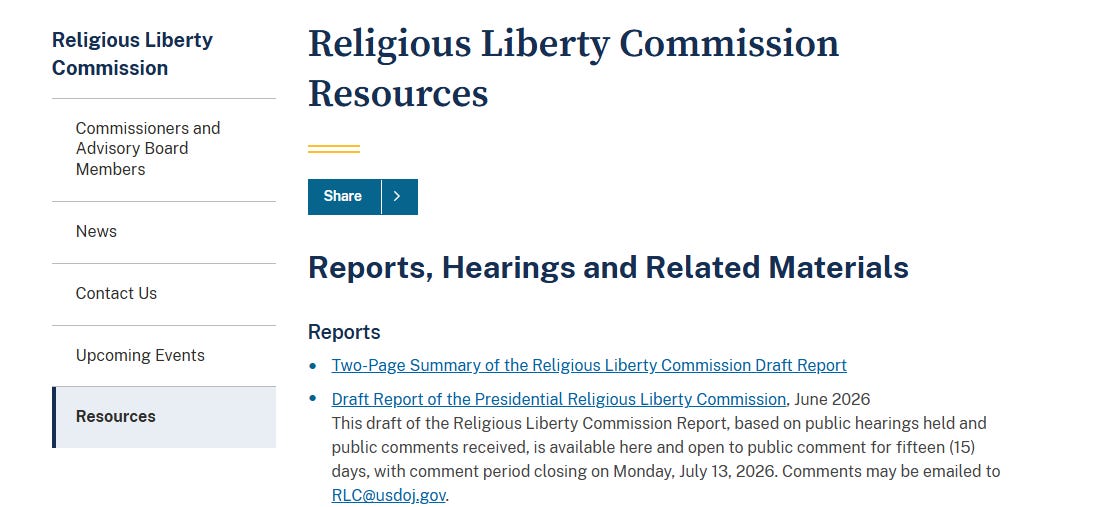
WASHINGTON — When the federal Religious Liberty Commission published its draft report and opened a portal for public comments, administration officials framed the initiative as an expansive, nonpartisan listening tour aimed at shoring up the First Amendment. What flooded into the official record, however, was a striking portrait of modern civic friction: tens of thousands of emails that laid bare a fierce contest between digital political machines, automated text-generation campaigns, and deeply personal defenses of the historic separation between church and state.
The public feedback log reveals far more than standard policy disagreements. An exhaustive analysis of the docket demonstrates that behind the staggering volume of incoming mail lies a remarkably concentrated set of arguments. The repository reflects the pervasive footprint of modern advocacy tools, where grassroots authenticity frequently blends with generative artificial intelligence, and partisan legal campaigns run parallel to profound historical warnings from everyday citizens.
An Ocean of Mail, a Puddle of Originality
At first glance, the public response appears to represent an overwhelming groundswell of civic engagement. Submissions poured in from across the country by the thousands, jamming federal inboxes with urgent pleas concerning religious liberty, educational policy, and constitutional law.
Yet when the entries are subjected to linguistic and textual analysis, the illusion of a vast, polyphonic debate quickly dissolves.
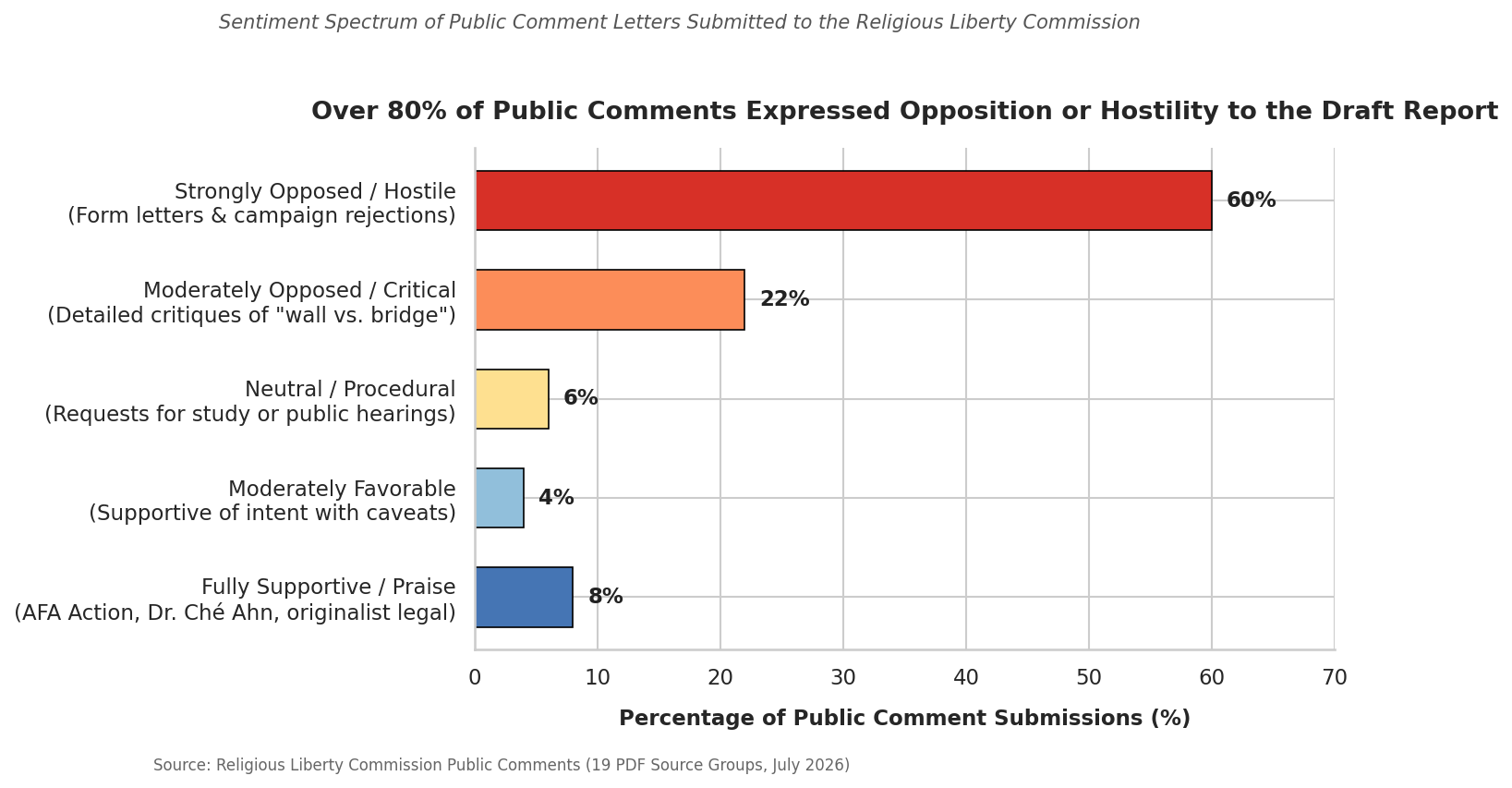
Uniquely composed letters make up only an estimated 10 to 15 percent of the total volume. The vast majority of the docket consists of coordinated, bulk form-letter initiatives organized by advocacy networks and religious media organizations.
The submissions fall primarily into several distinct tiers of digital mobilization:
-
Identical Boilerplate Submissions: Thousands of entries consist of verbatim paragraphs downloaded directly from advocacy websites, demanding the simultaneous defense of the Free Exercise Clause and the dismantling or preserving of the Establishment Clause.
-
One-Line Proxy Endorsements: Hundreds of submissions omit substantive commentary entirely, consisting solely of a single declarative sentence, such as: “I agree with Pillar of Freedom’s comments. Please implement them”.
-
Mobile Form Submissions: Batches of identical messages were fired off from mobile devices, closing with standard iPhone or Android signatures and containing identical text without alteration.
-
Leaked Campaign Prompts: In dozens of instances, the mechanics of the digital operations were left in plain view. Several senders inadvertently copied and pasted campaign administrative instructions directly into the public record, including boilerplate subject headers reading “[TOPIC OR CHAPTER NUMBER] – [YOUR NAME]” and organizational advisories reminding participants to alter their phrasing to circumvent agency deduplication software.
The Algorithmic Lobby: Generative AI on the Docket
Beyond predictable form-letter pipelines, the docket provides clear evidence of a newer phenomenon in administrative rulemaking: the large-scale deployment of generative artificial intelligence to manufacture simulated grassroots prose.
Rather than simply submitting identical templates, many participants or organized networks utilized large language models to rephrase central arguments, attempting to bypass automated spam filters while maintaining identical argumentative architecture.
The clearest footprint of this “AI spinning” centers around a widespread campaign responding to the draft report’s proposal to replace the traditional “wall of separation” with a cooperative institutional “bridge”. The source template for the campaign argued cleanly: “That wall wasn’t built by secularists to keep religion down. It was built by believers to keep the church free.”
Within the official docket, that single sentence appeared in dozens of synthetically altered permutations:
-
“The wall separating church and state was not created to diminish religion or silence people of faith. It exists to protect the independence and integrity of religious institutions.”
-
“This wall was not conceived as a secular barrier against religion; it was established by people of faith to safeguard religious practice from government influence.”
-
“The architectural boundary between church and state was never a weapon devised to suppress faith, but rather a vital shield constructed by devout believers to insulate religious life from state corruption.”
These synthetic variations exhibit standard hallmarks of model-generated text: perfectly balanced antitheses, structured transitional clauses, and clean bibliographies appended to the bottom of the emails citing legal dictionaries and encyclopedia entries. While these tools succeeded in swelling the word count of the docket, they generated repetitive echo chambers that masked the actual number of independent voices engaging with the commission.
Partisan Agendas vs. Genuine Historical Concern
The motivations underlying the public comments reveal an unmistakable divergence between institutional, politically aligned factions and unaffiliated citizens motivated by genuine historical caution.
The Partisan Footprint
Submissions from institutional actors, including prominent conservative advocacy funds and legal defense foundations, operate from an explicitly partisan framework. These filings frequently opened with direct praise for current political figures, commended the executive branch for appointing conservative commissioners, and framed religious freedom not as a universal civil liberty, but as a strategic tool to score culture-war victories.
These organizations explicitly urged the Department of Justice to leverage the commission’s findings to initiate federal litigation aimed at overturning long-standing Supreme Court precedents. For these groups, public comments functioned as strategic amicus briefs designed to push federal policy toward state financial support of religious institutions and the dismantling of campaign-finance boundaries for churches.
The Historical Counterweight
In sharp contrast to this institutional maneuvering, the substantial majority of independent citizen letters—many penned by lifelong churchgoers, Protestant evangelicals, Seventh-day Adventists, and religious minorities—displayed no interest in partisan advantage. Instead, their arguments reflected a profound, historically informed anxiety.
These writers did not argue against religion; rather, they argued for the protection of faith from the corrupting influence of the state. Drawing on centuries of European religious warfare, colonial crackdowns, and early American history, these commenters warned that whenever the civil magistrate is granted authority over sacred conscience, the inevitable result is persecution, division, and the decay of sincere spiritual life.
The Standout Critiques: Dissecting the Draft Report
Amid the mountain of replicated prose, a handful of uniquely crafted, highly effective letters cut through the administrative clutter. These standalone essays bypassed political talking points to deliver rigorous historical, theological, and constitutional rebuttals.
                     PRIMARY CATEGORIES OF SUBSTANTIVE OPPOSITION
┌──────────────────────────────┬────────────────────────────────────────────────────────┐
│ Area of Critique             │ Central Legal & Historical Argument                    │
├──────────────────────────────┼────────────────────────────────────────────────────────┤
│ The "Bridge" Metaphor        │ Replacing the "Wall" of separation invites regulatory  │
│                              │ oversight and compromises doctrinal independence.       │
├──────────────────────────────┼────────────────────────────────────────────────────────┤
│ Historical & Case Precedent  │ Founding documents and early court rulings (e.g.,      │
│                              │ Reynolds) established separation long before modern era│
├──────────────────────────────┼────────────────────────────────────────────────────────┤
│ Representation & Diversity   │ The commission's membership heavily favors majority    │
│                              │ traditions while marginalizing minority faiths.        │
├──────────────────────────────┼────────────────────────────────────────────────────────┤
│ The Johnson Amendment        │ Permitting political endorsements by churches converts │
│                              │ sacred pulpits into tax-sheltered partisan PACs.       │
└──────────────────────────────┴────────────────────────────────────────────────────────┘
1. The Peril of Replacing the “Wall” With a “Bridge”
A central recommendation of the commission’s draft report was to discard Thomas Jefferson’s historic metaphor of a “wall of separation” in favor of an institutional “bridge” that fosters direct cooperation between church and state.
Several of the most cogent public submissions dismantled this premise, warning that a “bridge” inevitably transforms into a two-way conduit for state interference.
One particularly thorough critique observed:
“The wall separating church and state was not created to diminish religion or silence people of faith. It exists to protect the independence and integrity of religious institutions. A bridge between church and state does not strengthen the church; instead, it invites government influence through funding, political favoritism, and regulatory oversight. Over time, churches can become dependent on government support and accountable to political leaders rather than remaining solely devoted to their spiritual mission.”
The submission argued that when churches accept government grants to fund their activities, they surrender their prophetic independence, trading their spiritual autonomy for federal compliance mandates.
2. Founding Precedent and the Lessons of History
Other standout submissions tackled the draft report’s selective reading of American legal history. Commenters noted that the draft report erroneously framed the wall of separation as an artifact of 20th-century secular judges.
Refuting this, one historical brief traced the concept back to 17th-century theologian Roger Williams, who argued for a “hedge or wall of separation between the garden of the church and the wilderness of the world,” and to James Madison’s 1785 Memorial and Remonstrance Against Religious Assessments.
The submission highlighted Madison’s famous warning that the same authority capable of establishing a specific religion may also force conformity to any other creed, reminding commissioners that the 1879 Supreme Court ruling in Reynolds v. United States had cited Jefferson’s Danbury Baptist letter as an authoritative definition of the First Amendment nearly seven decades before modern case law.
3. Exclusion of Minority Faiths and Secular Americans
Multiple substantive letters criticized the structural makeup of the commission, arguing that its composition fatally undermines its legitimacy.
Commenters pointed out that the advisory leadership is overwhelmingly stacked with conservative Christian figures, leaving minority religious traditions—such as Jewish, Muslim, Hindu, Buddhist, and Sikh communities—virtually unrepresented, while ignoring the nation’s rapidly growing nonreligious demographic.
“Religious liberty must be absolute and equal for all people,” one widely cited individual comment emphasized. “By focusing almost exclusively on protecting majority Christian institutions while largely ignoring discrimination against minority faiths, the report inherently narrows the freedom of all others.”
4. The Integrity of the Pulpit: Opposing the Johnson Amendment Repeal
A significant number of detailed comments took aim at the commission’s proposal to repeal the 1954 Johnson Amendment, which prohibits 501(c)(3) religious and non-profit organizations from endorsing or opposing candidates for public office.
Commenters argued that repealing the restriction would inflict catastrophic damage on the integrity of houses of worship:
-
Political PACs in the Pews: Removing the restriction would incentivize political campaigns and donors to use tax-exempt houses of worship as untraceable money conduits for partisan campaigns.
-
The Politicization of the Pulpit: Clergy would face intense internal and external pressure to endorse specific candidates, fracturing congregations along partisan political lines.
-
Government Entanglement: The Internal Revenue Service and state agencies would inevitably be drawn into investigating sermons and church activities to determine where religious expression ends and illegal electioneering begins.
Preserving the Sacred Boundary
As the Religious Liberty Commission sifts through the tens of thousands of emails filling its official repository, the public record offers an unmistakable lesson in both the mechanics of modern advocacy and the enduring power of foundational constitutional principles.
The docket demonstrates how modern advocacy organizations can deploy pre-packaged campaigns and generative artificial intelligence to flood government channels. Yet beneath that automated veneer, the genuine, unvarnished civic voice remains lucid, articulate, and historically informed.
The overwhelming message rising above the digital noise is not a demand for government patronage, but a plea for federal restraint. Across ideological and theological divides, the public’s most compelling submissions urged the commission to remember that authentic religious freedom is not secured when the government becomes a partner of faith, but when it maintains a strict, neutral, and respectful distance.
As one commenter wrote in a closing appeal: “Protect free exercise for all, and keep the state out of the business of religion. The two commitments stand or fall together.”