Justice Department Says Rules Blocking Religious Groups From Some Federal Money Are Unconstitutional
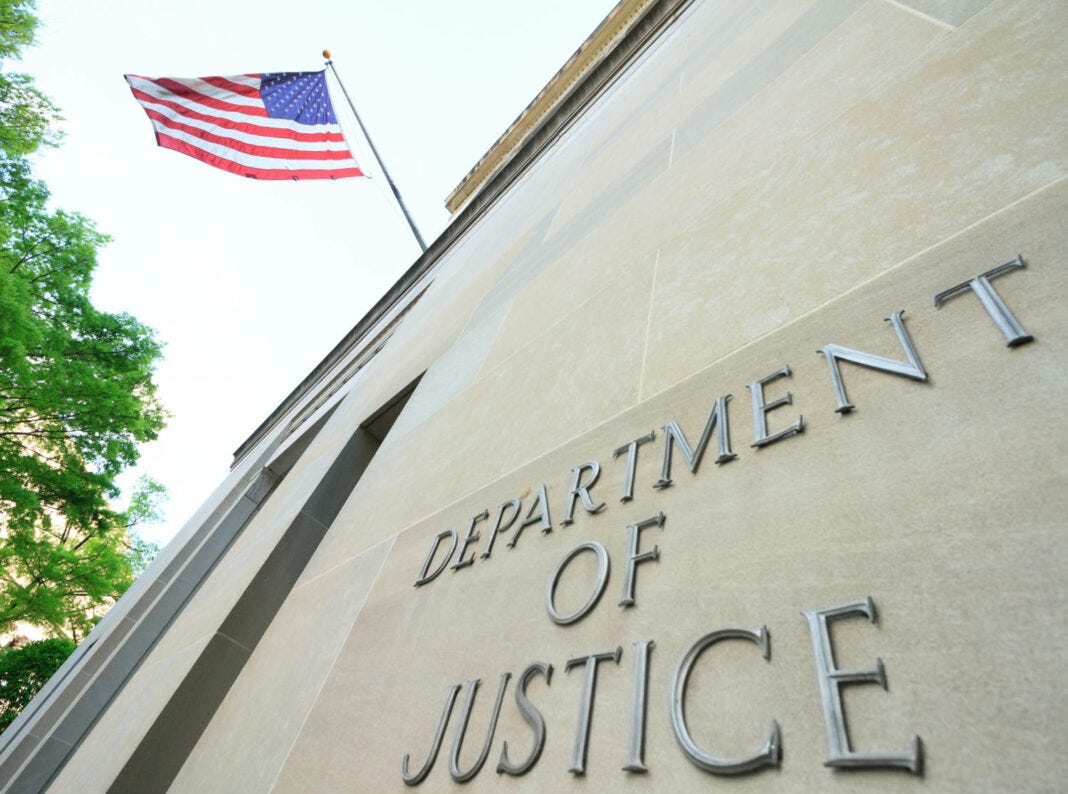
WASHINGTON — The Justice Department has concluded that a set of federal rules limiting how religious charities can use government money violates the Constitution. The finding came in a legal opinion released Tuesday by the department’s Office of Legal Counsel, which advises federal agencies on the law.
Opinion: Constitutionality of Religious Restrictions on the Use of Federal Funds, 50 Op. O.L.C. __ (Aug. 25, 2026).
The opinion focuses on three federal programs run by the Department of Health and Human Services. They fund things like child care, job training, homeless shelters and substance abuse treatment. For years, groups that received this money, including religious ones, were barred from spending it on what the law calls “sectarian worship, instruction or proselytization.”
The Office of Legal Counsel said those limits go too far. The opinion argues that singling out religious groups this way violates their right to freely practice their religion under the First Amendment.
The opinion was signed by T. Elliot Gaiser, an assistant attorney general, and Joshua J. Craddock, a deputy assistant attorney general, both in the Office of Legal Counsel.
What the rules said
The three laws in question date back several decades. The Personal Responsibility and Work Opportunity Act was passed in 1996. The Public Health Service Act and the Child Care and Development Block Grant Act are older still. All three let religious charities receive federal grants alongside secular ones. But they also said the money itself could not pay for religious activities like prayer, sermons or efforts to convert people.
Health and Human Services asked the Justice Department to review these rules after a string of recent Supreme Court decisions changed how courts look at religion and government funding.
A shift at the Supreme Court
For a long time, courts allowed rules like these because of a 1971 Supreme Court case called Lemon v. Kurtzman. That decision set up a test for deciding when government support for religion crossed a constitutional line. But the Supreme Court has since moved away from that test.
In 2022, in a case called Kennedy v. Bremerton School District, the court said judges should instead look at how the nation’s founders understood the Constitution’s religion clauses. Other recent decisions, including Espinoza v. Montana Department of Revenue in 2020 and Carson v. Makin in 2022, said governments usually cannot exclude religious groups from public benefit programs that are otherwise open to everyone.
The Justice Department opinion leans heavily on those cases. It argues that once the government opens a funding program to charities in general, it cannot then tell religious charities they must strip out anything religious to take part.
The reasoning, in plain terms
The opinion walks through two separate constitutional questions.
The first is whether the funding limits are required by the part of the First Amendment that bars the government from establishing an official religion. The opinion says no. It looked at how the founders understood that clause and compared it to early American history. It found that the federal government paid religious groups directly to run schools and provide services for most of the nation’s first century, without anyone treating this as a constitutional problem.
The second question is whether the limits violate the part of the First Amendment protecting the free exercise of religion. Here the opinion says yes. It compares a religious food pantry that cannot say a prayer before serving a meal to a secular food pantry that faces no such restriction. It says that kind of unequal treatment must meet the highest level of legal scrutiny, and that the government has not shown a strong enough reason for it.
What happens next
The opinion does not strike down the underlying laws. Instead, it tells the health department that the specific religious restrictions inside them are unenforceable. The rest of each law stays in place.
If the health department decides to stop enforcing these restrictions, it must notify Congress within 30 days, under a federal law requiring the executive branch to report when it declines to enforce a statute.
The opinion also revisits and partly reverses a 2019 Justice Department opinion on a related question involving federal loans to historically Black colleges and universities. That earlier opinion had drawn a distinction between restricting money based on a group’s religious status, which it called clearly unconstitutional, and restricting money based on how the money would be used, which it treated as more likely to be allowed. The new opinion says that distinction no longer holds up under the Supreme Court’s recent rulings.
This story may be updated as reaction develops.
Footnotes
-
Memorandum Opinion for the Director of the Office for Civil Rights, Department of Health and Human Services, Constitutionality of Religious Restrictions on the Use of Federal Funds, 50 Op. O.L.C. __ (Aug. 25, 2026).
-
Personal Responsibility and Work Opportunity Reconciliation Act of 1996, 42 U.S.C. § 604a(j).
-
Public Health Service Act, 42 U.S.C. §§ 290kk-2, 300x-65(i).
-
Child Care and Development Block Grant Act of 1990, 42 U.S.C. §§ 9858k(a), 9858l(a)(4).
-
Lemon v. Kurtzman, 403 U.S. 602 (1971).
-
Kennedy v. Bremerton Sch. Dist., 142 S. Ct. 2407 (2022).
-
Espinoza v. Mont. Dep’t of Revenue, 140 S. Ct. 2246 (2020).
-
Carson ex rel. O.C. v. Makin, 142 S. Ct. 1987 (2022).
-
Trinity Lutheran Church of Columbia, Inc. v. Comer, 582 U.S. 449 (2017).
-
Religious Restrictions on Capital Financing for Historically Black Colleges and Universities, 43 Op. O.L.C. 191 (2019).
-
28 U.S.C. § 530D(a)(1)(A)(i).