Public Funds, Public Scrutiny: The Constitutional Case Against AB 2624
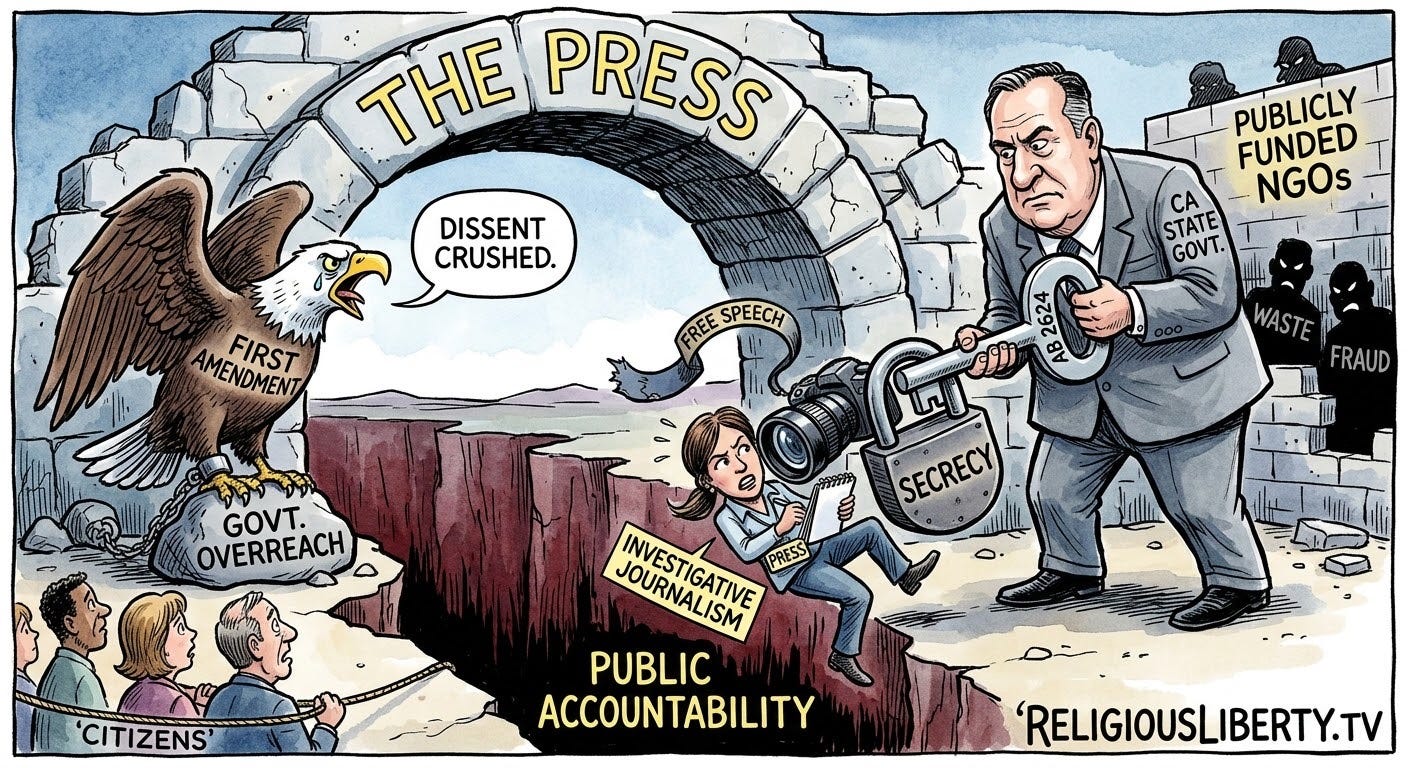
The enactment of California Assembly Bill 2624 (widely dubbed the “Stop Nick Shirley Act”) represents a dangerous escalation in the legislative encroachment on investigative journalism and constitutional free speech. Under the banner of combating online harassment and “doxxing,” the state has created a statutory shield that threatens to criminalize the core function of an independent press: documenting, questioning, and exposing the operations of powerful, state-funded organizations.
When evaluated through the lens of constitutional law and civil liberties, this measure sets a perilous precedent for public accountability.
Redefining Public Reporting as “Harassment”
The lifeblood of investigative reporting is the ability to record facts on the ground. When journalists and citizen commentators investigate allegations of fiscal mismanagement, fraudulent practices, or administrative failures within non-governmental organizations (NGOs), they necessarily capture footage of front-facing staff, public premises, and organizational conduct.
AB 2624 undermines this right by expanding the state’s “Safe at Home” confidentiality scheme to immigration service providers and punishing the dissemination of personal information or images under broadly framed statutory definitions. By conflating public-interest video recording with criminal intimidation, the statute creates an immediate chilling effect. The line between an aggressive, adversarial press inquiry and prohibited “harassment” is left to the subjective interpretation of state enforcers and litigators, inviting selective prosecution against reporters whose ideological viewpoints clash with the political establishment in Sacramento.
Shielding Publicly Funded Operations from Scrutiny
A central premise of American democracy is that entities executing public policy and receiving taxpayer subsidies must operate under open public scrutiny. When the state intervenes to insulate certain favored institutions from visual documentation, it effectively creates a protected class of actors immune from watchdog oversight. Exposure of criminal actors who are fraudulently taking state funds becomes a crime.
If a journalist cannot record employees at a taxpayer-funded facility or publish truthful video footage without facing civil liability, takedown orders, and severe financial penalties, the public loses its most vital check against corruption and waste. Historically, some of the most impactful investigative reports (from exposures of nursing home neglect to abuses in government-contracted facilities) relied on undercover filming and persistent confrontational questioning. Under the logic of AB 2624, much of that foundational reporting could be classified as actionable endangerment.
The First Amendment and the Right to Record
The United States Supreme Court has repeatedly affirmed that the First Amendment protects the right to gather news and film in public and semi-public spaces. Furthermore, the publication of truthful, lawfully obtained information on matters of public concern enjoys near-absolute constitutional immunity (Bartnicki v. Vopper, 2001; Smith v. Daily Mail Publishing Co., 1979).
By imposing liability on the publication of images and details gathered during public inquiries, AB 2624 operates as a de facto prior restraint and an unconstitutional content-based restriction:
-
The Heckler’s Veto Expanded: Imposing liability based on how third-party viewers react online punishes the speaker for the unauthorized, illegal threats of unknown individuals.
-
Vague Subjective Standards: Prohibiting the distribution of “images” that induce an “objectively reasonable fear” creates a standard so ambiguous that no investigative reporter can safely publish unedited field footage.
A Dangerous Slippery Slope
The most alarming aspect of the legislation is its potential for expansion. If California can shield immigration service providers from investigative reporting under the guise of personal privacy, there is no limiting principle to stop the state from extending identical protections to correctional officers, child welfare contractors, or any other contentious government-funded enterprise.
Protecting individuals from physical violence and true threats is already addressed by existing criminal statutes against assault, stalking, and direct extortion. Layering speech-restrictive confidentiality mandates over entire sectors does not enhance public safety; it cripples the ability of the fourth estate to hold public and quasi-public institutions accountable.
Cases:
Smith v. Daily Mail Publishing Co. (1979):
Core Holding: The Supreme Court held that if a publisher lawfully obtains truthful information about a matter of public significance, the government cannot punish the publication absent a need to further a state interest of the highest order.
Relevance: In the context of AB 2624, this precedent directly challenges state efforts to punish or penalize journalists who truthfully disclose or publish information and identities lawfully acquired in the course of reporting on public-facing or taxpayer-funded matters.
Bartnicki v. Vopper (2001):
Core Holding: The Supreme Court affirmed that the First Amendment protects the disclosure of truthful information of public concern, even when the underlying material was intercepted illegally by a third party (so long as the publisher did not participate in the unlawful act). The Court explicitly emphasized that privacy interests yield to the right to publish on matters of public importance.
Relevance: This case directly undercuts the state’s attempt to prioritize categorical privacy or confidentiality claims over the public’s right to receive investigative reporting on issues of public significance.