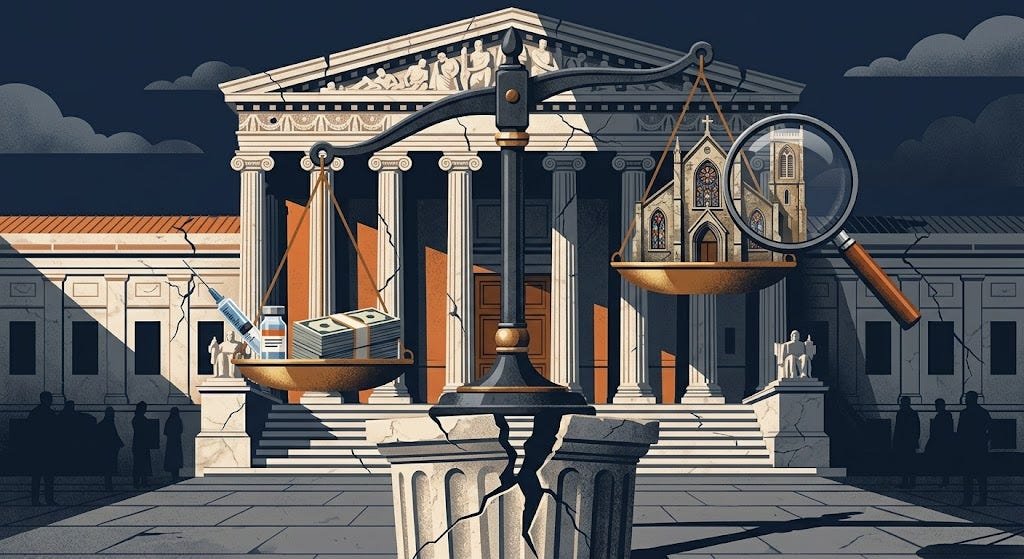
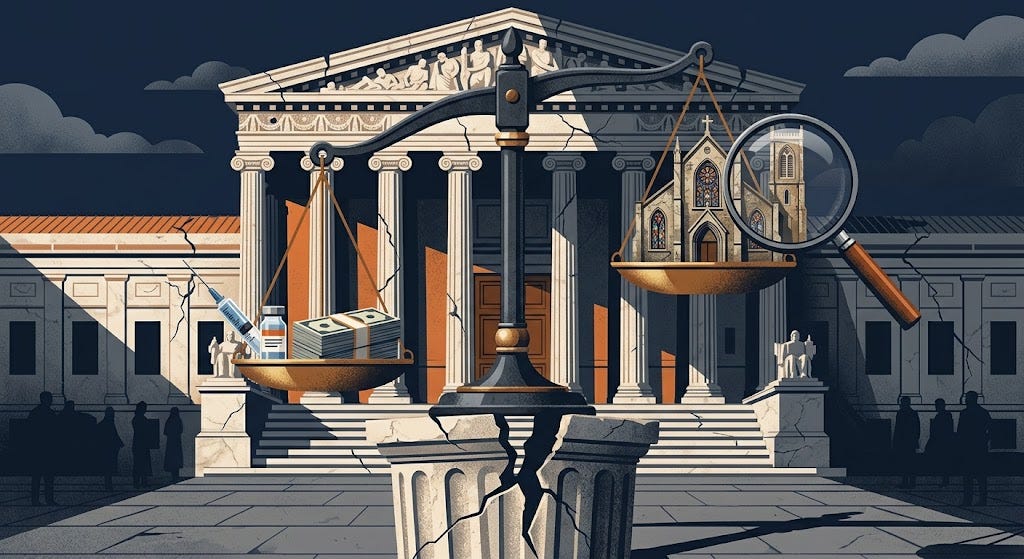
Federal appellate jurisprudence often demands a strong stomach, yet rarely has a single court exhibited such breathtaking intellectual acrobatics in seventy-two hours. The bone of contention is Employment Division v. Smith, Justice Antonin Scalia’s 1990 thunderbolt that severed the Free Exercise Clause from strict scrutiny. Smith established that if a law is merely neutral and generally applicable, the government may trample religious objections with impunity under forgiving rational basis review. For thirty-six years, conservative and liberal jurists alike have feuded over Scalia’s handiwork.
In mid-September 2026, the Ninth Circuit unveiled a case study in judicial split personalities. In Lewis-Williams v. San Francisco Bay Area Rapid Transit District, Smith was decried from the bench as a historical fraud, an intolerable relic ripe for the judicial guillotine. Three days later, in Cedar Park Assembly of God v. Kuderer, Smith was dusted off, polished, and enthroned as the supreme instrument of state authority.
The Vaccine Jackpot: Scorning Smith as an Ahistorical Blunder
In Lewis-Williams, six public transit workers—utility cleaners, computer technicians, maintenance supervisors—rebelled against BART’s COVID-19 vaccine mandate. The transit agency’s bureaucrats subjected them to extensive questionnaires and intrusive interviews, ultimately handing down an ultimatum: accept the shot, retire, or face termination. A federal jury handed the workers a staggering $7.8 million windfall under Title VII, and the Ninth Circuit ratified the judgment.
The panel majority took the path of constitutional avoidance. Because Title VII statutory damages made the workers whole, the judges dismissed their First Amendment Free Exercise cross-appeal as legally moot.
Judge Ryan Nelson refused to remain silent, authoring a concurrence aimed at Employment Division v. Smith. The district court had granted summary judgment against the workers by deploying Smith, ruling that BART’s mandate was neutral and generally applicable because administrators lacked “unfettered discretion”. Nelson attacked this reasoning. Citing the circuit’s en banc holding in Fellowship of Christian Athletes, he insisted that Fulton v. City of Philadelphia forbids even the slight existence of a discretionary exemption mechanism. BART’s case-by-case evaluation of religious sincerity blew up Smith‘s general applicability shelter, automatically triggering strict scrutiny.
Nelson then targeted Smith itself. Quoting Justice Clarence Thomas, he called Smith “demonstrably erroneous” and demanded its burial. He insisted Scalia’s opinion ignored original meaning, historical understanding, and the textual shift forged by the Fourteenth Amendment. The 1791 Founders had intended a substantive right of religious exemption, bounded only by breaches of the peace and safety of the state. By 1868, Reconstruction Republicans drafted the Privileges or Immunities Clause specifically to crush generally applicable laws that Southern states used to silence abolitionist preachers and forbid teaching enslaved people the Gospel. To Nelson, Smith was an indefensible mistake that reduced our first freedom to bureaucratic whim. The lesson was clear: give government bureaucrats discretionary power, and Smith must yield to searching constitutional scrutiny.
The Church Healthcare Mandate: Canonizing Smith to Silence Conscience
Seventy-two hours later, in Cedar Park, the Ninth Circuit executed a complete reversal.
Cedar Park Assembly of God is a church that partners with pregnancy clinics and preaches that human life begins at conception. Washington State enacted its Reproductive Parity Act, mandating that employer health plans covering maternity care must include abortion services. The state pointed to an older Conscience Statute as an escape valve. Yet this mechanism was an illusion: the law still required insurance carriers to guarantee enrollees seamless, subsidized access to abortions using the church’s policy umbrella.
Faced with an actual house of worship asserting core First Amendment rights, Judge Susan Graber’s majority opinion revived Employment Division v. Smith as an absolute defense of the regulatory state. The fiery skepticism toward administrative authority vanished.
To keep the state within Smith‘s safe harbor, the majority engaged in delicate boundary-drawing. Washington’s Parity Act contained explicit exemptions: it carved out self-funded ERISA plans, multistate plans, and a sweeping Section 5 provision that automatically suspends the mandate whenever it threatens federal funding. Under the expansive view of Fulton that Nelson championed in Lewis-Williams, Section 5 is an individualized administrative escape valve that destroys general applicability. The Cedar Park majority dismissed this argument, labeling Section 5 a “narrow legal question” of federal preemption rather than an individualized exemption.
The court likewise salvaged Smith by redefining comparability. Under the Conscience Statute, direct healthcare providers receive broad immunity from participating in or paying for abortion under Section 2(a), while religious purchasers under Section 3(a) remain trapped in mandatory insurance networks. The majority brushed off this double standard, declaring that both provisions neutrally classify commercial actors rather than disfavoring religion. With Smith firmly installed, the majority applied toothless rational basis review, held that Washington easily satisfied it, and ordered the church to submit.
In a dissent, Judge Consuelo Callahan exposed the ideological double standard. She argued that the majority ignored Fulton, Bates, and Tandon v. Newsom to keep Smith alive on life support. The state had reserved the discretion to exempt plans to preserve federal cash while denying that same grace to a church whose theological existence revolves around the sanctity of life.
The Doctrinal Chasm
The treatment of Employment Division v. Smith across these two decisions reveals a court in open ideological conflict:
-
In Lewis-Williams, Smith was described as an intellectual embarrassment, a constitutional deviation that circuit precedent must strictly confine and the Supreme Court must overturn.
-
In Cedar Park, Smith was embraced as an unyielding command, stretched to shield state insurance regulations from strict scrutiny.
-
In Lewis-Williams, administrative discretion was treated with deep suspicion, rendering a policy non-generally applicable the moment bureaucrats began asking questions.
-
In Cedar Park, statutory exemptions were minimized as legal determinations, preserving the illusion of general applicability.
The end result is an erratic legal landscape. In the transit yard, skepticism of state power reigns supreme, individual dissenters receive millions, and judges openly call for Smith‘s destruction. In the sanctuary, state authority is vindicated, the church is compelled to comply, and Smith reigns supreme, and religious freedom in the Ninth Circuit has ceased to be a coherent constitutional guarantee.
