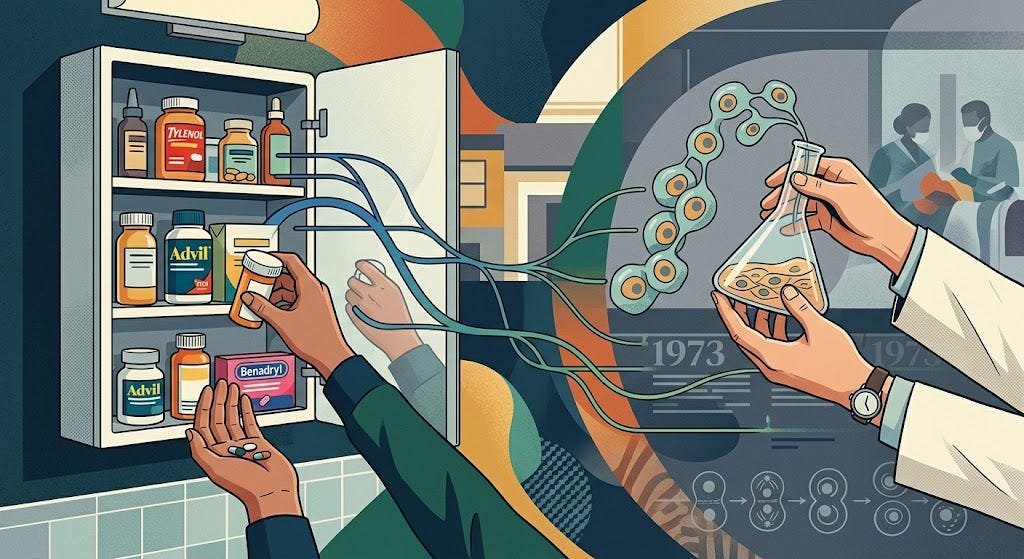

Open your bathroom medicine cabinet right now.
Grab the Tylenol you took for a tension headache. The Advil you gave your kid after soccer practice. The Pepto-Bismol, the Claritin, the Tums.
During the pandemic, a fierce battle line was drawn: “I will not take a vaccine tested on aborted fetal cell lines.” It sparked furious family blowouts, workplace firings, and a culture war that dominated headlines for years.
Here is the reality that makes almost everyone across that divide uncomfortable:
Virtually everything keeping your household alive, comfortable, and pain-free is plugged into that exact same scientific matrix.
There are entirely legitimate, evidence-based conversations to be had about the COVID-19 vaccines. One can reasonably debate clinical trial timelines, the exact durability of mucosal immunity, the incidence of rare adverse events like post-vaccine myocarditis or thrombosis, the risk-to-benefit calculus for young and healthy demographics, or the wisdom of sweeping government mandates. Those are real health, scientific, and policy debates.
The fetal cell argument, however, does not belong in that category. It is scientifically distorted, historically incoherent, and—as many who still wield it know—factually indefensible. It is time for it to be permanently retired.
Myth vs. Reality: What Is Actually in the Vial?
The most sensational internet claim must be dismantled upfront: there are no fetal tissues, body parts, or cellular fragments in a vaccine vial.
What biomedical laboratories use are immortalized cell lines—specifically famous scientific lineages like HEK-293 (cloned from human embryonic kidney cells in 1973) and PER.C6 (derived from retinal tissue in 1985).
Decades ago, scientists took cells from elective abortions, isolated them, and genetically enabled them to multiply indefinitely in laboratory settings. These cells function as living biological photocopy machines. Modern research does not require, solicit, or incentivize ongoing abortions; laboratories culture the great-great-great-grand-clones of cells that have lived exclusively in glass and plastic for forty to fifty years.
Furthermore, degrees of reliance vary dramatically:
-
mRNA Vaccines (Pfizer, Moderna): HEK-293 was used exclusively during early, preclinical proof-of-concept testing to confirm that the mRNA sequence accurately instructed a cell to produce the target spike protein. Zero cell lines of any kind were used in the actual manufacturing or mass production of the doses.
-
Viral Vector Vaccines (Johnson & Johnson, AstraZeneca): These utilized PER.C6 or HEK-293 directly during production to cultivate the modified adenovirus vectors.
-
Routine Childhood Vaccines (MMR II, Chickenpox, Hepatitis A): For over half a century, vaccines that billions of children receive have grown attenuated viruses directly on historical fetal cell lines like WI-38 (1962) and MRC-5 (1966).
The Receipts: Modern Medicine’s Foundational Workhorse
This was never an isolated 2020 experiment. It is the plumbing of contemporary pharmacology.
Regulatory bodies like the FDA require extensive preclinical profiling—evaluating receptor binding, cellular toxicity, and molecular transport mechanisms. Because HEK-293 cells grow rapidly and reliably, they have served as the global academic and industrial workhorse for decades.
If an absolute ethical standard demands zero contact with compounds evaluated on historical fetal cell lines, modern pharmacy shelves become largely inaccessible:
Pain & Fever Relief
Acetaminophen (Tylenol), Ibuprofen (Advil/Motrin), Aspirin, Naproxen (Aleve)
Gastrointestinal
Calcium carbonate (Tums), Famotidine (Pepcid), Omeprazole (Prilosec)
Allergies & Respiratory
Diphenhydramine (Benadryl), Loratadine (Claritin), Albuterol inhalers
Chronic Disease Mainstays
Metformin (diabetes), Atorvastatin (Lipitor), Enalapril (blood pressure)
Consumer Taste Tech
Flavor compounds and artificial sweeteners tested via HEK-293 biosensors
The Concession Behind Closed Doors
This brings us to the most frustrating aspect of this entire debate: the glaring gap between what critics admit in private and what is shouted in public.
In countless private discussions, vocal opponents of the vaccine will candidly concede the facts. When pressed on the biochemical realities, they admit that the shot contains no fetal tissue. They admit that their own medicine cabinets are filled with drugs tested against the exact same cell lines. They acknowledge that singling out this specific vaccine as uniquely contaminated is factually indefensible.
Yet, when the microphones turn on, the legal filings are drafted, or the public debates flare up, they continue to raise the fetal cell argument anyway.
Why? Because in an era of institutional mandates, the “aborted fetal cell” claim functioned as the ultimate trump card.
General skepticism about novel mRNA technology, concerns over long-term side effects, distrust of public health messaging, or anger at government overreach were often legally insufficient to secure a workplace exemption or culturally ineffective at winning arguments. But invoke an abortion-derived cell line, and the objection instantly transformed into an impenetrable moral and legal shield.
The tragedy of this cynical pivot is that it poisons genuine discourse. It converts what could be legitimate debates over bodily autonomy, risk profiles, or state coercion into a factual falsehood that the speaker themselves knows to be untrue. By wielding an argument in bad faith simply because it provides legal cover or emotional leverage, critics undermine the credibility of genuine conscience claims and genuine scientific critique alike.
The Jurisprudential Fault Line: Faith vs. Empirical Fact
This tactical deployment exposes the fragile fault line in constitutional law and bioethics: the collision between protected religious conviction and verifiable empirical fact.
Under foundational legal doctrine (notably the U.S. Supreme Court’s United States v. Ballard), secular courts, employers, and administrative bodies are constitutionally forbidden from evaluating whether an individual’s religious beliefs are “true,” reasonable, or theologically sound. If an employee asserts a sincere religious conviction that utilizing any product connected to an abortion endangers their spiritual salvation, the state cannot put that theological proposition on trial. Faith, by legal design, is exempt from judicial cross-examination.
Yet the premise beneath this religious objection is not a metaphysical mystery. It is a verifiable historical and biochemical fact.
Whether a drug, vaccine, or food additive was tested against HEK-293 or MRC-5 is not an article of faith. It is an empirical data point recorded in peer-reviewed journals, FDA filings, and patent registries.
This sets up a profound clash:
-
The Inviolability of the Religious Conviction: An individual’s moral threshold—“My faith forbids me from benefiting from products tied to fetal cell lines”—enjoys robust statutory and constitutional protection.
-
The Fragility of the Factual Boundary: The factual claim that this specific vaccine violates that threshold, while the medication in their medicine cabinet does not, is entirely testable.
This tension surfaced across human resource departments and federal courtrooms during mandate disputes. Employers could not legally ask: “Is your religious interpretation correct?” Instead, they asked an empirical question: “If your religious objection prohibits products tested on HEK-293, why does your standard medical history show routine use of ibuprofen, acetaminophen, and famotidine?”
Push too far, and an institution risks violating Title VII by improperly interrogating the orthodoxy of a worker’s conscience. But back off entirely, and the legal system must pretend that objective, published biochemical records do not exist. You cannot refute an article of faith with laboratory data, but neither can laboratory data be selectively cited to declare one intervention uniquely compromised while ignoring the rest of the pharmacy.
Clearing the Board for Honest Debate
Retiring this argument is not a defense of vaccine mandates, nor is it an attempt to silence health-related scrutiny.
If someone questions the COVID-19 vaccine because of concerns about cardiovascular risks in young males, the necessity of boosters for previously infected populations, or the institutional failure to acknowledge natural immunity, they are raising medical arguments that can be analyzed with clinical data. Those arguments deserve honest engagement.
But leaning on the fetal cell objection does not strengthen that critique—it degrades it. It leans on a 50-year-old biological reality that the entire global pharmacopeia shares, pretends it is unique to a single shot, and asks the listener to ignore the contents of their own bathroom shelf.
Modern healthcare is not an ethical clean slate; it was built on messy, historical compromises that eradicated deadly childhood diseases, managed chronic conditions, and relieved everyday pain. If we want a serious, credible debate about medical ethics and public health, we must ground it in truth. The fetal cell argument has served as an ideological sledgehammer and it is time to put it away.
