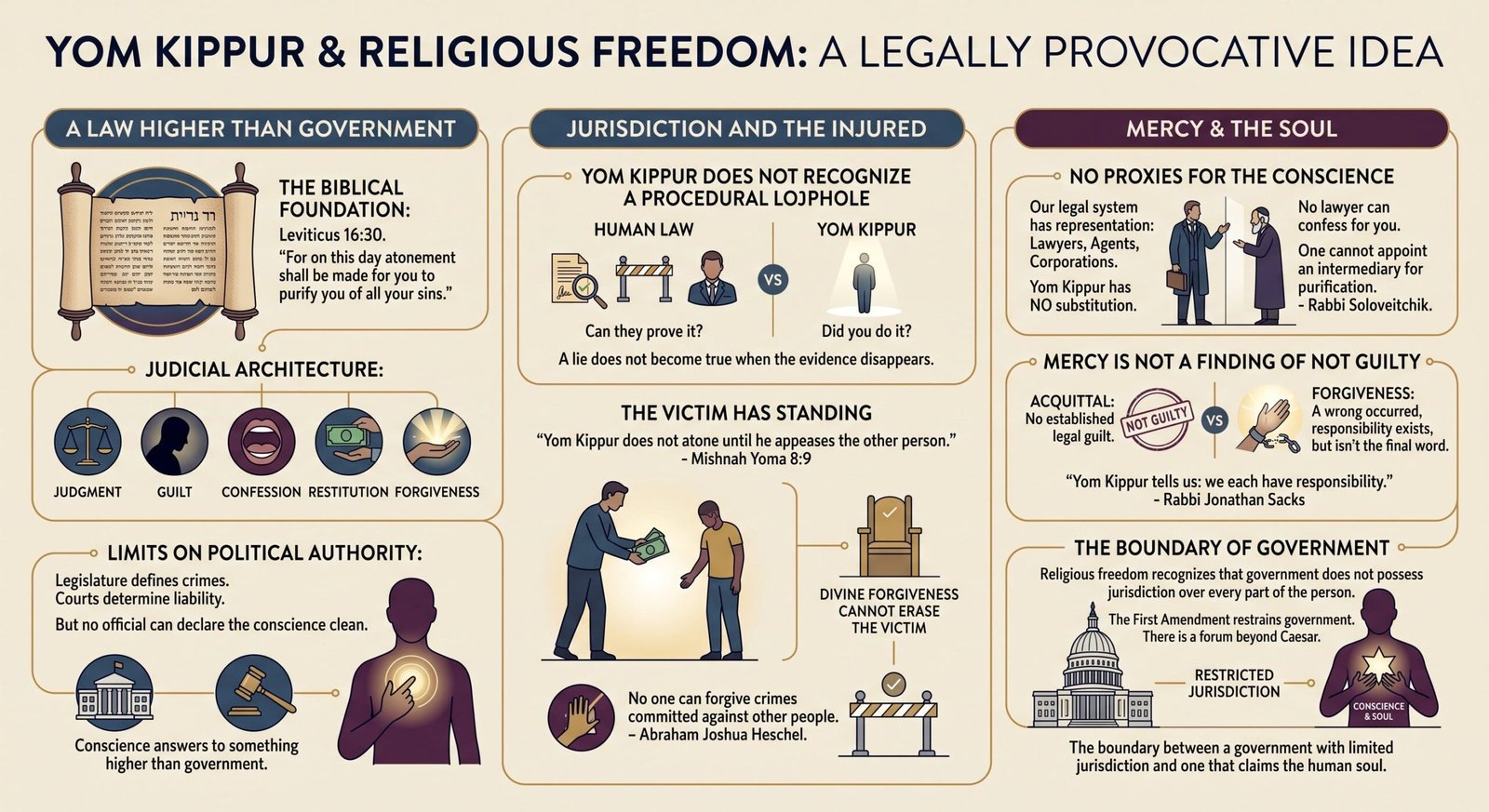
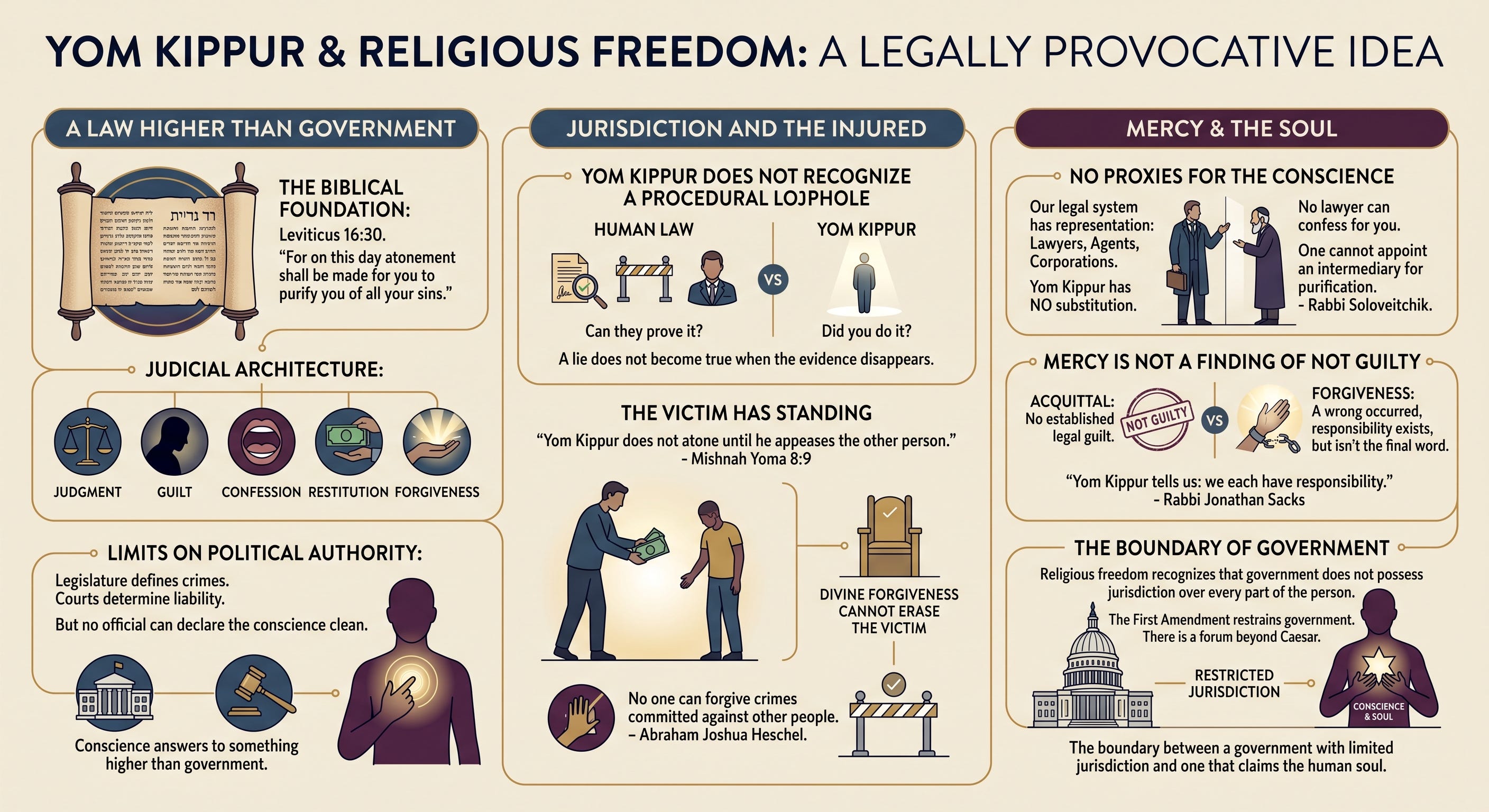
Yom Kippur, observed this year on Tishrei 10, 5787, or September 21, 2026, presents one of religion’s most provocative accounts of judgment. Its central demand is not vague regret. It calls for confession, restitution, repentance, forgiveness, and changed conduct.
A lawyer recognizes parts of this structure. There is wrongdoing, responsibility, injury, and repair. Yet the resemblance has limits. Yom Kippur is not a rival court system. It asks questions that civil courts cannot answer. A court can decide liability. It cannot declare a conscience clean.
This distinction carries a lesson for religious freedom. Government possesses real authority, but its jurisdiction is incomplete.
A judgment the state cannot issue
Leviticus provides the biblical foundation for the Day of Atonement:
“For on this day atonement shall be made for you to purify you of all your sins; you shall be pure before GOD.”
The verse appears within a chapter devoted to priestly rites, sacrifices, purification of the sanctuary, and the scapegoat. It should not be mistaken for a modern theory of personal repentance. Later Jewish teaching developed the connection between atonement, confession, restitution, and reconciliation.
Civil law occupies a different field. Legislatures enact laws. Courts determine whether legal standards have been met. Judges impose remedies and sentences. None of these institutions can determine whether remorse is sincere, repentance has occurred, or a person has been reconciled to God.
That limit does not diminish civil law. It identifies the work civil law can perform. Government may restrain conduct, compensate an injured person, or punish an offender. It cannot manufacture repentance.
Proof and moral responsibility
Human courts operate through rules of evidence, burdens of proof, limitations periods, and constitutional protections. These rules are safeguards, not loopholes. They reduce unreliable verdicts and restrict coercive government.
A spiritual examination asks a different question. A court asks whether a claim has been proved under governing law. Conscience asks what the person knows about his or her own conduct.
Martin Buber described that examination in The Way of Man According to the Teachings of Hasidism:
“The decisive heart-searching is the beginning of the way in man’s life.”
Buber was writing about repentance and self-examination, not supplying a commentary limited to Yom Kippur. His words still identify the difference between adjudication and confession. Missing evidence does not turn a lie into truth. An expired claim does not transform cruelty into kindness.
A person may escape conviction or civil liability and remain morally responsible for the conduct at issue. Legal nonliability and moral innocence are not identical findings.
The injured person cannot be erased
The Mishnah draws a direct distinction between wrongs involving God and wrongs involving another person:
”For transgressions between a person and another, Yom Kippur does not atone until he appeases the other person.”
This rule appears in ‘Mishnah Yoma’ 8:9. It prevents a wrongdoer from treating prayer as a substitute for facing the person harmed.
Maimonides carried the rule into his ‘Mishneh Torah’. In Hilchot Teshuvah 2:9, he states that returning money or property is insufficient by itself. The offender must seek forgiveness from the injured person. Maimonides then warns the injured person against cruelly refusing a sincere request for forgiveness.
The rule gives both parties moral agency. The offender must confess, repair the loss, and request forgiveness. The injured person is not reduced to a prop in someone else’s religious drama. At the same time, forgiveness is treated as a moral act rather than an instrument of revenge.
Emmanuel Levinas expressed a related concern in a different setting. In “Useless Suffering,” he wrote:
‘The justification of the neighbor’s pain is certainly the source of all immorality.”
Levinas was addressing attempts to explain or justify another person’s suffering. He was not interpreting the Mishnah. The connection is ethical. The sufferer cannot be turned into raw material for someone else’s theory, redemption, or peace of mind.
Abraham Joshua Heschel stated the issue with severity in his response to Simon Wiesenthal’s “The Sunflower”:
“No one can forgive crimes committed against other people.”
Heschel’s statement arose from a discussion of whether one person may forgive crimes committed against someone else. Its force lies in rejecting forgiveness by proxy. The victim cannot be removed from the moral account.
Responsibility cannot be outsourced
The biblical Yom Kippur service involved representation. The high priest performed rites on behalf of Israel, and the ritual used sacrifices and the scapegoat. Modern Yom Kippur worship retains a communal character. Its principal confessions speak in the plural, “We have sinned.”
Personal responsibility remains within that communal structure. No priest, attorney, institution, or congregation can supply another person’s remorse. No representative can make an offender honestly admit a wrong or decide to change.
This is the sounder meaning of saying that repentance has no proxy. It does not deny Yom Kippur’s priestly history or communal prayers. It means that participation in a ceremony cannot replace the moral action demanded from the person who caused the harm.
Confession and the right to remain silent
The Fifth Amendment protects a person from government-compelled self-incrimination. That protection responds to the coercive force of the state. It restrains prosecutors and protects the fairness of criminal proceedings.
Yom Kippur confession serves another purpose. It is a religious practice directed toward repentance, not evidence supplied to a prosecutor. The worshipper is asked to stop acting as his or her own defense counsel.
The comparison must remain limited. Constitutional silence protects a person from official coercion. Religious confession challenges self-deception. One guards the accused against the state. The other asks the individual to examine personal conduct before God and the community.
Neither should be used to discredit the other. A fair legal system needs the presumption of innocence and a demanding burden of proof. A serious moral system needs an account of responsibility that reaches conduct no court can adjudicate.
Forgiveness is not an acquittal
An acquittal means that criminal guilt was not established under the required legal standard. It does not necessarily establish factual innocence.
Forgiveness addresses a different condition. It presupposes that a wrong occurred. The offender does not claim exoneration. The injured person does not pretend the injury was imaginary. Forgiveness declares that the offense need not control every future relationship.
Rabbi Jonathan Sacks captured this combination of freedom and responsibility:
“Yom Kippur tells us: we each have responsibility.”
Elsewhere, Sacks wrote that repentance and forgiveness can break the hold of the past. His account does not erase accountability. It places moral change after acknowledgment of the wrong.
A system that explains every offense away has little need for forgiveness. Yom Kippur asks for something harder. The offender admits the act. The injured person retains a voice. Restitution addresses the loss. Mercy leaves open the possibility that a person can become more than the worst act that person committed.
Conscience and civil authority
Religious freedom protects belief and religious exercise, but it does not give every act motivated by conscience automatic immunity from law.
Under Employment Division v. Smith, the federal Free Exercise Clause ordinarily does not require exemptions from valid laws that are neutral and generally applicable. Federal statutes such as the Religious Freedom Restoration Act provide broader protection against certain federal burdens on religion. State constitutions and state religious-freedom statutes may provide additional protection.
Claims of conscience require legal analysis, not slogans. Courts examine the governing law, the burden on religious exercise, the government’s reasons, and the protections supplied by the applicable constitution or statute.
Yom Kippur adds a moral limit in the opposite direction. Religious sincerity does not cancel injury to another person. The demand for restitution and appeasement rejects the claim that devotion to God makes human harm irrelevant.
Freedom of conscience and responsibility to others belong in the same discussion. Government should not claim authority over theology or repentance. Religious claimants cannot treat conscience as permission to erase the people affected by their conduct.
Albert Einstein expressed the danger of blind obedience in words reported in Paul Schilpp’s 1949 volume, Albert Einstein: Philosopher-Scientist:
“Never do anything against conscience even if the state demands it.”
The statement is a warning against surrendering moral judgment to political authority. It is not a complete rule of constitutional law. Conscience can resist injustice, and conscience can be mistaken. Religious liberty protects the right to believe and, within legal limits, to act. It does not make every private conviction legally controlling.
The file that conscience can reopen
Civil law needs finality. Filing deadlines expire. Judgments become final. Appeals end. Records close.
Conscience operates on no comparable calendar. A person may return years later to repay a debt, admit a deception, correct a false accusation, or ask forgiveness. The passage of time may change what legal remedies remain, but it does not make moral repair meaningless.
This may be Yom Kippur’s deepest legal insight. The offender is not permanently identical to the offense. Accountability does not require the conclusion that change is impossible.
The state can order payment, but it cannot create remorse. It can imprison a person, but it cannot compel repentance. It can declare conduct lawful, but it cannot issue a decree of moral innocence.
Yom Kippur places the human person before a judgment civil government did not create. It asks questions no statute can answer completely:
“What have you done? Whom have you harmed? What do you owe? What will you do now?”
Those questions mark a boundary around political authority. Government has jurisdiction over conduct, rights, remedies, and public order. It does not possess jurisdiction over the human soul.
Christian theology reads Yom Kippur as a pattern that points to the atoning work of Jesus Christ. The Epistle to the Hebrews presents Christ as both high priest and sacrifice, entering the heavenly sanctuary and offering himself “once for all” for sin. In this account, divine grace provides what human effort cannot obtain, reconciliation with God, cleansing from guilt, and freedom to begin again. Yet Christian atonement does not erase responsibility to the person harmed. Jesus instructed worshippers to seek reconciliation before presenting an offering, and Zacchaeus demonstrated repentance through restitution. The cross therefore cannot serve as a spiritual device for avoiding confession, repair, or the injured person’s dignity. It declares that sin is real, judgment is real, mercy is available, and forgiveness carries the redeemed person into a changed life. Like Yom Kippur, Christian atonement places moral judgment beyond the state’s jurisdiction. A court may punish conduct or award damages, but it cannot reconcile a person to God, cleanse the conscience, or produce the repentance through which grace becomes visible in human action.
Sources
-
[https://www.sefaria.org/Leviticus.16.30 Leviticus 16:30]
-
[https://www.sefaria.org/Mishnah_Yoma.8.9 Mishnah Yoma 8:9]
-
[https://www.sefaria.org/Mishneh_Torah%2C_Repentance.2.9 Mishneh Torah, Repentance 2:9]
-
[https://www.chabad.org/library/article_cdo/aid/911891/jewish/Teshuvah-Chapter-2.htm Maimonides, Hilchot Teshuvah, Chapter 2]
-
Martin Buber, ‘’The Way of Man According to the Teachings of Hasidism’‘
-
Emmanuel Levinas, “Useless Suffering,” in ‘’Entre Nous: Thinking-of-the-Other’‘
-
Simon Wiesenthal, ‘’The Sunflower: On the Possibilities and Limits of Forgiveness’‘
-
[https://rabbisacks.org/videos/rabbi-sacks-ishay-ribo-sivan-rahav-meir/ Rabbi Jonathan Sacks, recorded conversation with Sivan Rahav Meir and Ishay Ribo]
-
[https://www.law.cornell.edu/supremecourt/text/494/872 Employment Division v. Smith, 494 U.S. 872 (1990)]
-
Paul Arthur Schilpp, ed., ‘’Albert Einstein: Philosopher-Scientist’‘ (1949), p. 653
