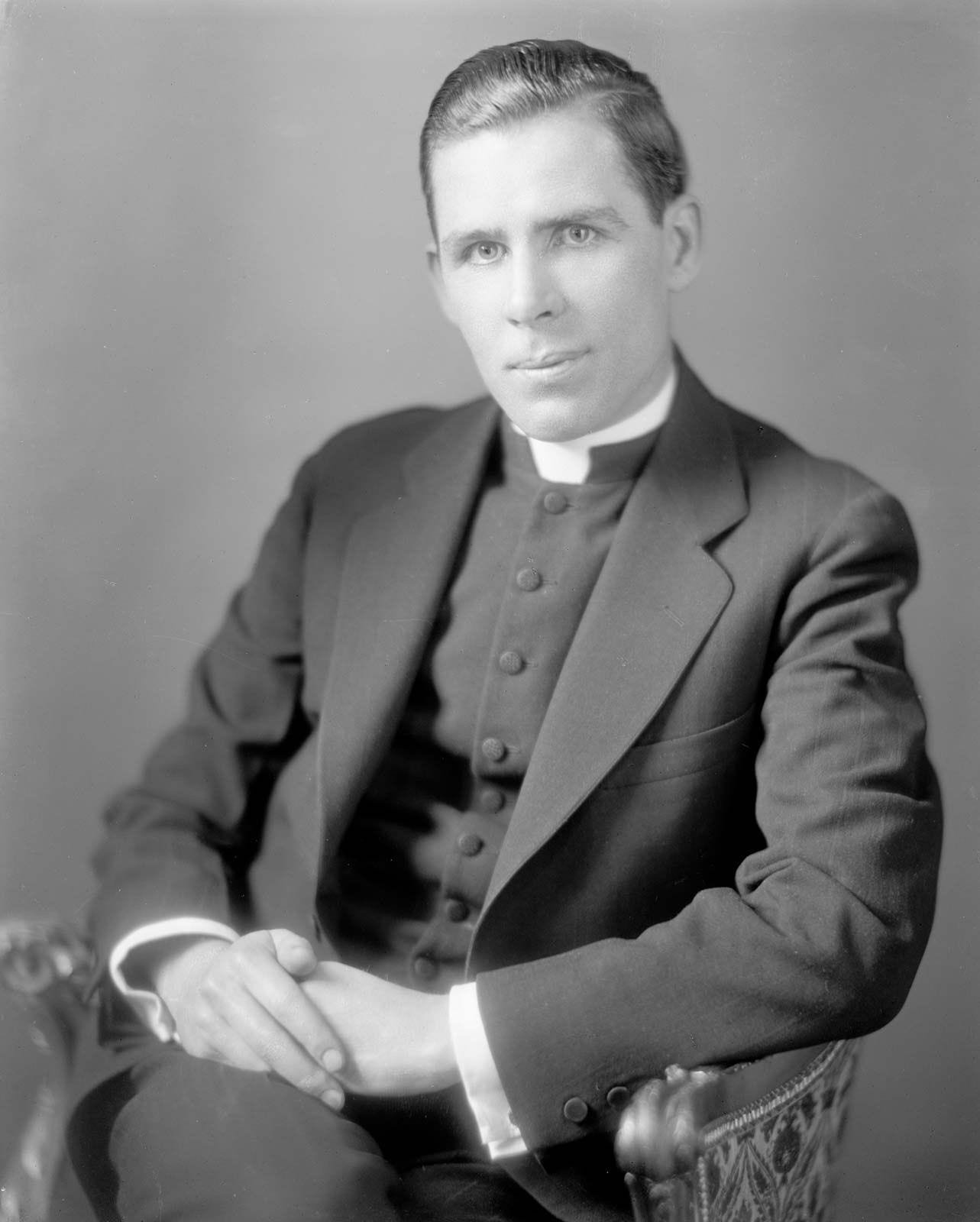
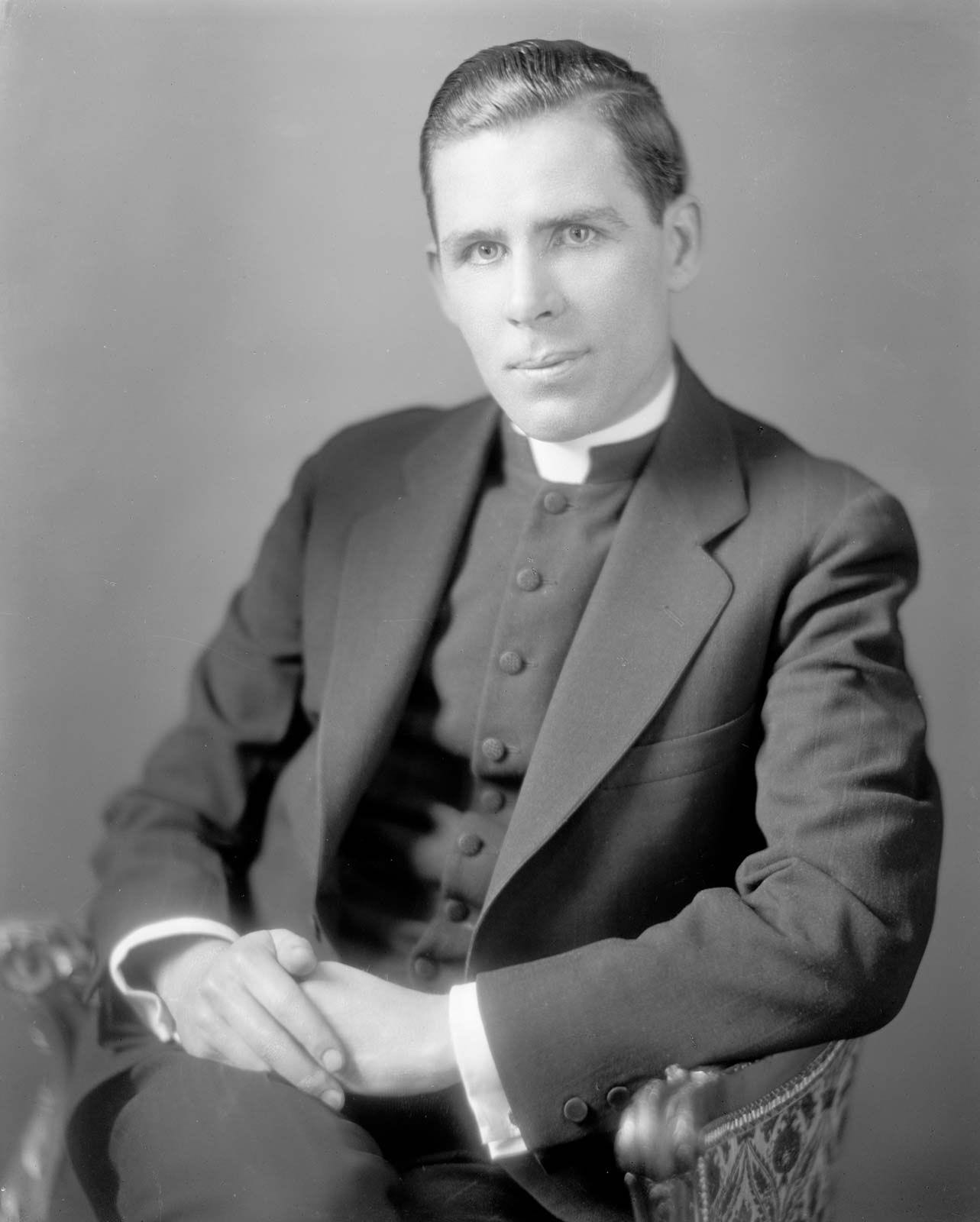
Archbishop Fulton J. Sheen (1895–1979) was one of the most influential American religious figures and communicators of the twentieth century. Ordained in 1919 and holding advanced degrees in philosophy from the Catholic University of Louvain, Sheen spent over two decades teaching theology and philosophy at the Catholic University of America before capturing national attention as a broadcast pioneer. Through his long-running radio program, The Catholic Hour, and his Emmy-winning 1950s television series, Life Is Worth Living, Sheen reached tens of millions of viewers of all faiths. Beyond his media charisma, he was an incisive critic of totalitarianism, a philosopher of human dignity, and an active participant in the Second Vatican Council, where he contributed to pivotal discussions shaping the Catholic Church’s modern engagement with global human rights.
As the Catholic Church approaches his long-anticipated beatification ceremony this week in st. Louis, republishing Sheen’s 1941 essay on religious freedom offers a timely reflection on the philosophical foundations of human liberty written at a critical juncture in world history. Our decision to share this piece is not an endorsement of his specific theology, but rather an appreciation of his intellectual contribution to the cause of conscience. Penned on the eve of America’s entry into World War II, Sheen’s essay directly confronted the rise of state authoritarianism by arguing that fundamental rights do not originate from the grace of government, but reside inherent within the individual. By highlighting his voice now, we recognize a thinker who articulated the imperative of religious liberty during one of the twentieth century’s darkest hours, providing arguments that continue to inform contemporary debates over the essential boundaries between conscience and the state. It’s good to have an honest assessment of what others believe.
So what do you agree with or disagree with in this essay? Subscribe and let us know in the comments below.
A Declaration of Dependence (1941)
By Fulton Sheen
There has never been an anti-American movement in the United States that did not, in one form or another, appeal to the Declaration of Independence.
Communists base their right to destroy democracy on the Declaration of Independence; monopolistic capitalists invoke it to escape even a just government supervision for the common good; the so-called progressive educators appeal to it to mold children independently of religion; spurious defenders of civil liberties tearfully quote it to justify every attack upon the foundations of liberty; in a word, the Declaration of Independence has come to mean for a group of our fellow citizens nothing other than independence of authority, law, and order.
In these days when everyone talks of rights and few of duties, it is important for us Americans to recall that the Declaration of Independence is also a Declaration of Dependence. The Declaration of Independence asserts a double dependence: dependence on God and dependence on law as derived from God.
Where do we get our right of free speech? Where do we get freedom of conscience? Whence is derived the right to own property? Do we get these rights and liberties from the State? If we did, the State could take them away. Do we get them from the Federal Government in Washington? If we did, the Federal Government could take them away.
Whence comes the right to life, liberty, and the pursuit of happiness? Read the Declaration of Independence and there find the answer: “We hold these truths to be self-evident, that all men are created equal, that they are endowed by their Creator with certain unalienable Rights, that among these are Life, Liberty, and the pursuit of Happiness.”
Notice these words: The Creator has endowed men with rights and liberties; men got them from God! In other words, we are dependent on God, and that initial dependence is the foundation of our independence.
Suppose we interpret independence, as some liberal jurists do, as independence of God; then rights and liberties come either from the State, as Bolshevism contends, or from the dictators, as Nazism and Fascism believe.
But if the State or the dictator is the creator of rights, then the State or the dictator can dispossess men of their rights. That is why in those countries where God is most denied, man is most tyrannized, and where religion is most persecuted, man is most enslaved.
It is only because we are dependent on God that we are independent as persons from the total will of any man on earth.
Let us not think that by denying God we will have purchased independence. The pendulum of the clock that wanted to be free from its point of suspension found that on becoming independent of its suspension, it was no longer free to swing.
The Communists and the Nazis and the Fascists who denied God as the source of their freedom got in the end the inglorious freedom of State prisoners.
Democracy is based not on the Divine Right of Kings but on the Divine Right of Persons. Each person has a value because God made him, not because the State recognizes him.
The day we adopt in our democracy the already widespread ideas of some American jurists that right and justice depend on convention and the spirit of the times, we shall write the death warrant of our independence.
When watchmakers set watches according to their whims and not according to a fixed point of reference, such as the sun, we will no longer have the right time; when aviators build machines in repudiation of the laws of gravitation, we will no longer fly; and when we deny God as the foundation of our rights, we shall no longer have rights.
The Declaration of Independence, I repeat, is a Declaration of Dependence. We are independent of dictators because we are dependent on God. Because we are dependent on God, it follows that it is religion’s first duty to preserve that relationship between man and his Creator.
Religion and democracy, therefore, are not the same. Some religious leaders never once in their discourses mention the name of God, but they actually define religion as democracy. Certain alarmists, when a personal representative of the president was sent to the Holy Father, shrieked against union of Church and State, but they do not protest against the identification of religion and democracy, which is an insult to both religion and democracy.
If religion is democracy, then let us drop religion and become State servants; if democracy is religion, then let us scrap democracy and enter a monastery. Religion is not democracy. The two are as different as soul and body.
Religion is primarily for the salvation of man’s soul, and democracy is primarily for the prosperity and common good of the nation. God is not Caesar, and Caesar is not God. Have our so-called religious leaders forgotten: “Render therefore to Caesar the things that are Caesar’s; and to God, the things that are God’s” (Matt. 22:21)?
Once religion abdicates its soul-saving mission as its primary end, it becomes as ridiculous as mathematicians turned theologians. There is too much of an interchange between professions. We think that because a man is an expert in one field, he is an expert in all. Because Einstein knows the relativity of space and time, some think that he should therefore be regarded as an authority on God. This is as incongruous as that a theologian should be consulted as an expert on space and time.
Both of them would be talking about something neither of them knows anything about.
There should be standards for all professions. A barber, in order to get a license, must know how to cut hair; a plumber must know how to thread pipe; a stone cutter must know how to chisel, in the right sense of the term. But in the field of religion, it is too commonly assumed that a man can be an authority without being religious.
A minimum condition that should be imposed upon all who talk religion is that they say their prayers. The primary service of religion is not to preserve a democracy identical with our own, for if it were, there could be no religion where there was a method of government different from our own. The primary business of religion is God; to bring man to God and God to man.
Religion’s service to democracy is secondary and indirect; that is, by concentrating on spiritualizing the souls of men, it will diffuse through political society an increased service of justice and charity rooted in God.
There is no such thing as saving democracy alone. Democracy is a branch, not a root. The root of democracy is the recognition of the value of a person as a creature of God. To save democracy alone is like saving the false teeth of a drowning man. First save the man and you will save his teeth. First preserve belief in God as the source of rights and liberties and you will save democracy. But not vice versa.
Religion’s greatest contribution to democracy is by serving something else. Just as a man loves a woman best on condition that he loves virtue more, so religion serves democracy best when it loves God most of all: “Seek ye therefore first the kingdom of God, and his justice, and all these things shall be added unto you.” (Matthew 6:33).
Be not deceived by slogans about Democracy, as if it were like an heirloom which once possessed needs only to be preserved. Democracy is an endowment like life, and needs to be repurchased in each new generation. Democracy is not the luxury of civilization; it is not affluence which obscures injustice by the comparative comfort of the oppressed; it is not a license which allows freedom to be destroyed by invoking rights without duties.
Christianity has a new battle before it; it is no longer with scorn that calls itself skepticism; no longer with dilettantism that masquerades as learning; no longer with injustice that calls itself progress, but with the new pride that would free governments from the moral restraints of God and authority.
In the hour that is dawning, the Church must defend democracy not only from those who enslave it from without but even from those who would betray it from within. And the enemy from within is he who teaches that freedom of speech, habeas corpus, freedom of press, and academic freedom constitute the essence of democracy. They do not.
They are merely the accompaniments and safeguards of democracy. Given a freedom that is independent of God, independent of the moral law, and independent of inalienable rights as the endowment of the Divine Spirit, America could vote itself out of democracy tomorrow.
How can we continue to be free unless we keep the traditions, the grounds, and the roots upon which freedom is founded? We could not call our soul our own unless God exists. Why, we would not even have a soul!
Democracy has within itself no inherent guarantees of freedom; these guarantees are from without. That is why I say our Declaration of Dependence on God is the condition of a Declaration of Independence of Dictatorship.
The greatest defenders of America are not necessarily those who talk most about freedom and democracy; it is the sick who talk most about health. For that reason, there should be less loose talk about democracy and freedom; instead of judging religion by its attitude toward democracy, we should begin to judge democracy by its attitude toward religion.
For in a crisis such as this, America will save her Stars and Stripes by grounding them on other stars and stripes than those that are on the flag: namely, the stars and stripes of Christ, by whose stars we have been illumined and by whose stripes we have been healed.
Fulton J. Sheen, ‘‘A Declaration of Dependence’’ (Milwaukee: The Bruce Publishing Company, 1941), https://archive.org/details/declarationofdep0000shee.
