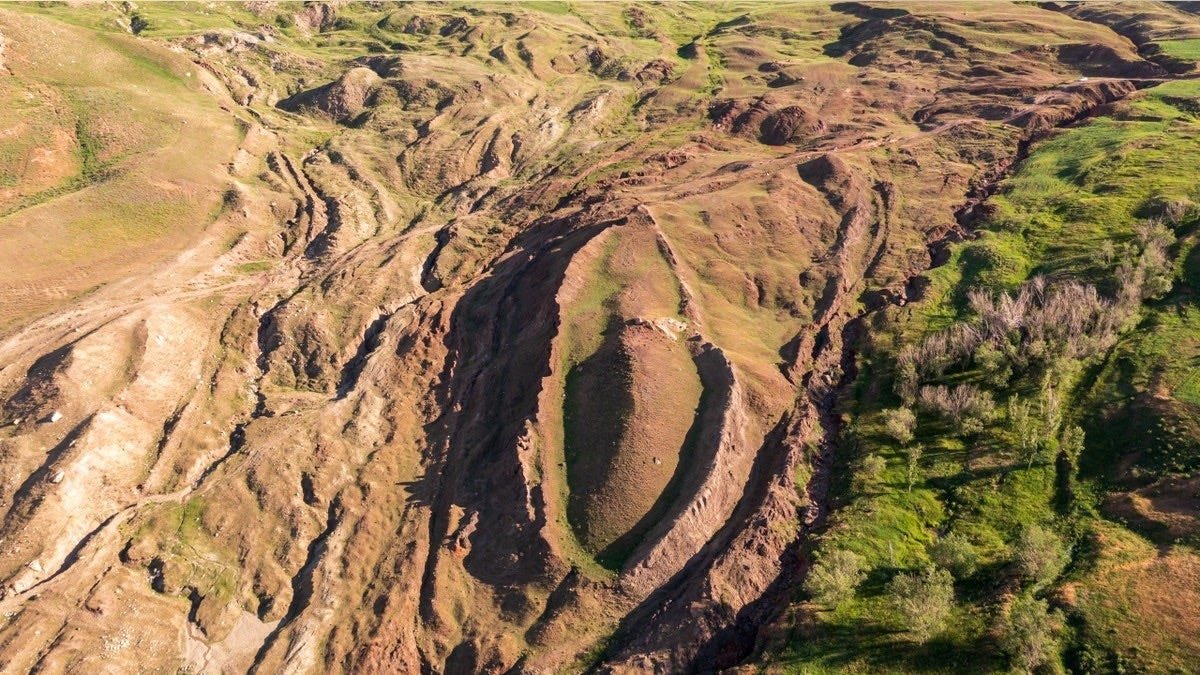
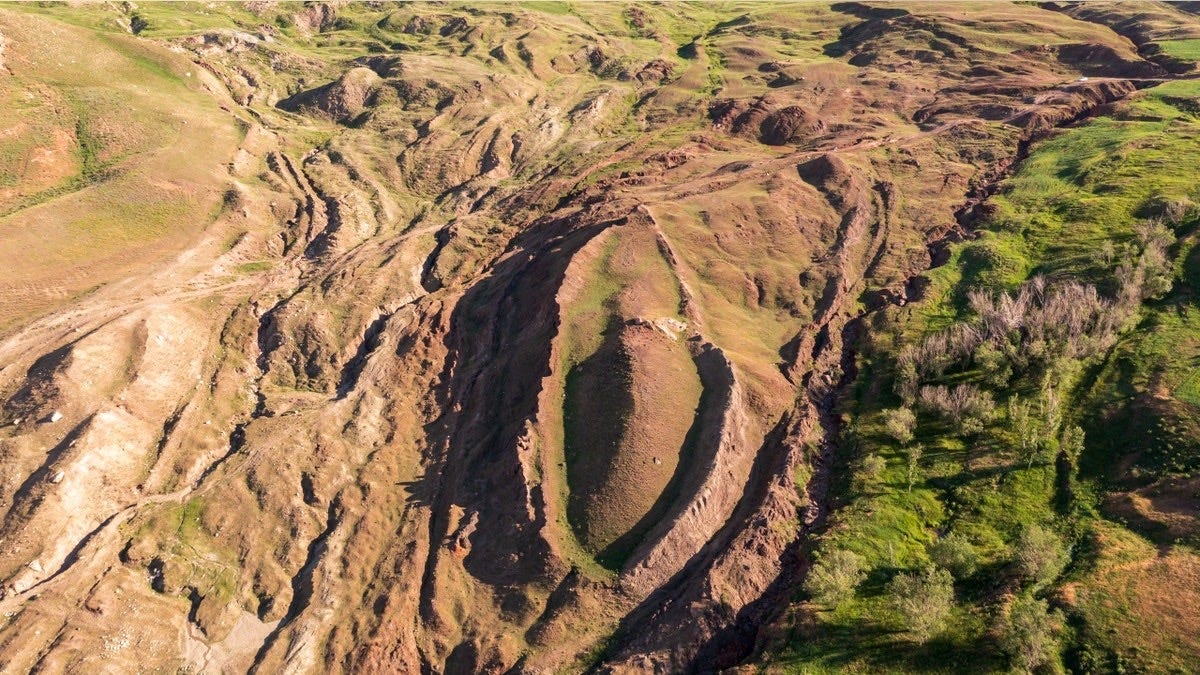
Every few years, the cycle repeats like clockwork: breathless headlines declare that Noah’s Ark has finally been discovered in eastern Turkey. Aerial photos circulate showing a boat shaped mound of earth, soil samples are cited, and social media lights up with triumphant claims that the Bible has at last been proven by modern science.
Most recently, attention has swung back toward the Durupinar site, a 538 foot boat shaped formation located about twenty miles south of Mount Ararat’s summit. First spotted by a Turkish army captain in aerial surveys back in 1959 and later championed by amateur explorer Ron Wyatt, the formation periodically sees renewed public interest following rock and soil core samplings by international research teams.
Finding the Ark would undeniably be one of the most astonishing archaeological discoveries in human history. Yet before anyone stakes their spiritual conviction on satellite scans or ground penetrating radar, or core drilling, a heavy dose of objective scrutiny is required.
Interestingly, one of the most vocal warnings against jumping the gun comes from within the young earth creationist camp itself: Ken Ham and his research team at Answers in Genesis.
The Skeptic in the Pews: What Ken Ham and Geologists Actually Say
You might expect an organization that built a massive, full scale Ark replica in Kentucky to champion any claim of the real thing with open arms. Instead, Ken Ham and geologist Dr. Andrew Snelling have spent decades publicly refuting the Durupinar claims.
Their caution is not born of skepticism toward the biblical text, but of basic geological and logical coherence:
Geological formation: Geologists across the spectrum have repeatedly shown that the Durupinar site is an eroded natural formation composed of mudflows, limestones, and volcanic basalt. Similar boat shaped features exist in other regions where harder rock resists surrounding erosion.
The volcanic timeline: Mount Ararat is a massive compound volcano that underwent substantial eruptions following the timeline described in the Genesis account. A wooden vessel landing on active volcanic terrain would have had little chance of sitting undisturbed on a hillside rather than being incinerated or deeply buried.
The post Flood reality: Ham and Snelling have pointed out a practical reality. If Noah, his family, and the animals emerged into a landscape devoid of mature trees, the massive timbers of the vessel would have been the single most valuable resource for firewood, tools, and immediate shelter. Expecting an immense wooden barge to sit intact for thousands of years ignores basic human survival needs.
The Danger of Turning Theories into Articles of Faith
Investigating anomalous sites in the ancient Near East is legitimate and worthwhile. Archaeology regularly provides valuable cultural, geographic, and historical context to the ancient world. If rigorous excavation, peer reviewed soil data, and material analysis someday unearth indisputable structural timbers from a colossal vessel, that would be monumental.
The danger lies in confusing provisional research with the bedrock of faith.
When believers eagerly celebrate an unverified anomaly, elevate speculative theories to the level of doctrine, and declare that scripture is proven because of a mound in Turkey, they set an unnecessary trap. What happens when further trenching reveals nothing more than volcanic clay, iron rich mudstone, and natural sedimentation?
Too often, the reaction is disillusionment. Observers and skeptics reasonably conclude that Christian conviction relies on sensationalism, while sincere believers can feel that if the artifact vanishes, the underlying spiritual truth vanishes with it.
Faith that attaches itself to sensational headlines is fragile. It leaves individuals vulnerable to every exaggerated claim and subsequent retraction.
Letting Research Be Research
Believers do not need to invent artifacts to validate the moral and spiritual weight of Scripture. Truth has nothing to fear from objective investigation.
Let the researchers take their core samples, evaluate the geophysical imaging, and publish their findings for peer review. If it yields verifiable evidence of human habitation, timber structures, or something extraordinary, that is wonderful. If it turns out to be just another folded ridge in the rugged Turkish mountains, nothing of eternal value has been lost.
Looking at the evidence honestly, without premature celebration or defensive denial, is not a lack of faith; it is intellectual integrity. The biblical narrative stood long before anyone pointed an aerial camera at the slopes of Agri Dagh, and its message does not depend on whether a pile of petrified wood is ever dug up.
