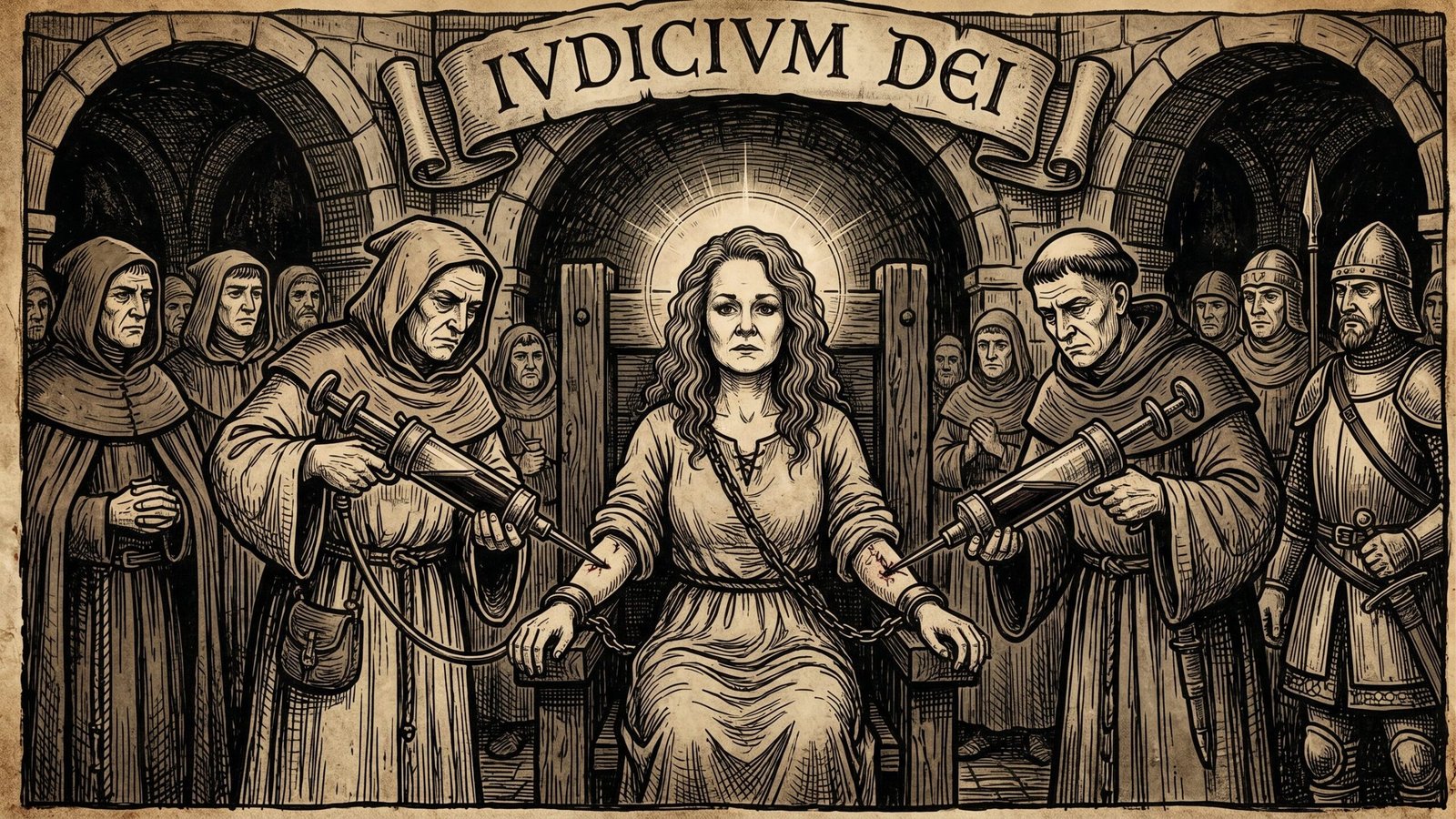
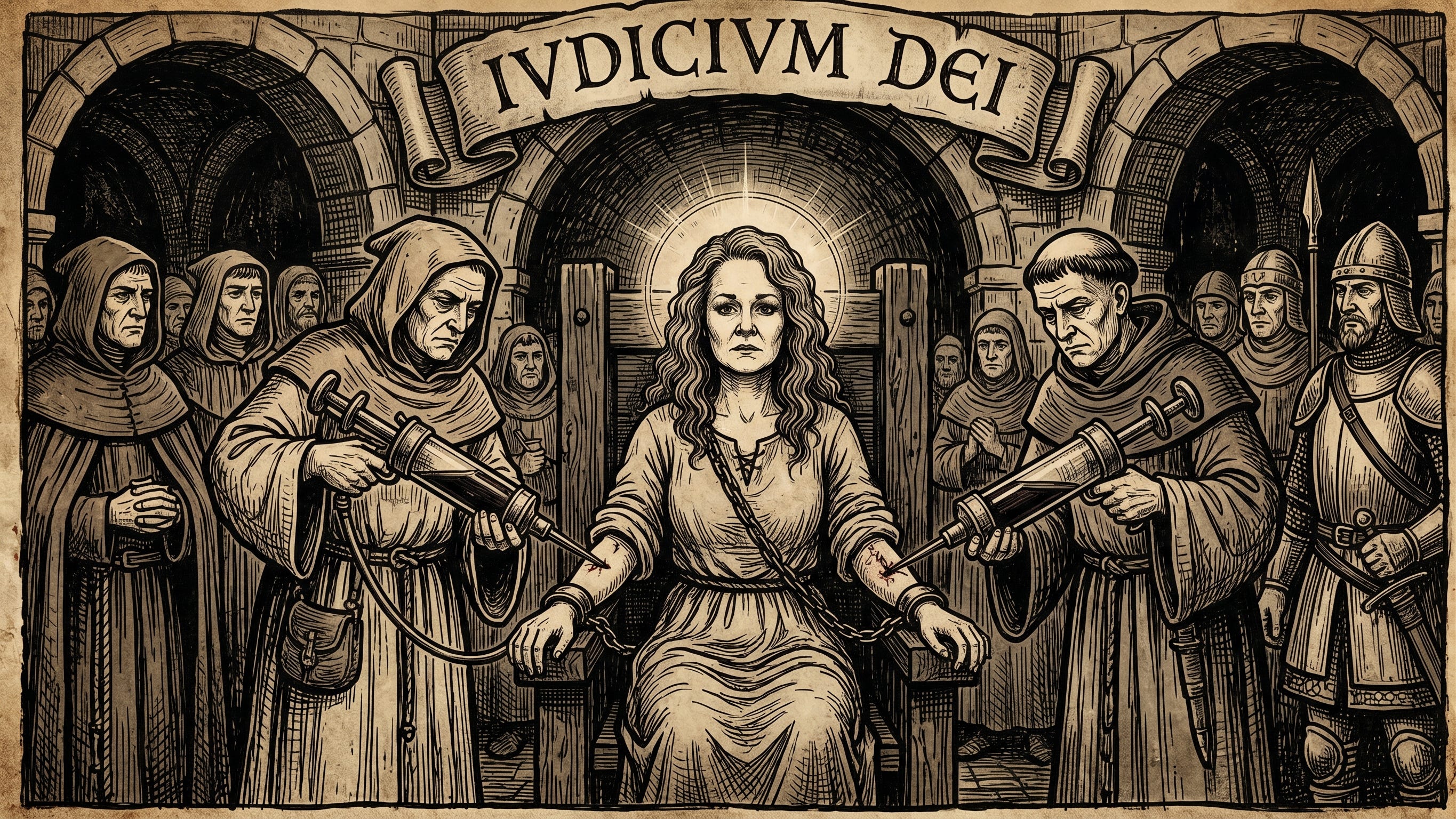
Surviving an execution forces a profound theological and moral
reckoning upon the church and the state alike.
By Michael Peabody, Esq.
In the early Middle Ages, when human tribunals reached their forensic limits, European justice turned to judicium Dei, “Judgment of God,” or the trial by ordeal. When human courts could not decipher truth, they surrendered the defendant to the elements.
In the ordeal of cold water, an accused person was bound and lowered into a river; if the water accepted them and they sank, they were cleared, while floating signaled an unnatural rejection by the creation itself. In the ordeal of hot iron, the defendant carried a burning bar across church stones. The blistered hand was bandaged and inspected three days later. If the flesh festered, mortal magistrates carried out death; if the wound healed clean, the executioner dropped his instruments. Scripture, too, records moments when the imperial furnace failed: Nebuchadnezzar cast Shadrach, Meshach, and Abednego into flames seven times hotter than normal, only to watch them walk unburned in the presence of a fourth figure. The ancient premise was singular: when earthly authority attempts to wield ultimate violence, divine sovereignty holds veto power.
For centuries, our society congratulated itself on outgrowing such mysticism. The Enlightenment replaced the cauldron and the glowing iron with statutory codes, cross-examination, and the Eighth Amendment. Modern capital punishment arrived by promising clinical sterility. The burning stake gave way to clean sheets, intravenous lines, and measured vials of pentobarbital. The state assured the public that retribution could be administered with the dispassionate precision of surgery, scrubbing away all traces of spectacle

On the evening of September 30, 2026, inside Tennessee’s Riverbend Maximum Security Institution, that modern illusion fractured.
Christa Gail Pike, fifty years old, was scheduled to die for the 1995 murder of Colleen Slemmer, an act of horrific cruelty committed when Pike was just eighteen. Over thirty years on death row, the adolescent occultism of her youth had long receded. Pike embraced Buddhism, relying on contemplative prayer and the spiritual counsel of an ordained teacher who stood beside the gurney, singing words of love and reciting blessings as the state initiated its lethal protocol.
Then the injection stopped working.
For an hour witnesses sat in stunned silence listening to the heavy, rhythmic
snores of an inmate who was supposed to be dead.
Ten minutes after the first infusion, Pike remained conscious, complaining that her arm burned. The curtain fell, reopened, and Tennessee administered a second full round of lethal barbiturate. For an hour behind drawn curtains, media witnesses sat in stunned silence listening to the heavy, rhythmic snores of an inmate who was supposed to be dead. An ambulance was summoned. Surviving two complete lethal overdoses, Pike was wheeled out on a stretcher, placed on a ventilator at Vanderbilt Medical Center, and has since regained consciousness.
Surviving the gurney does not make Christa Pike a righteous martyr. Her guilt in the brutal destruction of Colleen Slemmer remains total. In the eyes of statutory law, she has not fulfilled her sentence, nor does survival entitle her to walk free.
Yet surviving an execution forces a profound theological and moral reckoning upon the church and the state alike. When human authority arrogates the sovereign right to end a life, it assumes an omnipotence it does not possess. Having failed to kill her, Tennessee was forced into the surreal posture of deploying emergency doctors, ventilators, and ICU medications to preserve the very heartbeat its executioners had twice tried to extinguish.
Eighty years ago, in Louisiana ex rel. Francis v. Resweber, a divided Supreme Court permitted Louisiana to send seventeen-year-old Willie Francis back to the electric chair after an initial mechanical failure. But constitutional law has long since abandoned the cruel mechanics of 1947. Under Trop v. Dulles, the Eighth Amendment must reflect the evolving standards of decency that mark the progress of a maturing society. Willie Francis survived an electrical circuit that never reached his heart.
Christa Pike absorbed two full rounds of lethal poison, felt the physical trauma of an overdose, and crossed the existential threshold of her own death.
To drag a human being who has survived that chemical crucible back to the execution chamber ceases to be an administration of law. It becomes an endurance test of flesh against poison.
The gospel insists that earthly rulers operate under delegated, bounded authority. When the state lights the fire and the fire fails to consume its quarry, humility demands that mortal authority halt. To strap Christa Pike back to a gurney would not balance the scales of justice for Colleen Slemmer’s grieving family; it would merely prove that when the state’s pride is wounded by its own incompetence, it will choose vengeance over decency every time.
(As an aside, consider that the lethal injection regimen is similar to the “Medical Aid in Dying” protocol that is called “compassionate” among many who otherwise disagree with the death penalty.)
