Note: It seems that state-sanctioned death has now been at the top of the headlines for a few weeks, and we’ve been tracking it since it seems to have a lot to do with human rights and concerns for where we’re headed. I was going to take today off from a blog entry, but this afternoon the Pentagon announced that it plans to publicly execute mass murderer and terrorist Nidal Hasan. This is by all counts a major shift in how the United States wants to operate and how it wants the world to perceive its power. Some will welcome it as an opportunity to see justice fulfilled, but it may also start a round of national bloodlust that will only grow from here. Now, not later, is the time to pay attention to the broader implications of what this means for all of us. – Michael Peabody
There is something uniquely repulsive about watching the state discard its polite hypocrisies only to reveal something far more sinister underneath. For decades, the legal establishment maintained the pious, nauseating fiction that capital punishment was an aseptic clinical duty. It was supposed to be a discreet transaction conducted at the margins of society, concealed behind high prison masonry, managed by anxious wardens, and administered by state functionaries masquerading as medical practitioners. We were assured that the state extinguished human life not out of bloodlust, but out of a solemn devotion to public order.
That squeamish curtain has now been ripped down. The Pentagon wants blood, it wants the crack of military rifles, and above all, it wants the spectacle broadcast live.
The proposal to march Nidal Hasan before a firing squad and syndicate his destruction over a digital livestream is not an exercise in judicial transparency [1]. It is the bloodthirsty theater of the Roman Colosseum retrofitted for high-speed fiber optics. Hasan is a contemptible terrorist who slaughtered thirteen unarmed human beings and maimed dozens more in 2009. His moral ledger is bankrupt. Yet the moment the sovereign decides to turn the physical annihilation of a human into public digital entertainment, the state ceases to administer justice. It begins pandering to the mob.
Power never yields a freshly annexed precinct of savagery. Let no one entertain the childish delusion that this will be an isolated performance. Precedent in the American regulatory machine is an aggressive, predatory creature. If the Department of Defense is permitted to televise an execution to sate popular fury, the floodgates collapse. Every headline atrocity, every sensational federal conviction, and every political monster will soon be queued up for a streaming link. What begins as an extraordinary measure for a despised terrorist becomes standard administrative procedure tomorrow.
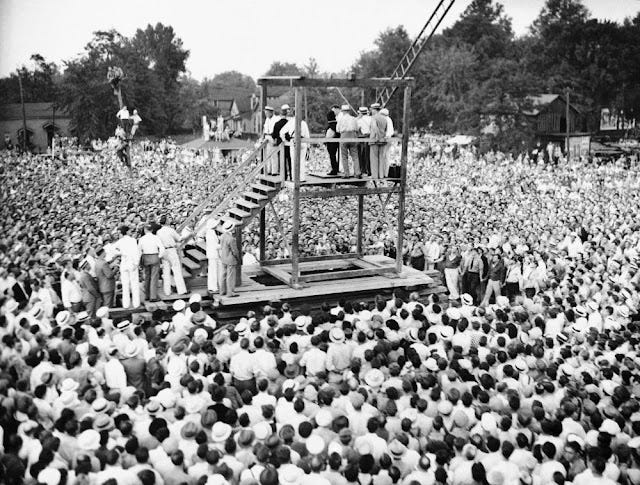
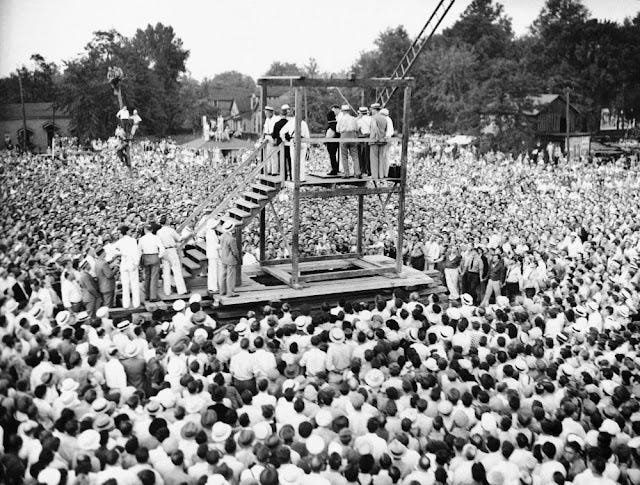
We know how this debauchery ends. History records with horrifying precision how it rots the commonwealth. When twenty thousand howling spectators descended upon Owensboro, Kentucky, in August 1936 to watch Rainey Bethea swing from a gallows, the gathering immediately degenerated into a drunken carnival where citizens brawled over shreds of the death hood [2]. The sheer revulsion of that spectacle forced state legislatures to retreat, ashamed, behind high penitentiary masonry. The law recognized what modern bureaucrats are eager to forget. Subjecting a populace to the butchery of the sovereign does not elevate public virtue; it turns citizens into spectators.
The clinical literature confirms the degeneration. Psychiatric examination of eyewitnesses to capital executions demonstrates that watching the state extinguish a life produces severe trauma, not moral clarity. Researchers studying media personnel who witnessed executions at San Quentin discovered that over sixty percent suffered from acute dissociative symptoms, profound emotional estrangement, and intrusive nightmares indistinguishable from survivors of violent disasters [3].
This sudden, feverish resurgence of state killing is part of a wider, darker realignment.
Distribute that psychic contagion across three hundred million glowing touchscreens, and the consequence is mass moral necrosis [4]. Transforming state killing into casual content cauterizes the capacity for empathy. The public palate demands ever-harsher displays to register any sensation at all. It is the deliberate, state-sponsored atrophy of the human conscience.
To anyone with even a passing memory of the ancient apocalyptic texts, this collective hardening arrives with a chilling, unmistakable resonance [5]. The prophetic warnings never envisioned an end times defined merely by earthquakes and plagues. They warned of a profound moral winter, an era when institutional tyranny enforces terminal coercion over conscience while the love of the many grows cold. The prophetic vision in Revelation of state-mandated death decrees, where populations gaze upon the dead in the public streets and throw parties over the corpses, describes a culture that has lost its last scrap of horror at the taking of life [6]. We are busily assembling the technical and legal scaffolding required to make that nightmare operational. We are cultivating an appetite for public spectacles of blood, decreed by law, and applauded by a populace whose capacity for revulsion has been entirely burned away.
The sheer desperation behind this streaming circus stems from bureaucratic panic. The clinical pretense of the death chamber has completely collapsed under the weight of its own incompetence. Within eight days, Tennessee managed to bungle a lethal injection so catastrophically that prison technicians burned their subject with chemical infusions, failed to secure viable intravenous lines, and ultimately aborted the slaughter to haul the prisoner to a hospital. A week later, Texas strapped another man to a gurney in Huntsville and snuffed him out with routine efficiency [7]. The state cannot even guarantee the plumbing of its own chemical gallows. Now the generals propose to abandon the collapsing veins entirely, haul out military carbines, and blow their way through the Eighth Amendment in prime time.
This sudden, feverish resurgence of state killing is part of a wider, darker realignment. While prison officials revive archaic execution protocols, state houses across the land are simultaneously legalizing and expanding medical aid in dying. The state is asserting an aggressive, totalizing monopoly over human mortality.
If the government stands Hasan against a post, unleashes a volley of lead, and pipes the carnage into the nation’s living rooms, it will not demonstrate the majesty of the rule of law. It will demonstrate only our descent into institutional barbarism.
Footnotes
-
Department of Defense Execution Records; see also 10 U.S.C. § 856 (Art. 56, Uniform Code of Military Justice) and Death Penalty Information Center: The Military Death Penalty. The armed forces have not carried out an execution since the hanging of John Bennett on April 13, 1961, at Fort Leavenworth, Kansas. The military last utilized a firing squad on January 31, 1945, to execute Eddie Slovik for desertion in Sainte-Marie-aux-Mines, France.
-
Perry, Thomas. The Last Public Execution in America: The Hanging of Rainey Bethea. University Press of Kentucky, 1995. Bethea’s public hanging on August 14, 1936, witnessed by an estimated 20,000 spectators, provoked national condemnation over its chaotic, carnival atmosphere and led directly to the nationwide prohibition of outdoor executions.
-
Freinkel, Andrew, et al. “Dissociative Symptoms in Media Eyewitnesses of an Execution.” The American Journal of Psychiatry, vol. 151, no. 9, 1994, pp. 1335–1339. The landmark study documented acute anxiety, dissociative symptoms, and emotional detachment in 15 of 18 media eyewitnesses following the 1992 gas-chamber execution of Robert Alton Harris at San Quentin.
-
Sarat, Austin. When the State Kills: Capital Punishment and the American Condition. Princeton University Press, 2001, pp. 187–208. Documenting the brutalization thesis and detailing how public exposure to sovereign violence systematically desensitizes the populace and degrades democratic civic norms.
-
Matthew 24:12; 2 Timothy 3:1–3. Outlining the moral decay of the terminal age, marked by escalating institutional lawlessness where “the love of many will grow cold” and human culture becomes callous, irreconcilable, and brutal.
-
Revelation 11:7–10; Revelation 13:15. Prophetic depictions of state-enforced capital decrees over matters of conscience, culminating in populations across the globe viewing the dead in the public streets and celebrating their destruction without restraint.
-
Denno, Deborah W. “The Lethal Injection Quandary: How Medicine Has Dismantled the Death Penalty.” Fordham Law Review, vol. 76, no. 1, 2007, pp. 49–128; see also Death Penalty Information Center: Botched Executions. Chronicling the recurring operational failures of lethal injection protocols and the reactive legislative return to archaic methods such as firing squads and asphyxiation.
