When thirty-seven local congregations across Maryland decided they could no longer remain part of the United Methodist Church, their break over theology quickly became an ugly battle over brick, mortar, and millions of dollars. The dispute, which culminated this week in a decisive ruling from the Appellate Court of Maryland, embodies the heartbreak unfolding in sanctuary after sanctuary across the United States. Local believers pour decades of tithes, labor, and devotion into constructing their parish halls and sanctuaries, only to discover that when they fundamentally disagree with their regional leadership, they own almost none of it.
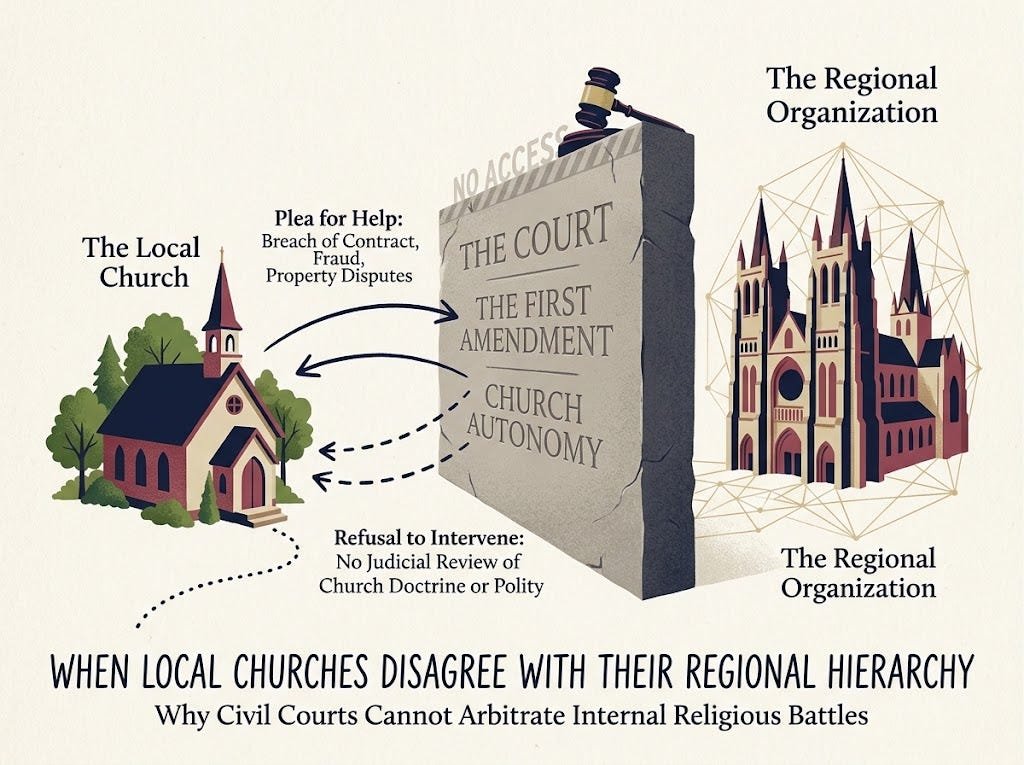
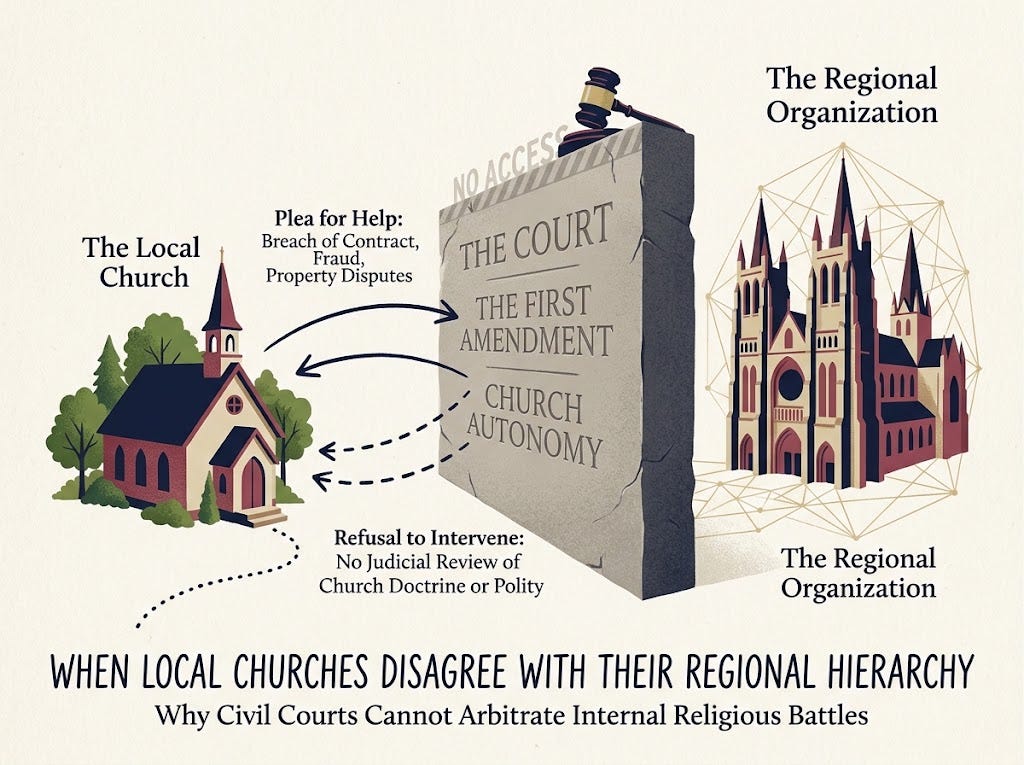
In response, local trustees routinely turn to the secular judicial system for help. They plead with civil judges to step in, treat their denomination like a rogue corporation, and protect their physical assets from regional authorities. Yet time and again, dissenting congregations find that secular courts can do almost nothing to rescue them. The Maryland appellate ruling in The Methodist Church of Cape St. Claire v. The Baltimore Washington Conference (Filed October 6, 2026) is a stark reminder of that constitutional reality.
The Illusion of Civil Contract Law
Desperate to protect their campuses without paying the crushing exit fees demanded by the regional conference—namely, half the assessed property value plus pension liabilities—the Maryland churches dressed their theological heartbreak in standard commercial garb. They sued the regional conference for breach of contract, constructive fraud, and financial mismanagement, arguing that the denomination’s foundational rulebook, the Book of Discipline, functioned as a binding secular agreement. They even petitioned the court under state trust law, claiming that recent denominational shifts regarding human sexuality had frustrated the original, pious purpose of the trusts that held their lands.
To a secular court, however, that argument is an immediate dead end. The Maryland appellate panel recognized that accepting the churches’ invitation would require civil judges to wander straight into a theological thicket. A judge cannot determine whether a regional bishop breached a fiduciary duty without deciding what Methodist custom and doctrine actually required. A civil bench cannot audit clergy pension management without dictating how a religious hierarchy should value and compensate pastoral ministry. And no secular court can rule that shifting doctrines frustrated a trust’s purpose without defining what true religious faith was supposed to look like in the first place.
The Unyielding Wall of Church Autonomy
The reason civil courts repeatedly throw up their hands in these fights is rooted in the First Amendment’s church autonomy doctrine, also known as ecclesiastical abstention. Secular magistrates are constitutionally prohibited from deciding internal church governance matters, interpreting ecclesiastical instruments, or arbitrating doctrinal schisms. Unless a property dispute can be settled by examining purely neutral secular documents—such as ordinary deeds or corporate charters that contain zero theological language—the state must stay out.
In hierarchical denominations like the United Methodist Church, the legal architecture was locked down long ago. The Book of Discipline establishes an express, irrevocable trust over all local real estate for the benefit of the entire denomination, a principle even codified into Maryland state law. Because the local churches willingly joined the connectional church and operated under its hierarchy for decades, the courts will not allow them to rewrite the denominational trust agreement simply because the marriage turned bitter.
The Steep Cost of Local Liberty
Congregants facing regional pressure often feel betrayed when the civil courthouse doors shut in their faces, but that restraint protects religious liberty as a whole. If judges had the power to rescue local churches from unfavorable denominational rules, the government would also possess the dangerous power to dictate how religious communities must govern themselves.
The law views membership in any hierarchical faith as an entirely voluntary act. Believers possess an absolute constitutional right to walk away when conscience demands it, but the First Amendment does not guarantee that departing will be cheap, convenient, or painless. The secular legal system can enforce public land records, but it will never decide who has the moral right to inherit the church steps.
