The Math Finally Broke: How “Free” Systems Bankrupted Europe’s Youth
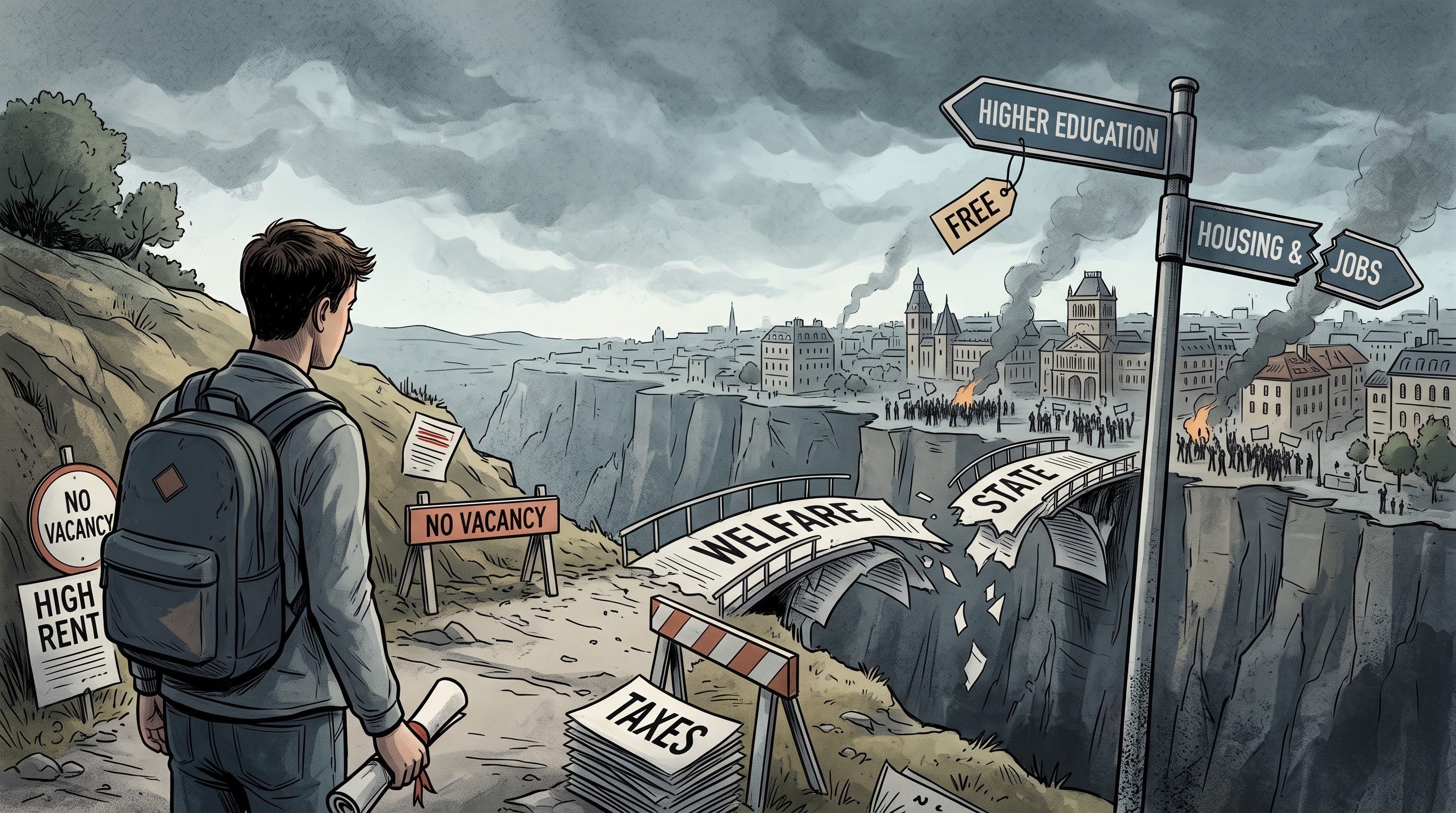
The European model relies entirely on a delicate balance. It requires a highly productive, high-tax-paying population continuously funding the system to support those who are drawing from it. In a purely free-market system, people move primarily for labor opportunities. If there are no jobs, migration naturally slows. But in a welfare state, the state itself is the safety net, guaranteeing housing, healthcare, and income support regardless of whether the labor market can instantly absorb new arrivals.
When you introduce mass immigration into this model, you rapidly expand the pool of people drawing heavily on state resources before they have spent decades paying into the tax base to fund those services.
Americans look across the Atlantic and see exactly what they want to see: a higher education system without the crushing weight of student loans. We picture young Europeans graduating debt-free and stepping easily into a comfortable, secure life.
But young people (and not a few others) are marching by the thousands. They are clashing with police, blocking university entrances, and setting up protest camps in city squares, and burning down government buildings and looting stores. They aren’t marching because the system is working. To hear them say it, they are protesting because the much-praised European social model is quietly collapsing under its own weight, and they are the ones paying the tab. So let’s take a look at what that means if they are telling the truth about why they are protesting.
The sheer scale of this unrest challenges the narrative that these protests are merely the work of isolated hooligans or political agitators. From the burning barricades in Paris to the encampments in Lisbon and clashes in Milan, this is a continent-wide structural crisis.
Having zero tuition doesn’t matter if you can’t afford to survive. The most immediate friction point for these students isn’t the cost of textbooks. It is housing. Teacher shortages crumbling infrastructure (ironic when they’re burning buildings).
In Portugal, housing prices surged by 124 percent between 2015 and 2024. That is double the European Union average, pushing young people to literally pitch tents in public spaces. In Spain, the anger boiled over recently when an 87-year-old woman was evicted after an investment fund hiked her rent by 230 percent. That single event mobilized thousands of students who suddenly realized they are graduating into a market where securing a basic apartment is nearly impossible.
The financial burden of adulthood hasn’t disappeared in Europe. It just shifted from the university billing department to the landlord.
The schools themselves are also starved for cash. There is a brutal trade-off when the state pays for everything: universities are entirely at the mercy of public budgets. France’s current wave of unrest actually began in high schools. Students walked out over severe teacher shortages and crumbling buildings. Unfilled staff vacancies left some pupils missing months of classes. When the protests spread to universities, the police response resulted in nearly 7,000 arrests.
This decay points to a much deeper mathematical flaw in the social democratic model.
The arrangement used to be simple. Citizens accepted high taxes and heavy regulations. In exchange, the state provided a cradle-to-grave safety net with strong worker protections, free healthcare, and subsidized education.
The math just doesn’t work anymore. That massive public sector requires robust, continuous economic growth, and Europe’s economy has been largely stagnant. High corporate taxes and rigid regulations tend to drive away capital. That means fewer dynamic, high-paying jobs for the exact graduates the state just spent thousands of euros educating.
Worse, the famous labor protections have created a locked two-tier society. Because it is incredibly difficult and expensive to fire a full-time employee, companies are terrified of hiring them. Older generations hold onto secure, iron-clad jobs. Young people entering the workforce are left with the scraps. They are forced into a revolving door of temporary contracts, freelance gigs, and endless unpaid internships.
This structural failure is now being accelerated by a demographic shock. The massive protests expose a fundamental reality that social democracies have tried to ignore for decades: the famous warning from economist Milton Friedman that you cannot simultaneously have open immigration and a welfare state.
The European model relies entirely on a delicate balance. It requires a highly productive, high-tax-paying population continuously funding the system to support those who are drawing from it. In a purely free-market system, people move primarily for labor opportunities. If there are no jobs, migration naturally slows. But in a welfare state, the state itself is the safety net, guaranteeing housing, healthcare, and income support regardless of whether the labor market can instantly absorb new arrivals.
When you introduce mass immigration into this model, you rapidly expand the pool of people drawing heavily on state resources before they have spent decades paying into the tax base to fund those services.
Nowhere is this mathematical failure more explosive than in the housing market. Decades of economic stagnation and budget constraints mean European governments have not built enough housing to keep pace with demand. When a country experiences a rapid influx of migrants, those individuals must be housed. Because the state is obligated to provide shelter, migrants are often placed in subsidized housing or emergency accommodations. This creates a severe bottleneck. Young Europeans, already facing stagnant wages and a two-tier labor market, find themselves competing for a physically shrinking pool of affordable apartments, driving rents into the stratosphere.
The anger on the streets is the realization of a zero-sum reality. If the state has a finite number of affordable housing units and a finite budget, adding millions of new people to the system means young citizens are priced out of their own cities.
The generational betrayal is absolute. Young Europeans look at their paychecks and watch a massive portion of their limited income vanish into taxes and social contributions. They are paying the premium price for the European welfare state, but the services they are supposedly funding are falling apart. They are essentially being taxed into poverty to fund the comfortable retirements and job security of their parents’ generation, while they themselves cannot even afford rent.
The entire premise of this government model relies on the idea that the state takes your money today to take care of you tomorrow. But when the state fails to deliver basic economic opportunity today, the social contract evaporates. The fires in European capitals aren’t just a complaint about rent prices. They are a wholesale rejection of an economic system that demands half your paycheck for a safety net full of holes.