The Dispatch from Capitol Hill: How Dr. Gary Ross Taught a Generation to Think About Freedom
By Michael D. Peabody, Esq.
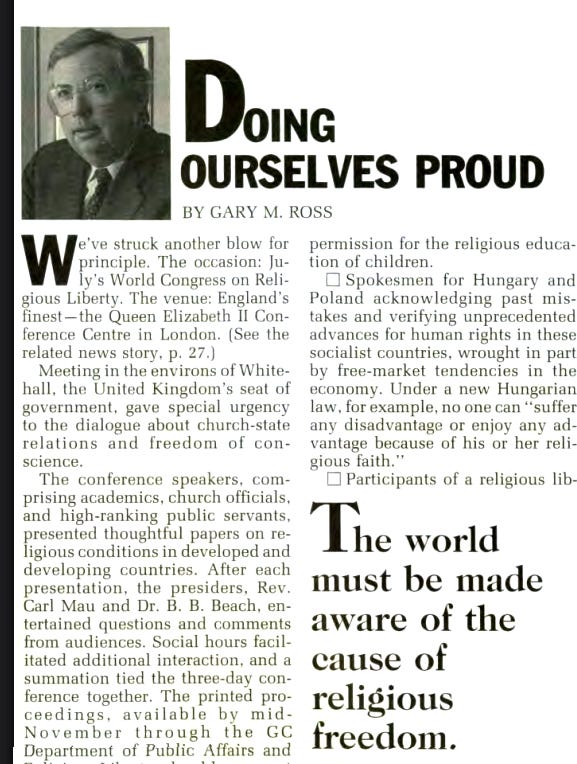
Back in the 1980s, copies of the Adventist Review arrived at our home like clockwork. While most kids flipped past the denominational updates and committee notices, I looked for a specific byline: “The Ross Report,” written by Dr. Gary Meredith Ross.
For approximately 15 years, spanning the 1980s and 1990s, Dr. Ross served as congressional liaison and associate director in the General Conference Department of Public Affairs and Religious Liberty (PARL), tracking legislation affecting freedom of conscience, and engaging international bodies, including the United Nations. To a kid like me to figure out how faith on a weekend intersected with the real world, his dispatches from Washington, D.C., read like nothing else in church print.
Most religious commentary at the time swung between apocalyptic anxiety and partisan cheerleading. Ross went the other direction. He wrote with the composure and precision of an academic historian, which he was, having earned graduate degrees at Stanford and a doctorate at Washington State University. He did not treat Capitol Hill as an enemy fortress. He treated it as a working constitutional apparatus governed by statute, procedural rules, committee politics, and legal precedent, and a practical sense that is often hard to achieve without actual experience. If anything, his columns were credible and calming.
Sometime in the mid-1980s, Dr. Ross came to speak on religious liberty at our church. Meeting him in person confirmed what came through on the printed page – he treated the congregation like thoughtful adults capable of following a constitutional argument.
I do remember meeting him briefly after his sermon as we shook hands while filing out, and I think he was surprised that a 13-year-old read his monthly column.
(You can read all of his monthly columns in their entirety on the Adventist Archives website.)
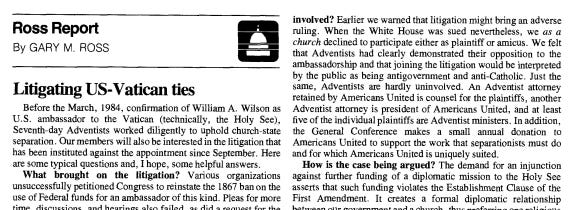
What set Ross apart in “The Ross Report” was his refusal to simplify hard questions. When Congress debated Title VII employment discrimination and workplace Sabbath accommodations, he explained the statutory mechanisms and court rulings that dictated what employers could and could not be forced to accommodate. When the Reagan administration moved to establish formal diplomatic relations with the Holy See in 1984, triggering intense debate and potential litigation across the denomination, Ross offered a steadying hand. Writing in his March 1985 column, he laid out the structural realities of standing and the danger of creating adverse legal precedent, showing why sustained public diplomacy and congressional engagement were often more effective than impulsive lawsuits.
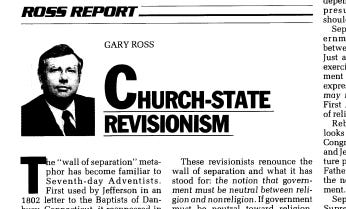
In his broader public affairs role, Ross viewed engagement with the United Nations and humanitarian arms like ADRA as vital extensions of religious freedom, not worldly entanglements to be feared. Representing the church at the UN and working alongside global relief efforts in Washington, he explained that defending human rights required Adventists to sit at the table where international charters and protections were shaped. He saw organizations like ADRA as practical embodiments of Christian witness, arguing that ministering to tangible human suffering across borders earned the moral authority needed to advocate for conscience. Rather than retreating into isolationism, Ross urged the denomination to recognize that working alongside global bodies to feed the hungry, protect refugees, and uphold universal rights was integral to safeguarding liberty for all people.
As I revisited some of his columns in preparing this piece, I was again struck at how accessible and current they were to the issues of the day. They weren’t partisan or stacked on one side or another, but accurately described the political tensions and logical realities that people faced in their everyday lives. He was not afraid to engage his readers in a way that did not alienate people but rather brought them along, and the Review would also publish letters from those who dissented. It was the kind of civil give and take that we could use more of today.
Above all, Ross held an expansive view of religious liberty that broke through denominational self-interest. He reminded church members that freedom of conscience is not a special tribal carve-out. In his view, if Adventists wanted their own Sabbath rights respected, they had an absolute moral and legal obligation to defend the rights of Jews, Muslims, non-conformists, and atheists. He frequently pointed out that genuine liberty of conscience includes the right not to practice any religion at all. Protecting dissenters was the only reliable way to protect anyone.
Dr. Ross passed away recently at the age of 89, with friends, family, and former colleagues gathering at La Sierra University’s Matheson Chapel to remember him. His career stretched far beyond Washington. He served as a history professor at La Sierra, helped secure university status for Northern Caribbean University in Jamaica, served as assistant to the president at Andrews University, and served as president of Helderberg College in South Africa. In 2005, Andrews awarded him the John Nevins Andrews Medallion for his contributions to Adventist higher education.
Ross spent his later years in Riverside, California, surrounded by thousands of heavily annotated books, mentoring younger colleagues, editing historical manuscripts, and in the words of Dr. Andrew Howe at Ross’ memorial on October 9, 2026, insisting on clean prose stripped of passive voice and split infinitives.
For those of us who grew up reading his reports and had the privilege of hearing him speak, Gary Ross set the benchmark. He demonstrated that you could step into the corridors of civil power without compromising your convictions, and that the best defense of liberty is calm, rigorous, and unyielding defense of everyone’s freedom.