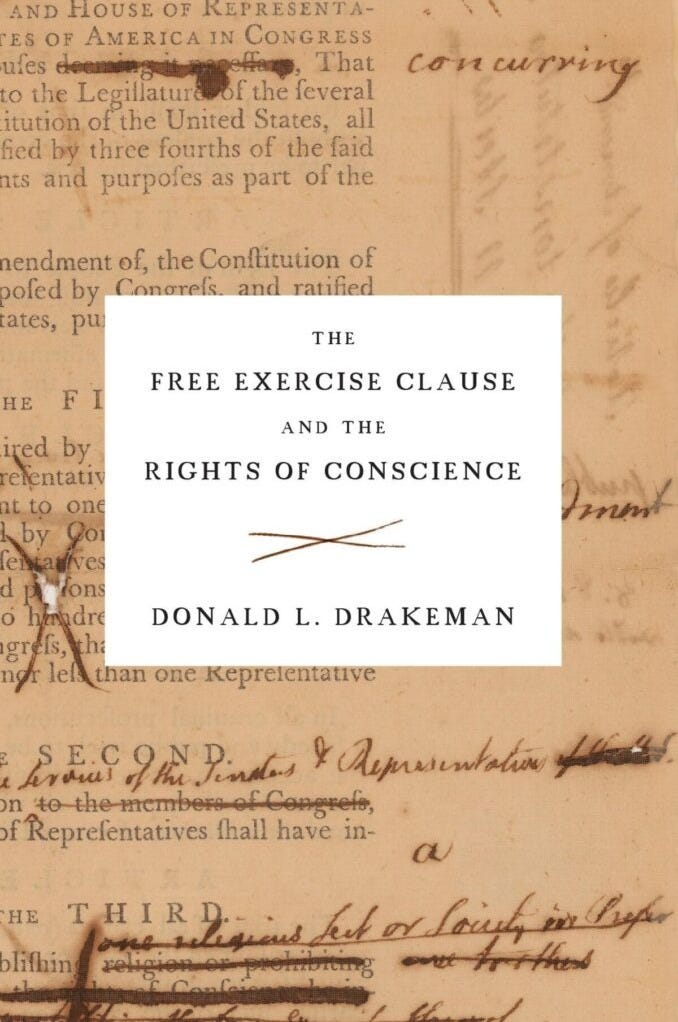
Book Review: The Free Exercise Clause and the Rights of Conscience by Donald Drakeman
By Michael Peabody, Esq.
Those of us who study First Amendment law take some things for granted. This includes the concept that those who negotiated the terms of the U.S. Constitution viewed “free exercise” as a broad shield for religious conduct, and that they used the term interchangeably with the “rights of conscience.”
But University of Notre Dame Professor Donald L. Drakeman’s new book challenges that premise. In his the book, due for release on November 17, 2026, which the publisher graciously provided for my review, argues that the modern consensus gets the history wrong. By tracking the phrase from the 313 CE Edict of Milan all the way through the 1689 English Toleration Act into colonial charters, Drakeman makes a case that “free exercise” was a highly specific term of art. It did not guarantee a general right to act on your faith. According to Drakeman, it meant one specific thing: “the ability to hold a worship service in a public place.”
Drakeman digs deep into the archives to prove his point, relying heavily on 19th-century state court cases to show that early American courts did not grant religious exemptions from standard statutory duties. The book contains a comprehensive list of these cases. The Sunday closing law cases offer the starkest examples. When Jewish merchants and seventh-day sabbath keepers challenged laws forcing them to close their businesses on Sundays, the courts consistently turned them away.
The 1848 South Carolina case, City Council of Charleston v. Benjamin, set a firm boundary:
“[T]he opinion by Judge John Belton O’Neall explained that the language in South Carolina’s constitution protecting ‘free exercise and enjoyment of religious profession and worship’ meant ‘that a man might be of any order of religious worshipper, or of none at all… that his worship might be in any form, at any time or place.’ The opinion then emphasized again that it ‘was to secure this privilege of worship… and this alone, that our Constitutional provision was adopted.’”
Soon after, in Specht v. Commonwealth, the Pennsylvania Supreme Court doubled down, declaring that “conscientious doctrines and practices can claim no immunity from the operation of general laws”. According to Drakeman, if a citizen wanted an exemption from a Sabbath law, a draft, or a parade permit ordinance, the courts sent them to the legislature, not the Constitution.
If his historical analysis holds, the mid-20th-century framework built by Sherbert v. Verner, in which the Supreme Court held in 1963 that the Free Exercise Clause prohibited the state of South Carolina from denying unemployment compensation benefits to a Seventh-day Adventist who was fired because she refused to work on Saturday. The Court found that denying benefits just because the Adventist refused to accept Saturday job assignments violated her right to free exercise because she had to choose between her religious beliefs and otherwise available benefits.
Sherbert gave constitutional cover to religious exemptions from generally applicable laws—is basically a modern invention that widened the scope of free exercise claims. If you’ve been reading this blog for any period of time, you know that Employment Division v. Smith (1990) already severely curtailed Sherbert by dropping the strict scrutiny standard for neutral laws, but Drakeman’s history suggests Sherbert was entirely untethered from the original meaning of “free exercise” to begin with.
To be fair, Drakeman makes a highly compelling point on one front: “free exercise of religion” and the broader “rights of conscience” are not identical concepts. This is a distinction I have emphasized repeatedly in recent litigation, particularly surrounding COVID-19 vaccine mandates and cases where secular individuals assert deeply held, non-religious but still conscientious objections. Incidentally, I would distinguish the cases since Sherbert’s belief in observing the Sabbath was central to her religious worship as whereas the avoidance of vaccines was a convenient way to obtain an exemption that was primarily secular but limited to “free exercise” since there is no stated “liberty of conscience” in the constitution.But that distinction can get messy, and that’s where Drakeman’s concept of a limited free exercise clause is clearest although it is too narrow a concept when it implies that the Sunday laws from the 1800s were not violative of the free exercise rights of those who worshipped on Saturday.
Then there is the reality that the idea of “liberty of conscience” is baked deep into our constitutional tradition, but modern doctrine forces us to access it almost exclusively through the Free Exercise Clause. That creates severe doctrinal bottlenecks when the courts try to squeeze every conscience claim into a framework built specifically for religion.
Drakeman’s solution is simple: because the broader “rights of conscience” didn’t survive the Senate’s editing pen, claimants must seek exemptions from the legislature. But leaving the rights of conscience entirely to the political process falls into a dangerous majoritarian trap. As the 1529 Protest of the Princes declared, “In matters of conscience, the majority has no power.” Legislatures operate strictly on popularity. They routinely ignore minority objections and rely on the courts to tell them what the Constitution requires. Telling a marginalized objector to go win a majority vote in the statehouse flips the entire purpose of civil liberties on its head.
This narrow historical box also fails to account for the modern weaponization of the Free Exercise Clause in the realm of state funding. Drakeman’s book focuses almost exclusively on claimants seeking exemptions from laws, but it notably does not address recent Supreme Court jurisprudence where religious organizations claim that being denied state funding violates their free exercise rights. In recent religious funding cases like Trinity Lutheran and Carson v. Makin, the Supreme Court has interpreted the Free Exercise Clause not just as a shield against government interference, but as a sword to demand equal access to public taxpayer dollars.
This creates severe doctrinal tension. My position is that the free exercise of religion must be wider than just the right to worship. It must be, because it currently serves as our primary constitutional vehicle for protecting religious liberty. But the clause cannot be stretched so wide that it requires others to subsidize those religious exercises with taxpayer funds. The proper balance lies somewhere in between: robust protection for religious practice without crossing the line into state-mandated financial support. (I could go further into that but it would involve the Establishment Clause, which is a direction that Drakeman avoids in this particular book.)
But before we rewrite the textbooks to match Drakeman’s thesis, we should look closely at how neat and tidy his linguistic box really is. History rarely fits perfectly into these kinds of categories. His own evidence shows the framing generation was not entirely unified on these terms. The authors of the 1778 Essex Result objected to the proposed Massachusetts Constitution and specifically scrutinized the phrase “free exercise and enjoyment of Religious profession and worship”. They pointed out that its meaning was a subject of “much altercation”. Drakeman tries to resolve this by arguing the controversy came from the word “enjoyment”. That is an elegant reading of the text, but it simply feels too surgically precise for the reality of revolutionary-era debates. If educated citizens in 1778 found the boundaries of “free exercise” fiercely contested, we should be skeptical of the claim that the phrase had an undisputed limitation a decade later.
Drakeman proves that public worship was at the heart of the free exercise right. He also documents exactly how 19th-century courts handled statutory exemptions. But insisting that this narrow historical application is the entire constitutional right leaves room for doubt, and, quite frankly, not a little concern about the future of religious freedom outside of observing the sacraments. For a country founded on unalienable rights, trying to permanently wall off the exercise of faith at the chapel doors misreads what the First Amendment was actually trying to do.