“Faithful Unto Death”: The Theology of Vaccine Refusal – Was It Faith, Fear, or Legal Strategy?
I have now published blogs about this issue for three consecutive days, not from any desire to belabor the point, but from the response each essay generated. The first piece raised questions I had not addressed fully, and the second produced another round of serious objections, legal arguments, and theological concerns that deserved a direct answer. Rather than leave those questions hanging, I wanted to follow the argument where it led and give the subject the treatment it requires. What began as one article has become a short series on religious vaccine exemptions, sincerity, conscience, and the difficult line between protecting faith and using religious language to shield a fundamentally secular objection.
And this subject is important – because for many, it was the first time that they personally ever asserted any religious freedom rights. It was when a largely insincere form of “religious liberty” took all the oxygen out of the room and left those of us who have been arguing for religious freedom for decades wondering what had happened.
– Michael Peabody
I added concise subheadings that break up the argument without making it feel chopped into sections.
I have now written about this issue for three consecutive days, not from any desire to belabor the point, but from the response each essay generated. The first piece raised questions I had not addressed fully, and the second produced another round of serious objections, legal arguments, and theological concerns that deserved a direct answer. Rather than leave those questions hanging, I wanted to follow the argument where it led and give the subject the treatment it requires. What began as one article has become a short series on religious vaccine exemptions, sincerity, conscience, and the difficult line between protecting faith and using religious language to shield a fundamentally secular objection.
When skepticism suddenly became religion
There is something deeply strange about discovering a sacred conviction at the exact moment the human-resources department announces a deadline.
For years, a person gets vaccinations, sees doctors, fills prescriptions, accepts anesthesia, takes antibiotics and gives no hint that modern medicine threatens his soul. Then comes the COVID vaccine mandate. Suddenly Corinthians appears in the exemption request.
Some people were sincere.
Some were not.
That distinction matters.
Federal law gave religion legal weight that ordinary skepticism did not have. “I distrust this vaccine” was a personal judgment. “I fear side effects” was a medical concern. “Government should stay out of my body” was political philosophy.
“God forbids me to take it” brought Title VII into the conversation.[1]
It did not take much imagination to see the temptation.
Religion is protected, sincerity is examinable
Lawyers for exemption claimants often argued for extreme judicial restraint. Once someone invokes religion, government should back away. Judges are not theologians. Courts should not decide whether a belief is orthodox, sensible or coherent.
There is truth in that.
United States v. Seeger makes clear that government does not get to decide whether a religious belief is true. Yet the case leaves one rather large door open. Government may examine whether the belief is actually held.[1]
God is not on trial.
Sincerity can be.
That became uncomfortable during COVID, when some people seemed to acquire theology with remarkable speed.
At one academic medical center, 26.9 percent of religious exemption applications contained unattributed language copied mainly from sample letters circulating online.[4] Copying does not prove deception. It does create an odd picture of intensely personal convictions before God arriving in identical paragraphs from the Internet.
Religious vaccine exemptions are not ancient
The history is just as awkward.
Compulsory vaccination in America is old. Broad religious vaccine exemptions are much younger.
In Prince v. Massachusetts in 1944, the Supreme Court used compulsory vaccination as an example of the limits of parental religious liberty. Massachusetts did not enact the exemption later examined in Dalli v. Board of Education until 1967.[2]
There was no ancient American constitutional sacrament called the religious vaccine exemption.
Then COVID arrived, and the argument became theological.
When Revelation entered the vaccination debate
Some Christians began talking about vaccination in the language of Revelation, 666, government control, microchips and the “mark of the beast.”[6] In Kneisler v. Legacy Health, a claimant expressly alleged that she believed the COVID vaccine was the mark of the beast.[7]
This is where, for me, the story moves from odd to tragic.
Many Christians had spent years hearing that a final crisis would come, that government persecution would threaten the faithful, and that believers might someday have to choose between obedience to God and preservation of their own lives.
Then a pandemic came.
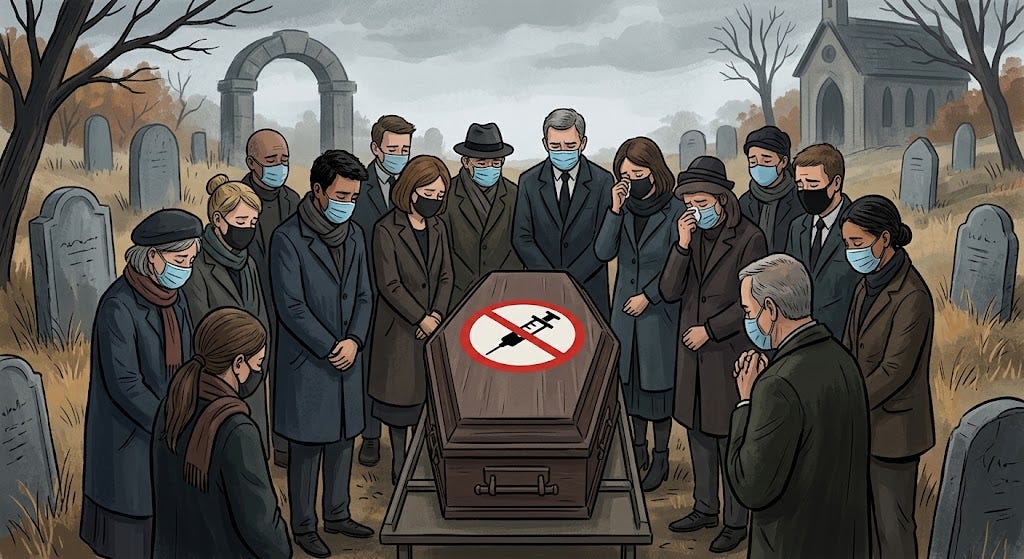
Some decided that this was it. They refused it, and the disease got them.
The vaccine became the line in the sand. The doctor’s recommendation became coercion. A government health order became persecution. Refusal became faithfulness.
But the Mark of the Beast in Revelation is not described as a vaccination program. Scripture does not teach that receiving ordinary medical treatment constitutes apostasy. Christianity does not require believers to confuse suspicion with discernment.
More troubling, it carried consequences far beyond theology.
Some believers had prepared themselves to die rather than surrender their faith during some future persecution. Then some became willing to die rather than take a vaccine that Scripture never forbade.
People preparing to be “faithful unto death” in the face of anticipated persecution sometimes became willing to die resisting the physicians who were trying to keep them alive.
Your conscience and your neighbor
Their decision did not concern them alone.
A Sabbath accommodation does not infect the person in the next office.
A yarmulke does not expose an elderly patient to a respiratory disease.
A hijab does not transmit a virus.
A vaccine exemption during an infectious outbreak raised a different moral problem. The choice could affect the people standing nearby.
My conscience can bind me.
It should not casually become my neighbor’s death sentence.
That point should be especially difficult to escape from within Christianity itself. Love of neighbor is not ornamental theology. The New Testament repeatedly asks believers to consider the welfare of other people and to refrain from using liberty in ways that injure them.
Yet the exemption argument could produce the reverse result.
“My belief governs my body” quietly became, “You must accept the risk created by my belief.”
That deserves scrutiny.
Whether the vaccine worked was a different question
The efficacy of the vaccine was almost beside the threshold religious question.
If someone truly believed God prohibited vaccination, the vaccine could have worked extremely well and the religious objection would remain.
If the vaccine worked poorly, that fact would not transform refusal into a religious act.
The legal question was whether the belief was religious, sincere and in conflict with the requirement.[1][5]
This distinction gets lost constantly.
“I refuse it since it does not work” is an empirical claim.
“I refuse it since God forbids it” is a religious claim.
Those are different arguments.
A claimant cannot move freely between them whenever one becomes inconvenient.
I watched this become personal
I knew a couple of people who were otherwise attentive to their health. They were not people who ordinarily rejected physicians or modern medicine.
Yet COVID vaccination became different.
They came to view the doctors recommending vaccination almost as people trying to kill them.
They refused it.
They contracted COVID.
They died in hospitals, attached to tubes and machines, surrounded by the very medical system they had come to fear.
By then, those doctors were trying to save them.
There was little left to offer.
I found the reasoning ludicrous.
I found the deaths heartbreaking.
Their deaths do not prove what would have happened had they been vaccinated. Human beings do not come with alternate timelines.
Population data gives us the broader comparison.
During October and November 2021, CDC surveillance across 25 jurisdictions found that unvaccinated adults had 12.7 times the COVID-associated death risk of fully vaccinated adults without boosters, and 53.2 times the risk of vaccinated adults who had received boosters.[8]
Some people spoke of being “faithful unto death.”
The terrible fact is that some really did die.
Religious liberty requires honesty too
Religious liberty deserves protection.
It deserves honesty too.
A genuine religious conviction should receive serious legal treatment.
A secular objection should not become untouchable merely after someone attaches a Bible verse to it.
And sincere believers deserve one further warning – Sincerity does not convert error into truth. A person may sincerely mistake fear for discernment. A person may sincerely mistake politics for theology. A person may sincerely believe resistance is faithfulness when the thing being resisted has nothing to do with the demands of Scripture.
Faith should not require lying about the facts. As discussed in the last two essays, vaccines did not contain the cells of aborted babies. But to this day, many accept that as if it is the gospel truth even after you prove that their entire belief was premised on an objective, factual lie.
Religious liberty should not require everyone else to bear the physical cost of a belief simply because someone has learned to pronounce it sacred.
Footnotes
[1] United States v. Seeger, 380 U.S. 163 (1965). The Supreme Court held that government may not test the truth of religious beliefs, yet sincerity remains subject to inquiry. The Court described sincerity as a threshold question.
[2] Prince v. Massachusetts, 321 U.S. 158, 166-67 (1944), stated that religious liberty did not create freedom from compulsory vaccination and referred to protection of the community from communicable disease. Dalli v. Board of Education, 358 Mass. 753 (1971), recorded that early vaccination statutes lacked religious exemptions and that Massachusetts added the exemption at issue there in 1967.
[3] Dorit Rubinstein Reiss, “Thou Shalt Not Take the Name of the Lord Thy God in Vain: Use and Abuse of Religious Exemptions from School Immunization Requirements,” 65 Hastings Law Journal 1551 (2014). Reiss used surveys, positions of religious organizations and social-media statements to document misuse of religious exemptions by people whose objections were secular.
[4] A mixed-methods study of 565 religious-exemption requests at one U.S. academic medical center found 152 applications, 26.9 percent, contained unattributed copied text, principally from sample exemption letters found online.
[5] U.S. Equal Employment Opportunity Commission guidance stated that risk of COVID-19 spread to employees or the public could form part of an employer’s undue-hardship analysis. Current EEOC guidance reflects Groff v. DeJoy, which requires a burden substantial in the overall context of the employer’s business.
[6] Scholarship on religious vaccine skepticism documents COVID vaccine claims involving microchips and the “mark of the beast.” Separate research on vaccine misinformation recorded references to the Bible, 666 and the mark of the beast among reasons offered for vaccine hesitancy.
[7] Kneisler v. Legacy Health, No. 3:24-cv-01011 (D. Or. 2024). The plaintiff alleged that her Christian beliefs included the view that the COVID vaccine was the “mark of the beast.” The court treated the allegation as religious in character at the pleading stage.
[8] CDC, MMWR, Jan. 28, 2022. During October-November 2021, age-standardized COVID-associated death-rate ratios were 12.7 for unvaccinated adults compared with fully vaccinated adults without boosters, and 53.2 compared with vaccinated adults who had received boosters.