New Federal Law Gives Clergy a Temporary Window to Opt Back Into Social Security and Medicare
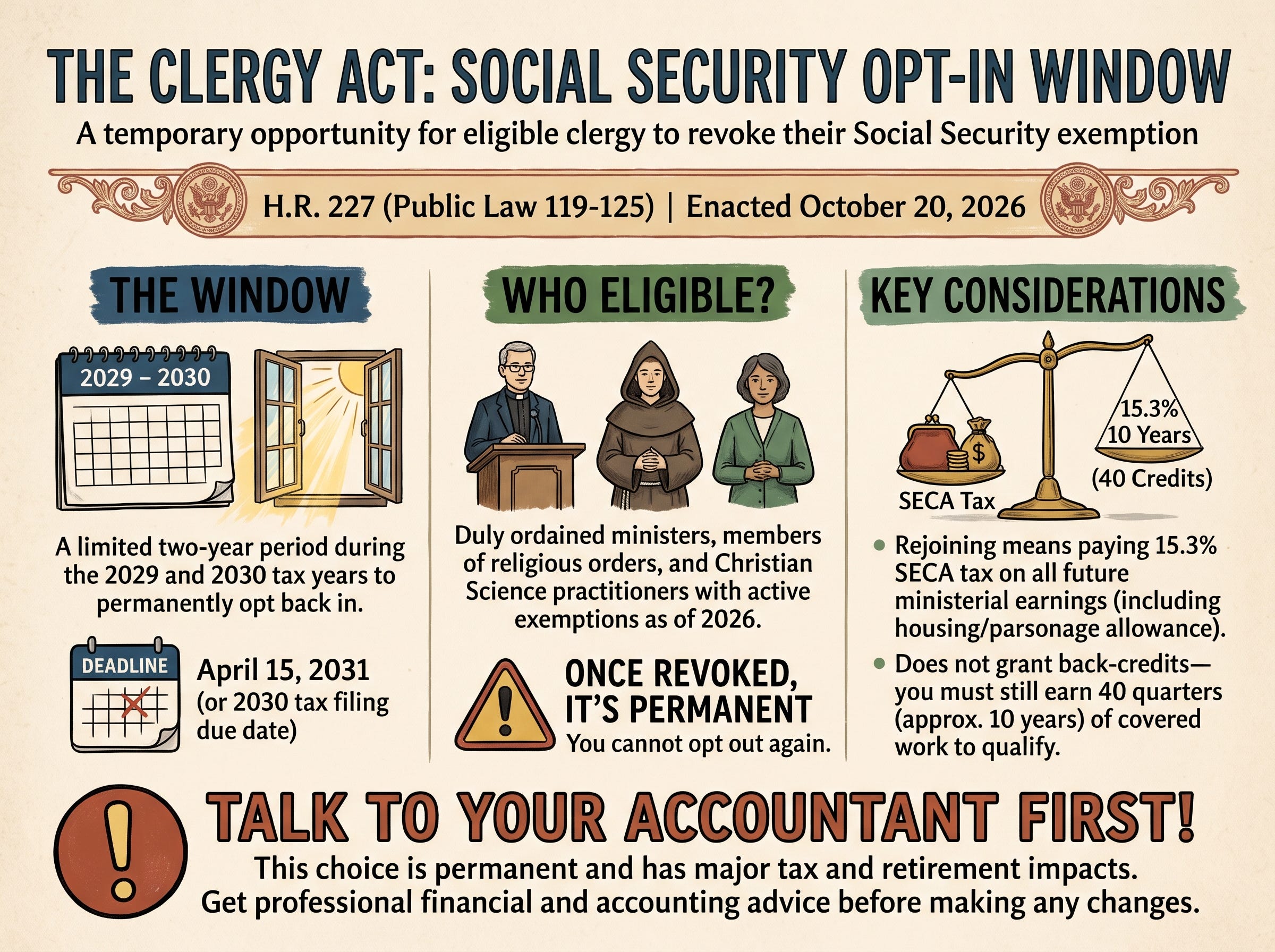
SUMMARY: President Donald Trump signed H.R. 227, the Clergy Act (Public Law 119-125), into law on October 20, 2026. The law opens a temporary window during the 2029 and 2030 tax years for eligible clergy to cancel a prior religious exemption and rejoin Social Security and Medicare. Under Section 1402(e) of the Internal Revenue Code, ministers who oppose public insurance for religious reasons (… eh hem …) can opt out of self-employment taxes early in their careers, a choice that is normally permanent.
However, many pastors opt out as young ministers without fully understanding the long-term financial impact, or later find that their theological views have changed and their private retirement savings are falling short. Revoking the exemption allows these ministers to earn Social Security retirement income, disability protection, survivor benefits for their families, and premium-free Medicare Part A hospital coverage. Within 90 days of the law’s signing, the Internal Revenue Service and the Social Security Administration must give Congress a plan to notify clergy about this option.
Law: Clergy Act, Public Law 119-125 (H.R. 227, 119th Congress) (LINK)
Enactment Date: October 20, 2026
Ministers who previously opted out of Social Security now have a legal way to change their minds. By passing the Clergy Act, Congress created a temporary exception to Section 1402(e)(4) of the Internal Revenue Code, which normally locks ministers out of Social Security forever once they claim an exemption. The new law applies nationwide to ordained, commissioned, or licensed ministers, members of religious orders, and Christian Science practitioners who had an active exemption in the 2026 tax year.
Representative Vince Fong (R-CA) and Representative Mike Thompson (D-CA) introduced H.R. 227 on January 7, 2025. The House Committee on Ways and Means unanimously approved an updated version of the bill in December 2025, and the full House passed it by a 350-5 vote on April 27, 2026. The Senate passed the bill without changes by unanimous consent on September 30, 2026, sending it to the president’s desk.
Under federal tax law, ministers are treated as self-employed for their church work. Because of this, they must pay a 15.3 percent tax under the Self-Employment Contributions Act (SECA) to fund Social Security and Medicare. However, Section 1402(e)(1) of the tax code lets newly credentialed clergy opt out of the system by filing IRS Form 4361 within their first two years of earning at least $400 in ministry income. To get the exemption, a minister must state that they are conscientiously or religiously opposed to accepting government insurance benefits for retirement, disability, death, or medical care. According to House Report 119-425 from the Committee on Ways and Means, about 2,000 clergy members receive this exemption each year. Many later struggle to afford retirement because the law barred them from rejoining the system. Congress previously opened temporary windows to opt back in during 1977, 1986, and 1999, leaving a 26-year gap before this law passed.
How does the new opt-in window work?
Section 2 of the Clergy Act sets strict rules and deadlines for clergy who want to cancel their exemption:
Who Qualifies: Ordained, commissioned, or licensed ministers, members of religious orders, and Christian Science practitioners who held an active Social Security exemption under Section 1402(e)(1) for the 2026 tax year.
When Coverage Starts: Clergy can choose to restart their Social Security coverage in either their first or second tax year beginning after December 31, 2028. For standard calendar-year taxpayers, this means coverage starts in either 2029 or 2030.
Filing Deadline: The application to rejoin must be filed with the IRS no later than the tax return due date (including extensions) for the applicant’s 2030 tax year. For most filers without an extension, the final deadline is April 15, 2031.
Paying Back Taxes for 2029: If a minister waits until after the 2029 tax deadline to file their application, but chooses to make their coverage start in 2029, they must pay the full amount of 2029 SECA taxes when they turn in the application.
No Second Chances: Once a minister cancels their exemption under the Clergy Act, the decision is permanent. The law states that the minister “may not thereafter again file an application for an exemption under such section 1402(e)(1).”
Why does this law matter to clergy and why should they talk to an accountant first?
Rejoining Social Security is a major financial decision that will not help every minister. Opting back in means paying a 15.3 percent SECA tax on all future ministry income. For clergy, taxable self-employment income includes both regular salary and the value of a church-provided parsonage or housing allowance.
In addition, rejoining the system does not give a minister credit for past years when they were exempt. To collect Social Security retirement checks and get free Medicare Part A hospital coverage, a worker generally needs 40 work credits, which takes 10 years of paying taxes. If a minister has no prior work credits from non-ministry jobs, they will have to work and pay SECA taxes for at least 10 full years after 2029 or 2030 to qualify for benefits on their own record.
Whether opting back in makes financial sense depends on a minister’s age, past secular work history, church salary, housing allowance, and private retirement savings. Because the tax rules are strict and irreversible, clergy must not rush to file paperwork when the window opens. Every minister considering this change should talk to their accountant or a licensed tax professional who understands clergy taxes and get actual, personalized financial advice before making any changes to their tax status.
What happens next?
Under Section 3 of the Clergy Act, the IRS Commissioner and the Social Security Commissioner have until January 18, 2027 (90 days after the October 20, 2026 signing date) to give the House Ways and Means Committee and the Senate Finance Committee a plan for informing clergy about the new law. Before the window opens on January 1, 2029, the IRS will release instructions and an application form (similar to IRS Form 2031, which was used in past windows) for ministers to use.
Commentary
The tax rules for clergy sit at an unusual crossroads between tax policy and the First Amendment. Section 1402(e) protects religious freedom by ensuring that ministers whose religious beliefs forbid taking government insurance are not forced to violate their faith in order to preach. At the same time, Congress wrote the law to protect the Social Security trust fund. If ministers could opt in and out of Social Security whenever they wanted, many would avoid paying taxes during their healthy working years and join right before retiring.
To prevent that, Congress forced ministers to make a one-time, permanent choice at the very beginning of their careers. In the real world, however, young ministers fresh out of seminary often sign Form 4361 because of bad financial advice, treating the exemption as a legal way to boost a small paycheck rather than a strict religious vow. When their beliefs change or their private savings fall short decades later, the permanent ban leaves older pastors without retirement income or Medicare Part A hospital coverage.
By waiting until 2029 to open the window, Congress gave pastors and churches more than two years to look at their budgets and plan ahead. The new law does not change the basic constitutional rule for religious exemptions. Instead, it offers a one-time grace period. Because ministers still have to earn 40 work credits to collect benefits, the law prevents people from gaming the system at the last minute while giving mid-career pastors a fair shot at earning retirement coverage.
The biggest mistake a pastor could make right now is assuming that signing up for this window guarantees a Social Security check. Without checking their existing work credits and calculating the 15.3 percent tax hit on both their salary and housing allowance, an older minister could end up paying thousands of dollars in new taxes without working long enough to ever collect a dime in benefits. Sitting down with a qualified accountant is essential before signing any IRS form.
Sources
United States, Congress, House. Clergy Act. H.R. 227, 119th Congress, Public Law 119-125, enacted 20 Oct. 2026. Congress.gov, https://www.congress.gov/bill/119th-congress/house-bill/227/text.
United States, Congress, House, Committee on Ways and Means. Clergy Act. House Report 119-425, 119th Congress, 2nd Session, 7 Jan. 2026. GovInfo, https://www.govinfo.gov/content/pkg/CRPT-119hrpt425/pdf/CRPT-119hrpt425.pdf.
United States, Congressional Budget Office. Cost Estimate: H.R. 227, Clergy Act. 27 Feb. 2026, https://www.cbo.gov/publication/62189.
If you found this report useful, please like, share, and subscribe to ReligiousLiberty.TV for breaking religious liberty news and case information.
Disclaimers: This article was assisted by AI. This does not constitute legal or tax advice. Readers are encouraged to talk to licensed attorneys and certified public accountants about their particular situations before making any financial or tax changes.