The Johnson Amendment Handshake: Can the White House Cut a Deal to Cancel a Law?
Put aside the furious argument over church politicking. The real fight inside the Fifth Circuit Court of Appeals is about something far cleaner, colder, and more dangerous: Can a president quietly erase an Act of Congress with a courtroom handshake?
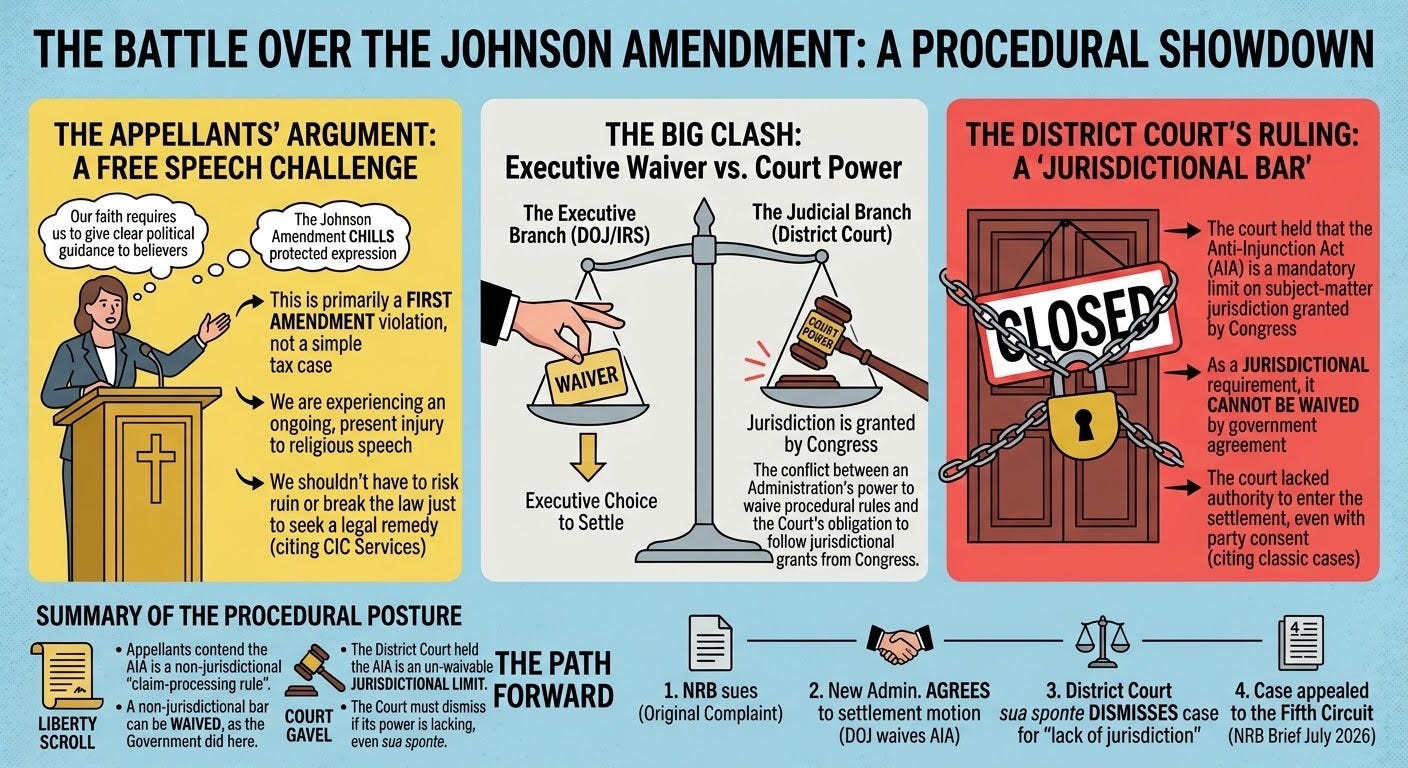
Case: National Relig Brcast v. Bessent, 26-40237, (5th Cir.)
Forget, for just a moment, whether you think a pastor should endorse a politician from the pulpit on Sunday morning. We have argued about that before, and both sides have plenty to say.
That is not what the judges on the federal appeals court are deciding today.
The case of National Religious Broadcasters v. Bessent has arrived at the Fifth Circuit Court of Appeals stripped down to pure legal procedure. The trial judge never even reached the First Amendment. Instead, this lawsuit crashed head-first into a foundational rule of American government: Can the White House team up with a private group in a courtroom to bypass a law passed by Congress?
1. The Backroom Handshake
Here is how the case landed in this bizarre procedural ditch.
In 2024, a group of religious broadcasters and Texas churches sued the federal government over the Johnson Amendment—a 1954 federal statute that says charities and churches lose their tax-exempt status if they campaign for or against political candidates.
Normally, the Department of Justice defends federal laws when someone sues. At first, they did. But when a new administration took office in Washington, the government did an abrupt about-face. Rather than defending the statute, government lawyers walked into court alongside the churches and asked the judge for a consent judgment.
In short, they told the judge:
“We agree with the plaintiffs. Sign this order telling the IRS never to enforce the Johnson Amendment against these churches during Sunday services.”
It looked like an easy win for both sides. The administration wanted to let its friends speak, the churches got what they wanted, and nobody had to fight a long trial.
Then the district judge, J. Campbell Barker, did something extraordinary: he said no.
2. You Cannot Give a Judge Power by Agreement
Judge Barker threw out the entire lawsuit on his own, without the government even asking him to.
Why? Because of a bedrock rule of American law that every first-year law student learns: subject-matter jurisdiction.
Federal judges do not have magic wands. They only have the power that the Constitution and Congress specifically give them. If Congress says a court does not have the power to hear a case, two parties cannot walk into a courtroom, shake hands, and say, “We give you permission to decide this anyway.”
As the Supreme Court has ruled for generations, you cannot create court power out of thin air simply by agreeing to it.
The roadblock in this case is a 160-year-old law called the Anti-Injunction Act (AIA). Congress passed it right after the Civil War to protect the nation’s wallet. It says nobody can bring a lawsuit to block the government from collecting taxes before those taxes are paid. The rule is simple: pay first, sue later. If you think a tax rule is illegal, you pay your taxes, file for a refund, and fight it out in court afterwards.
Judge Barker looked at the consent deal and saw the problem right away:
1. The Johnson Amendment decides whether a church owes taxes or stays tax-exempt.
2. The churches had not paid any tax or lost their exemption yet.
3. Therefore, under the Anti-Injunction Act, federal courts have no legal power to block the IRS ahead of time.
4. Because the court had zero power to hear the case, the government’s “consent” was legally worthless.
3. The Dangerous Playbook: Repealing Laws Without Congress
Why should everyday citizens care about an obscure 1867 tax rule? Because of what happens to the country if the executive branch is allowed to ignore it.
Church-state watchdogs and constitutional scholars raised an immediate alarm: if a presidential administration can simply choose to “waive” the Anti-Injunction Act whenever it dislikes a statute, it discovers a backdoor trick to nullify laws without passing a bill through Congress.
Consider how dangerous this playbook is:
Sneaking Past the Capitol: If a president cannot convince the Senate and the House to repeal the Johnson Amendment, they do not need to. They can simply wait for an ally to sue them, refuse to raise the normal legal defenses, and sign a court settlement that permanently ties the hands of their own agency.
Binding the Future: If a president simply tells his staff, “Don’t enforce this law,” the next president can reverse that memo on day one. But a court-ordered consent decree carries the permanent authority of the federal judiciary. It locks the policy in place for future administrations.
The Death of Separation of Powers: The Constitution gives Congress the power to make laws, the president the duty to enforce them, and judges the power to decide live disputes. It does not give the executive branch the power to pick and choose which Acts of Congress apply by throwing court cases on purpose.
4. The Churches’ Counterpunch: “It’s Just a Rule, Not a Wall”
The lawyers representing the religious groups—Alliance Defending Freedom—appealed Judge Barker’s dismissal to the Fifth Circuit. They make two major legal arguments to salvage their deal:
Argument A: The Tax Law Is a “Traffic Rule,” Not Court Power
They argue that the Supreme Court has gotten much stricter about the word “jurisdiction.” In recent cases like Boechler (2022), the Supreme Court held that a statute only limits a court’s power if Congress says so in plain, unmistakable words.
The Anti-Injunction Act says “no suit… shall be maintained… by any person.” The churches argue that this command speaks to the person filing the lawsuit, not the judge. It is a claim-processing rule—like a deadline—and the government is free to waive procedural rules if it wants to settle.
Argument B: This Is About Free Speech, Not Tax Money
Relying on a 2021 Supreme Court ruling (CIC Services v. IRS), the churches argue that their lawsuit is not really about stopping a tax at all. It is about stopping the government from gagging their sermons.
They argue that any tax penalty is miles away: first a pastor has to speak, then the IRS has to notice, then the IRS has to launch an audit, and then the IRS has to decide whether to revoke tax status or levy a fine. Forcing pastors to break the law and risk their churches just to get into court, they argue, is absurd.
The Showdown at the Fifth Circuit
Strip away the partisan noise, and the Fifth Circuit must untangle three starkly opposed views of the law:
First, is the Anti-Injunction Act a brick wall or an unlocked gate? Judge Barker ruled that it is a hard jurisdictional wall stripping the court of power to touch tax disputes early. The churches and the Department of Justice reply that it is merely an ordinary procedural defense—one the government can decline to use whenever it decides a settlement is in the public interest.
Second, can the executive branch hand power to a judge by signing a private deal? The district court held that the parties cannot invent jurisdiction out of thin air. The churches answer that general federal-question law already gives the court authority, leaving the executive branch free to settle lawsuits however it sees fit.
Third, what is a citizen supposed to do when a law chills their speech? The district court insisted on the traditional tax rule: follow the statutory process, face an audit, pay the bill, and fight for a refund. The churches contend that forcing pastors to break federal law and face financial ruin just to defend their right to preach is an unconstitutional trap.
If the Fifth Circuit upholds Judge Barker’s dismissal, it sends a clear signal to the White House: You cannot dismantle statutes through sweetheart consent decrees. If you want to change the Johnson Amendment, you must march down Pennsylvania Avenue and ask Congress to vote on it.
If the Fifth Circuit reverses and lets the settlement go through, it opens the door to a new era of executive gamesmanship—one where the Department of Justice can selectively dismantle congressional rules simply by choosing which lawsuits it wants to lose.
If you enjoyed this breakdown of the procedural battle over the Johnson Amendment, subscribe to get our next legal dispatch delivered directly to your inbox.
Not legal advice.