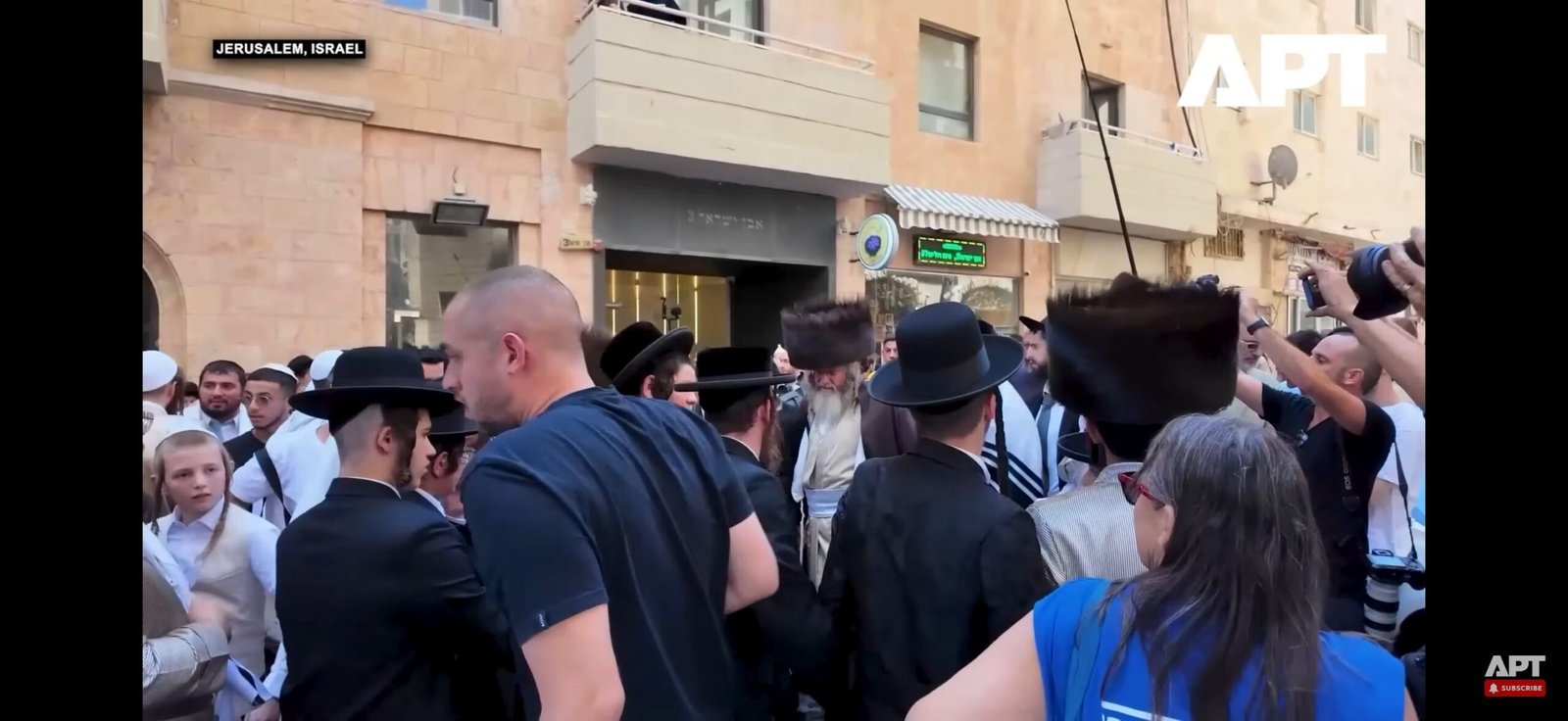
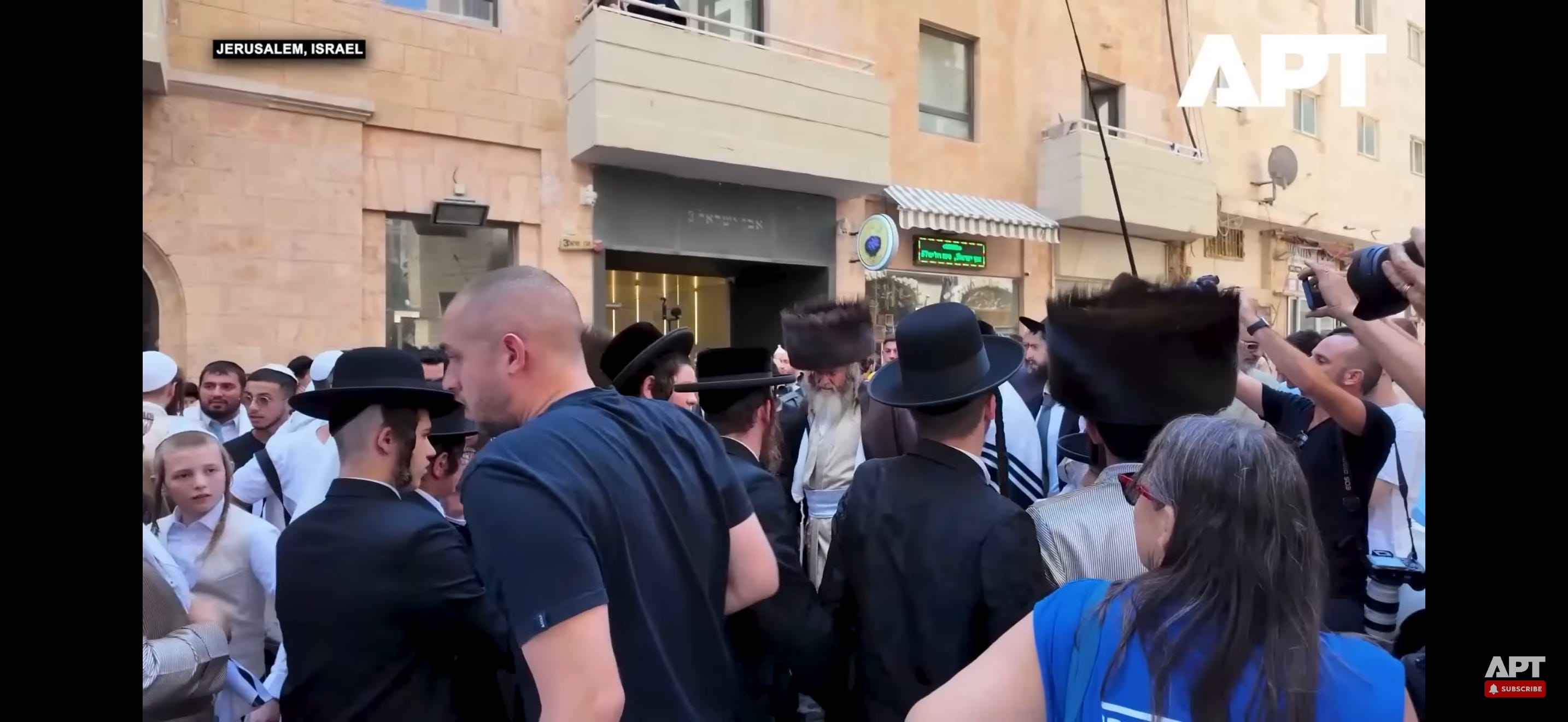
Screenshot from APT News report
On a blisteringly hot Saturday morning in central Jerusalem, a plastic cup of cold brew sits on an outdoor table, sweating in the sun while two dozen police officers form a human barricade around it. Just three feet beyond the blue metal barricades, a cluster of young men in heavy black wool coats lean forward, shouting “Shabbos! Shabbos!” until their faces flush crimson. Inches from their faces, secular counter-protesters blow yellow plastic whistles and chant back: “Titgaysu!”the Hebrew demand for the ultra-Orthodox to enlist in the army. Between these two walls of noise, patrons at Cafe Basimta take cautious sips of espresso, caught in a tiny pocket of contested air.
What appears to be a local dispute over storefront hours in Nahlaot is an open fracture in the capital. The confrontation pits an assertive ultra-Orthodox majority against a secular minority that feels increasingly cornered in its own neighborhoods. With national exemptions from military service threatened by the courts and deep demographic changes altering city hall, this single doorway has turned into a physical test site for which faction dictates public life.
Cafe Basimta opened earlier this year near the Mahane Yehuda market, set right along the informal border separating secular nightlife areas from observant residential blocks. Jerusalem maintains dozens of dining spots open through the weekend, but this particular address sits in plain view of foot traffic traveling to and from synagogue. Tensions multiplied after a religious activist group published documents showing the business has administrative ties to Messianic Jews affiliated with Jews for Jesus. The revelation transformed what began as a protest against Saturday commercial activity into a theological standoff over proselytization.
Inside the glass doors, the atmosphere remains quiet, lined with patrons reading novels or typing on laptops. Outside on the pavement, the scene fractures into street combat. Demonstrators on the religious side attempt to flip over metal seating, banging on the plate glass and throwing objects at the entrance. Secular organizers, organizing quickly through neighborhood group chats, assemble lines of bodies to shield the patrons.
“We leave them alone in their neighborhoods,” said one woman standing in the defense line, holding an iced tea in one hand and a protest placard in the other. “We pay our taxes, we send our children to fight in uniform, and we allow them to live as they choose. They owe us the same space to sit in peace on a Saturday.”
The cafe’s management maintains that the enterprise is rooted in hospitality rather than confrontation. The manager has stated that his faith informs his work ethics, asserting that offering rest and cold drinks serves human needs on the Sabbath. “If people want a spiritual conversation, they can ask,” he explained during a break between shifts. “If they just want an iced latte, they get an iced latte. No one is forced into anything.”
The theological discovery created deep friction among local liberal activists who had rallied around the storefront. Several community associations withdrew their public backing once the Messianic connection surfaced, worried about providing cover for proselytizing groups. Yet hundreds of patrons returned anyway. To them, defending the right of a non-traditional group to operate on a Saturday matters more than personal discomfort with the owners’ theology. If municipal law permits an establishment to stay open, they argue, ideological loyalty tests must not govern who receives police protection.
The weekly clashes reflect the broader strain fracturing the nation. Months of war have made the ultra-Orthodox exemption from the draft a boiling political grievance among the secular middle class. When Haredi youths shout scriptural warnings about Sabbath desecration at secular families on bikes, those families no longer respond with polite silence; they demand to know why those same youths avoid military uniforms.
As midday approaches, the line outside Cafe Basimta stretches around the corner, moving at a crawl. The young men in black hats continue to chant, their voices hoarse against the persistent hum of the espresso machine. The police maintain the barrier, looking at their watches, waiting for sunset to bring an end to another shift on the boundary line of a divided capital.
