The Sisters Are Fighting for Life in Court. Where Are the Rest of the Pulpits?
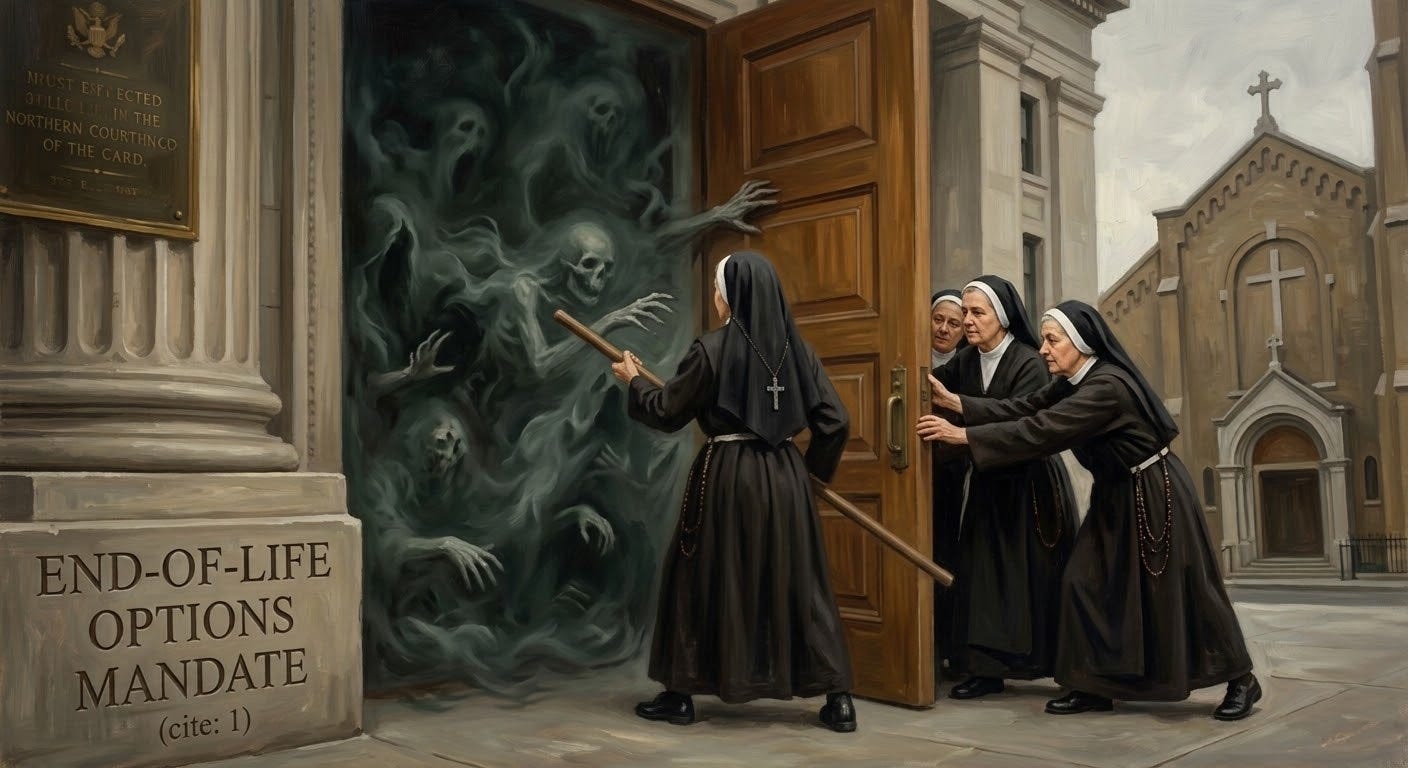
When the state decides to medicalize suicide, it rarely stops at permitting the act. Almost inevitably, the machinery of law turns its gaze toward the unwilling, transforming private choice into state-mandated conscription.
In Illinois, that transformation has arrived in the form of the End-of-Life Options for Terminally Ill Patients Act. Under its provisions, alongside the State’s Health Care Right of Conscience Act, medical providers caring for dying patients face an astonishing government command: present lethal drugs as a treatment option, facilitate the administrative documentation to qualify patients, and provide referrals to willing practitioners if you refuse to participate yourself. To actively dissuade a suffering soul or refuse to speed their journey toward the state’s lethal regime risks professional discipline, heavy fines, and even criminal liability under the guise of preventing “coercion”.
Faced with this bureaucratic overreach, a familiar and steadfast band of caregivers has stepped into federal court. The Carmelite Sisters for the Aged and Infirm and the Little Sisters of the Poor’s orders,whose entire ministry consists of sitting at the bedsides of the destitute and dying, have filed a lawsuit to defend their right to provide authentic, compassionate palliative care. For nearly two centuries, these women have lived by a radical, beautiful creed: to see Christ in the sick, to cure when possible, and always, unfailingly, to comfort. Their hospices do not abandon patients to technological agony, nor do they rush them out of existence. They accompany them into natural death.
Yet the most chilling aspect of this legal confrontation is not merely the overreach of Springfield lawmakers, but the deafening silence from America’s pulpits.
While elderly Catholic nuns head to federal court to prevent their nursing homes from being turned into waystations for state-sanctioned suicide, where are the church leaders of other denominations? Where are the mainline pastors, the evangelical preachers, and the local congregational councils? Where is your church?
Too many churches have cultivated an evasive quietism, mistaking cowardice for pastoral nuance. Desperate to avoid cultural friction or political offense, they treat assisted suicide as a private medical dilemma rather than an urgent moral crisis. They preach broad sermons on human empathy, yet fall mute while their neighbors – the elderly, the disabled, the depressed are subtly told by the state that their lives are expendable burdens whose termination should be rubber-stamped by the medical establishment.
This pastoral absenteeism is an abdication of the deepest spiritual order. To profess love for the vulnerable on Sunday while ignoring statutes that actively endanger their existence on Monday is a hollow faith. When the church stays silent, it does not achieve neutrality. It simply surrenders the moral imagination of the culture to the cold logic of cost-efficiency and therapeutic despair.
The First Amendment does not tolerate a state forcing religious orders to utter words they abhor, nor does it allow the conscription of conscience. But legal victory in a Chicago courtroom cannot substitute for moral clarity in our communities. If the state can compel a nun to facilitate the suicide of an impoverished resident under her roof, no conscience is safe. The Little Sisters and the Carmelites have once again shown what faithful witness looks like. It is past time for the rest of the American church to find its voice.