An Overview of the 4 Religion Cases the Supreme Court Will Hear This Term
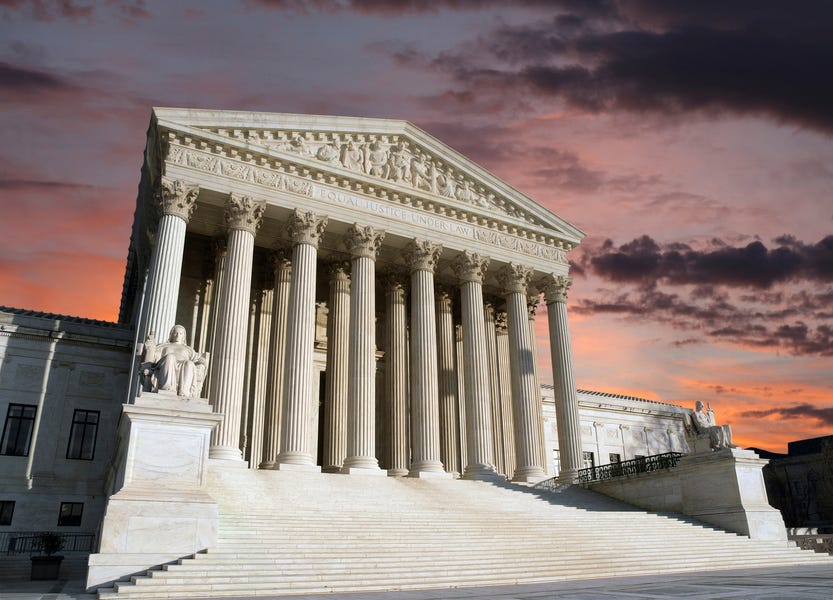
The Supreme Court is slated to hear arguments in four religion cases this year. Most cases involve technical issues of ripeness (is there a case to hear yet?) and standing (can this party bring the case?), and by the time a case reaches the High Court, the fun issues that people will discuss in the hallways and in the press are usually distilled to what many would consider the “boring” technical issues. But those issues matter, and the following is an attempt to simplify them objectively for those who aren’t lawyers but still want to know what the cases are about.
As always, please “like” and “subscribe” and feel free to share this resource with others.
Michael Peabody, Esq.
President,
Founders’ First Freedom
St. Mary Catholic Parish v. Roy (25-581)
https://www.scotusblog.com/cases/st-mary-catholic-parish-v-roy/
Issue the Court Agreed to Hear
Whether proving a lack of general applicability under Employment Division v. Smith requires showing unfettered discretion or categorical exemptions for identical secular conduct; (2) whether Carson v. Makin displaces the rule of Employment Division v. Smith only when the government explicitly excludes religious people and institutions.
Case Summary
Colorado’s universal preschool program bars schools that restrict admission based on sexual orientation or gender identity from receiving state subsidies. The Tenth Circuit held that this equal-opportunity mandate does not violate the Free Exercise Clause. Religious schools argue the mandate forces them to choose between state funding and their theological convictions on marriage and sex. They point out that Colorado allows secular enrollment preferences for low-income and disabled students while rejecting religious exceptions. The state counters that its nondiscrimination standard applies equally to all providers and excludes no one based on religious identity. The Supreme Court granted certiorari to decide whether strict scrutiny applies and whether Employment Division v. Smith remains controlling precedent.
What to Watch For
During the Supreme Court arguments, watch to see whether the conservative justices hone in on Colorado’s system for approving special enrollment requests on a case-by-case basis, or if they decide it is time to take on the broader 1990 legal precedent that currently lets governments enforce general laws that burden religion. Pay close attention to how the justices treat the program’s special carve-outs for low-income children and students with disabilities: if five justices decide that giving an edge to those groups means the state cannot turn around and deny a similar religious accommodation to church-run schools, Colorado’s rules will be struck down on those narrow grounds alone, leaving the larger precedent untouched.
Oral Argument will take place November 3, 2026.
International Partners for Ethical Care, Inc. v. Ferguson (25-890)
https://www.scotusblog.com/cases/international-partners-for-ethical-care-inc-v-ferguson/
Issue the Court Agreed to Hear
Whether parents have standing to challenge a law or policy that deliberately displaces their decisionmaking role as to “gender transitions” of their children, and in so doing creates present and likely future impediments to their ability to parent their children as they deem best for them.
Case Summary
The Ninth Circuit dismissed a constitutional challenge brought by parents and advocacy groups against Washington laws governing runaway youth seeking gender-affirming care. Washington Senate Bill 5599 allows licensed youth shelters to contact state welfare authorities instead of parents when a minor seeks protected healthcare. Five parent couples argued the statutory structure infringes fundamental parental rights, due process, and religious liberty by encouraging minors to leave home and concealing care. The panel held that plaintiffs lack Article III standing since there was not yet a case where this law had been implemented. The court ruled that altered parenting styles represent self-inflicted harm rather than state coercion. Furthermore, the court found the prospect of future injury speculative because no plaintiff showed a runaway minor currently in shelter custody. Petitioners have appealed the threshold dismissal to the Supreme Court.
Petitioners argue that the statutes target non-affirming parents by removing standard 72-hour runaway notification safeguards and treating them like abusive parents. They contend that the statutory framework creates a legal incentive for vulnerable children to leave home, which forces parents to walk on eggshells, censor their speech, and pull back on household discipline. Petitioners assert they have standing under Diamond Alternative Energy v. EPA as the functional objects and targets of the state law, and under Department of Commerce v. New York based on predictable third-party adolescent behavior.
The State argues that the statutes do not regulate parents, punish parental speech, or restrict parents from retrieving their children from shelters. State officials assert that the law merely directs shelters to report runaway youth to child welfare caseworkers, who must attempt good-faith parental contact and provide voluntary reconciliation services. The State contends that Petitioners rely on an eight-step chain of speculative possibilities—from a minor running away to rejecting reconciliation and receiving care—which falls far short of an actual or imminent injury under Lujan v. Defenders of Wildlife and Clapper v. Amnesty International USA.
What to Watch For
Watch how the Justices handle the lower court’s finding that the parents’ injuries were “self-inflicted.” The Court must decide whether parents altering how they speak and discipline their children at home is a normal, predictable reaction to state policy or merely self-imposed worry that does not belong in federal court.
Also pay attention to how the bench responds to Washington’s argument that too many things must happen before any harm occurs. The State argues a child has to identify as transgender, run away, reach a shelter, decline reconciliation, and seek medical referrals; whether the Court views this sequence as far-fetched or common sense will determine the outcome. The Court could use this case to develop a national rule for how parental standing to bring these kinds of cases is established.
Oral Argument will take place December 7, 2026.
Missionaries of Saint John the Baptist, Inc. v. Frederic (25-1131)
https://www.scotusblog.com/cases/missionaries-of-saint-john-the-baptist-inc-v-frederic/
Issue
Whether a land-use regulation that prohibits a religious institution from building a religious structure on its own property constitutes a “substantial burden” on religious exercise under the Substantial Burden Provision of the Religious Land Use and Institutionalized Persons Act.
Case Summary
The petitioner, Missionaries of Saint John the Baptist, Inc., operates Our Lady of Lourdes Church in Park Hills, a suburb of Cincinnati. The church structure dates to 1930 and sits in a residential neighborhood as a grandfathered nonconforming use. To honor its patron, the order sought to build an outdoor stone grotto measuring 16 by 39 feet on an adjacent residential parcel that it initially leased and later purchased. The planned grotto would feature a statue of the Virgin Mary, a plaza, and a walking path, mirroring the Marian shrine at Lourdes, France.
Trouble arose under the Park Hills zoning code. Section 10.4 of the local ordinance permits houses of worship in residential zones only if they sit adjacent to an arterial street. Neither the existing church tract nor the newly acquired residential tract borders an arterial street. The Park Hills Board of Adjustment nevertheless granted a conditional-use permit and setback variances in 2021, finding the grotto would contribute to the community welfare. Neighbors Joel and Elizabeth Frederic filed suit in Kenton County Circuit Court to halt the project, citing concerns about traffic and neighborhood congestion.
The Kentucky state Supreme Court held that local zoning limits did not substantially burden the order’s religious exercise because the priests could build a smaller grotto on existing church land and knew about the zoning restrictions before leasing the adjacent property.
What to Watch For
By granting review on Question 1 while bypassing the Equal Terms Provision, the Supreme Court has set up a clean confrontation over the core statutory test in federal land-use law: what constitutes a “substantial burden” on religious exercise?
The Missionaries have a decent textual case under 42 U.S.C. Section 2000cc-5(7)(B), which includes the building of real property within the definition of religious exercise. The Kentucky Supreme Court’s assertion that the priests could simply build a smaller grotto in the church parking lot directly clashes with the principle that civil courts cannot dictate the size, placement, or architectural adequacy of a religious sanctuary. If the government can avoid RLUIPA scrutiny simply by arguing that an adherent could practice a scaled-down version of their faith elsewhere, the statute’s strict-scrutiny shield loses much of its force.
The neighbors, however, have a defense anchored in local governance and traditional police powers. Zoning codes routinely steer traffic-generating assemblies away from residential interior streets and toward commercial arterial corridors. If every refusal to grant a use variance constitutes an automatic substantial burden, cities could lose the ability to protect residential neighborhoods from expansion projects. Moreover, the argument that a religious entity should not receive a special exemption from zoning restrictions it knew about before acquiring property has resonated with several circuits seeking to prevent land-use speculation under federal cover.
The most difficult hurdle for the church may not be the merits of RLUIPA, but the procedural trap created by state law. If the Supreme Court agrees with the Frederics that the local zoning board had zero statutory discretion under Kentucky Revised Statutes Section 100.247 to approve the shrine, the entire RLUIPA claim could unravel on the ground that no valid “individualized assessment” procedure was ever authorized. How the justices handle that state-law barrier at oral argument will signal whether they intend to issue a landmark statutory precedent or dismiss the case as improvidently granted.
The case will be briefed during the fall and winter, with oral argument expected in early 2027.
Grand v. City of University Heights (25-965)
https://www.scotusblog.com/cases/grand-v-city-of-university-heights/
Issue
Whether the First Amendment’s established chilling-effect doctrine, under which a credible government threat that deters the exercise of fundamental rights constitutes a complete and independently actionable constitutional injury, is displaced by Williamson Cty. Planning v. Hamilton Bank’s land-use finality requirement when a plaintiff alleges that government threats both before and after a Planning Commission meeting chilled religious exercise, worship, and assembly.
Case Summary
Daniel Grand has petitioned the U.S. Supreme Court to review a Sixth Circuit decision that dismissed his religious liberty lawsuit against University Heights, Ohio. The city ordered Grand to cease hosting prayer gatherings with friends in his home unless he secured a commercial house of worship permit. The Sixth Circuit held that his First Amendment and federal statutory claims were unripe because he withdrew his permit application before receiving a final administrative ruling. Grand argues that immediate government threats create an actionable constitutional injury, pointing to a deep split among federal appeals courts over whether property takings finality rules apply to religious exercise claims.
What to Watch For
The threshold question in Grand cuts straight to the functional difference between property rights and religious exercise. Regulatory takings doctrine requires administrative finality because a court cannot calculate an economic taking until it knows the precise extent of the land-use restriction. A property owner’s injury is incomplete until the zoning board issues its final verdict.
First Amendment freedoms operate under entirely different legal mechanics. The Supreme Court has repeatedly affirmed that the loss of First Amendment liberties, even for minimal periods, constitutes irreparable harm. When a city attorney issues an official demand to halt religious prayer under threat of sanctions, the chilling effect is immediate. If a homeowner must spend months navigating adversarial municipal boards simply to pray with neighbors, the regulatory process itself becomes the penalty.
The city offers a fair defense of municipal administrative integrity: local zoning bodies should have the opportunity to clarify ambiguities before facing federal lawsuits. From the municipality’s perspective, permitting processes allow local boards to accommodate unique uses or determine that an ordinance does not apply. If every preliminary warning spawned a federal case, city planning administration could quickly become unworkable.
Yet applying takings finality to home prayer gatherings presents serious constitutional risks. Small, minority religious groups that cannot afford commercial real estate or lengthy administrative proceedings are uniquely vulnerable to delay tactics. If a cease-and-desist order does not count as an injury until an administrative board formally votes, local officials can halt religious activity indefinitely simply by keeping the matter in procedural limbo.
The Supreme Court’s decision on Grand’s petition will indicate whether the justices are willing to clarify the boundary between municipal land use and private home worship.
Oral Argument set for December 9, 2026.