Aprons, Pins, and Precedent: How a Starbucks Coffee Bar Case Explains Everyday Labor Law
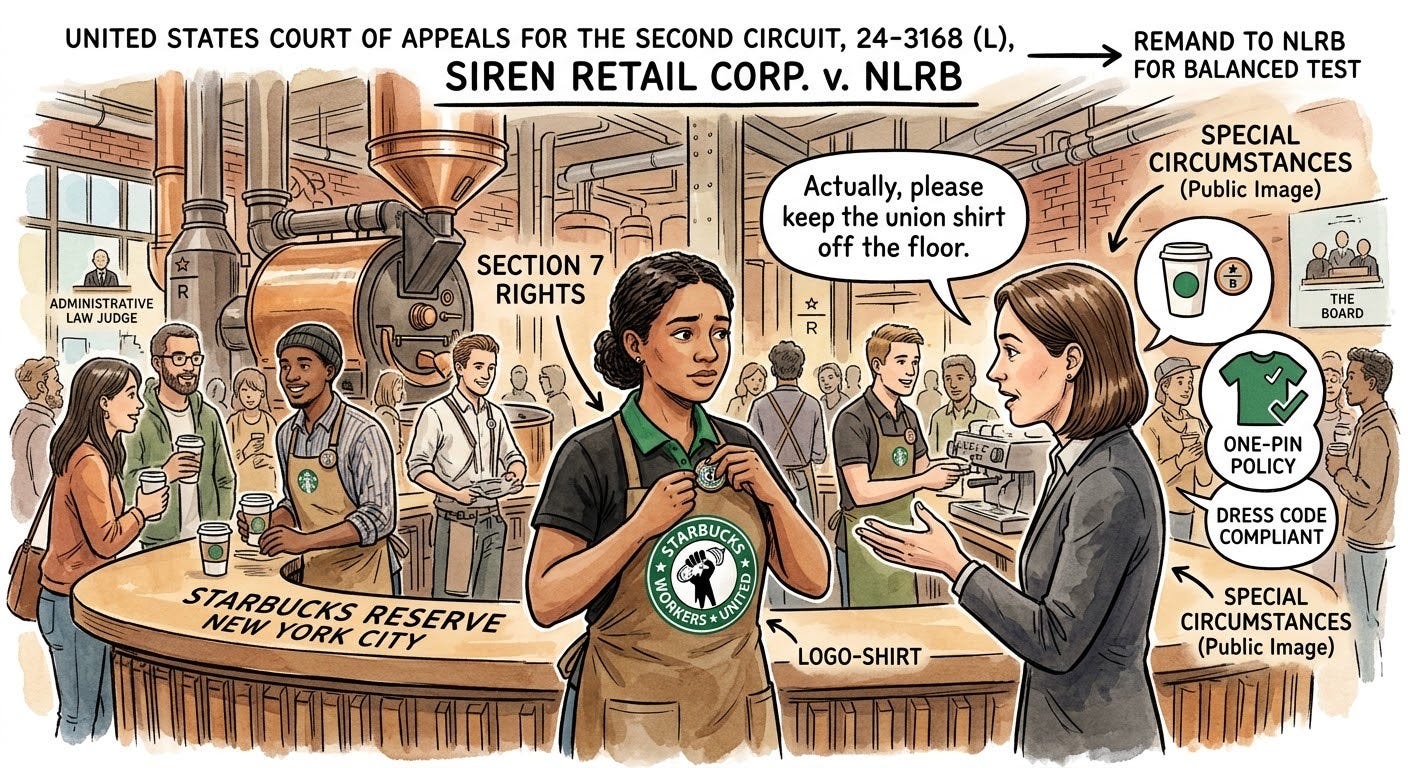
Almost everyone understands the workplace dynamic: an employer wants their brand to look clean and consistent, while workers want the freedom to express themselves and stick together. When those interests clash, the legal system does not simply flip a coin; it uses established principles, historical precedents, and balancing tests to decide where one person’s rights end and another’s begin.
Looking at today’s Second Circuit’s ruling in Siren Retail Corp. v. NLRB (9/02/2026) offers a practical masterclass in labor law. It takes abstract legal doctrines—statutory protections, administrative overreach, and judicial review—and grounds them in a scenario any working person can visualize: a barista being asked to change a t-shirt.
Can your boss tell you what to wear to work, even if what you want to wear shows support for your union?
That is the exact clash at the heart of Siren Retail Corp. v. NLRB, a Second Circuit Court of Appeals case involving a Starbucks Reserve Roastery in New York City.
Here is how the dispute unfolded, why federal labor law cares about t-shirts, and how the court settled the fight.
How the Fight Started
Back in September 2022, workers at the fancy NYC Starbucks Reserve Roastery were in the middle of a national push to negotiate their first union contract. One shift, five to seven baristas came to work wearing black t-shirts sporting the Starbucks Workers United logo over their Starbucks aprons.
The store manager stepped in, told them the shirts violated the employee dress code, and asked them to change. The baristas changed their shirts without a scene and finished their shifts, but their union quickly filed an unfair labor practice charge with the National Labor Relations Board (NLRB).
The union took aim at three Starbucks dress code rules:
* The One-Pin Policy: Employees could only wear one union button or pin on their aprons.
* The Issue-Pin Policy: Employees could not wear pins advocating for political, religious, or personal causes.
* The Logo-Shirt Policy: Shirts could have tiny brand tags, but no other designs, slogans, or writings that Starbucks hadn’t pre-approved.
The Law: Two Competing Rights
To understand why this ended up in a federal appeals court, you have to look at the National Labor Relations Act (NLRA).
Under Section 7 of the Act, workers have a legal right to organize, form unions, and act together for better working conditions. Decades of court history—starting with a famous 1945 Supreme Court case called Republic Aviation—establish that Section 7 includes the right to wear union pins and insignia on the job.
However, that right is not absolute. Employers also have a recognized right to run their businesses, maintain workplace order, and manage their public brand image.
Because both sides have valid rights, the law requires a balancing test:
* Workplace rules that limit union pins are typically scrutinized unless the company shows “special circumstances”—such as protecting customer relationships, preventing worker safety hazards, or avoiding serious damage to the company’s carefully curated public image.
The NLRB Goes Too Far
The NLRB, the federal agency that enforces labor law, decided all three Starbucks policies were illegal.
To get there, the NLRB relied on an aggressive legal rule it created in a 2022 case involving Tesla. Under that Tesla rule, the NLRB basically decided that any employer dress code or uniform policy that restricts union insignia in any way is presumed illegal from the start. To save its dress code, the company had to prove the rule was “narrowly tailored”—a super-strict legal bar usually reserved for high-stakes constitutional rights.
The Second Circuit stepped in and essentially said: Hold on, you’ve tilted the scales way too far.
The court pointed out that Republic Aviation never told regulators to treat standard, everyday uniforms as presumptively unlawful. Real life requires a reasonable compromise between a business owner’s property and branding rights and a worker’s organizing rights—not an automatic penalty against any business that asks workers to wear plain shirts.
What the Court Decided
The Second Circuit handed Starbucks a major win and sent the NLRB back to the drawing board.
The One-Pin Rule Stands: The court upheld Starbucks’ one-pin limit. Back in 2012 (in a case called Starbucks I), the same court had already ruled that allowing one union pin gives employees plenty of opportunity to show union pride, while still protecting Starbucks from having its brand hijacked by dozens of competing messages. The court said that rule still applies here.
The Tesla Test Is Tossed: The court rejected the NLRB’s rigid presumption against dress codes.
A More Balanced Three-Part Test: The court sent the other two policies (the issue pins and the logo shirts) back to the NLRB to re-evaluate under a fairer balancing test. The board must now weigh:
How big is the intrusion? (Is it a total ban on pins everywhere, or just a partial, modest limit during work hours?)
Is the rule neutral and fair? (Is it enforced across the board, or is the employer secretly picking on union shirts while ignoring other graphic tees?)
What is the context? (Does the employer have a legitimate, sensible business or branding reason for the policy?)
The takeaway is that companies are allowed to cultivate a brand aesthetic and require neat uniforms during paid working hours, so long as their rules are neutral and leave workers with a fair, practical way to display their union support.