Capitalism and Religious Liberty: The Case Against Marxism and Theocratic Rule
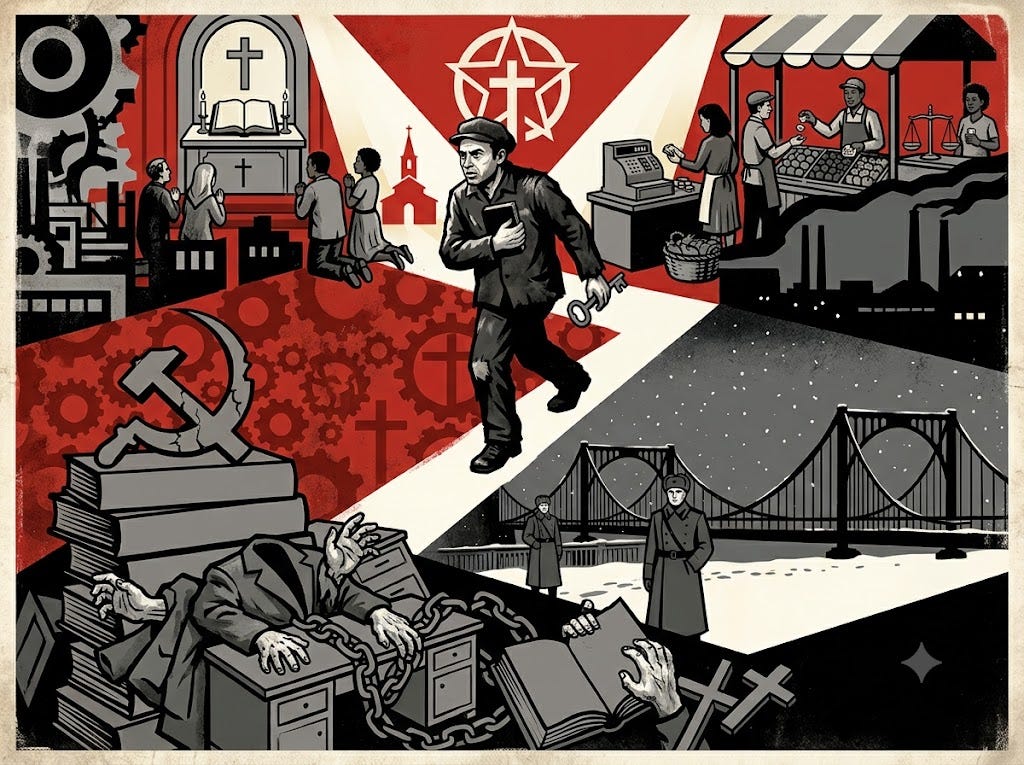
On the morning of February 11, 1986, a Soviet dissident named Natan Sharansky was led out onto the Glienicke Bridge between East and West Berlin, the last piece of business in a Cold War prisoner exchange. He had spent nine years in Soviet prisons and labor camps, much of it in solitary confinement, for the offense of wanting to emigrate as a Jew and speak as a free man. Shortly before his arrest, his wife Avital had given him a small book of Psalms, and over nine years his jailers had taken it from him and handed it back more times than he could count, each time a fresh reminder that the state considered even his prayers a privilege it could grant or withdraw on a whim. On the morning of his release, the guards tried once more to keep the book. Sharansky dropped into the snow and would not take another step until it was returned to him. It was. Then he walked toward the white line marking the border, and the same men who had spent nine years ordering him to walk a straight line gave him one final order to cross it straight, and instead he zigzagged the whole way, because it was the last order they would ever give him, and he meant for the first free steps of his life to belong to no one but himself.
A government that trusts you with a mortgage is a government willing to trust you with your own soul. One that doesn’t trust you with either isn’t a government. It’s a landlord.
Nobody in the Kremlin had planned that small black book into any five-year plan, and nobody could plan it away either. That is what a government built on gray suits never understands about the human conscience, and it is the very thing this country was founded to protect.
People like to put free enterprise and religious faith on opposite ends of a debate stage, as though the cash register and the altar rail belonged to two different countries. I have never believed that. They grew up in the same house.
Here is what I mean. A market economy asks a simple question a thousand times a day: what will you choose? A farmer chooses what to plant. A widow chooses where to bank her savings. A kid with a wrench and a garage decides to build an engine nobody asked for, and once in a while that garage becomes a company, and that company changes the world. No committee in the capital signs off on any of it. That is the whole point of the arrangement.
Free enterprise cannot save anyone’s soul. But it is the only system that has ever left the question open.
Faith asks the same question about the soul instead of the ledger. Will you keep the Sabbath or trade it for a Saturday shift. Will you raise your children in your grandmother’s church or some other way entirely. No bureaucrat can answer that question honestly on your behalf, and the moment one tries, you have left the country of the free and wandered into some other country that only pretends to have your interests at heart.
That is why I have never trusted a system built to put one office in charge of both your wallet and your conscience. History has offered us two versions of that office in living memory, dressed differently, wanting the same thing.
One version wears the gray suit of the party. It tells the farmer what to plant and how much of the harvest belongs to the state, and it tells the widow her savings are the people’s savings now, and it tells the grandmother her church is a museum piece from a superstitious age soon to pass. Mao shut the temples. Moscow’s old guard turned cathedrals into grain warehouses nobody could afford to fill. Havana jailed its pastors and called it public order. Every regime built this way discovers, sooner or later, that a citizen who refuses to let the state plan their harvest is exactly the citizen who will refuse to let it plan their prayers too. The regime is right to fear that. Free enterprise, for all its faults, keeps producing that same stubborn independence by the millions, because someone who signs their own contracts learns early that their judgment is their own to exercise.
The other version wears robes instead of gray suits, and its capital is Tehran rather than Moscow. It tells you the marketplace itself is corruption, that a cleric’s ruling outranks your ballot, your storefront, your daughter’s own choice of what to wear on a Tuesday morning. I want to be precise here, because the trouble was never that someone knelt facing Mecca five times a day, any more than the trouble was that a Russian peasant crossed themselves before supper. Personal devotion has never been the enemy of anyone’s liberty. The trouble starts the moment a government decides it will do the praying for you, enforce it with a morality police unit patrolling the sidewalk, and call the arrangement holy. A police force in religious dress is still a police force. The uniform does not make it scripture.
Free enterprise cannot save anyone’s soul, and I would be the last person to claim otherwise. But it does something a five-year plan and a clerical decree both refuse to do: it leaves the question open. It lets the Baptist and the Buddhist and the neighbor with no religion at all keep their own shops, ring their own registers, and go home to worship however conscience directs, or to skip the whole exercise if that is where conscience lands. A system willing to trust you with a mortgage is a system built by people willing to trust you with your own soul.
The Founders grasped this better than we sometimes credit them for. They built a government too small to run a church and too limited to run a factory floor, on the theory that a citizen fit to sign a contract was fit to choose a creed. Every arrangement since that has tried to hand a single office both jobs, whether that office sits behind a politburo desk or beneath a cleric’s turban, has ended up running a warehouse and a prison instead of the free and generous country it promised on the way in.
We built something else on this continent. A nation of shopkeepers and Sunday services and Saturday markets, none of it planned from a central desk, all of it somehow adding up to the freest, most generous republic this earth has produced. I would not trade it for any regime, gray suited or robed, that has ever offered to do our thinking for us. Keep the ledger open. Keep the altar open. That, in the end, is the whole of the American proposition.