Fauci’s Fifth, the Biden Pardon and the Limits of Silence
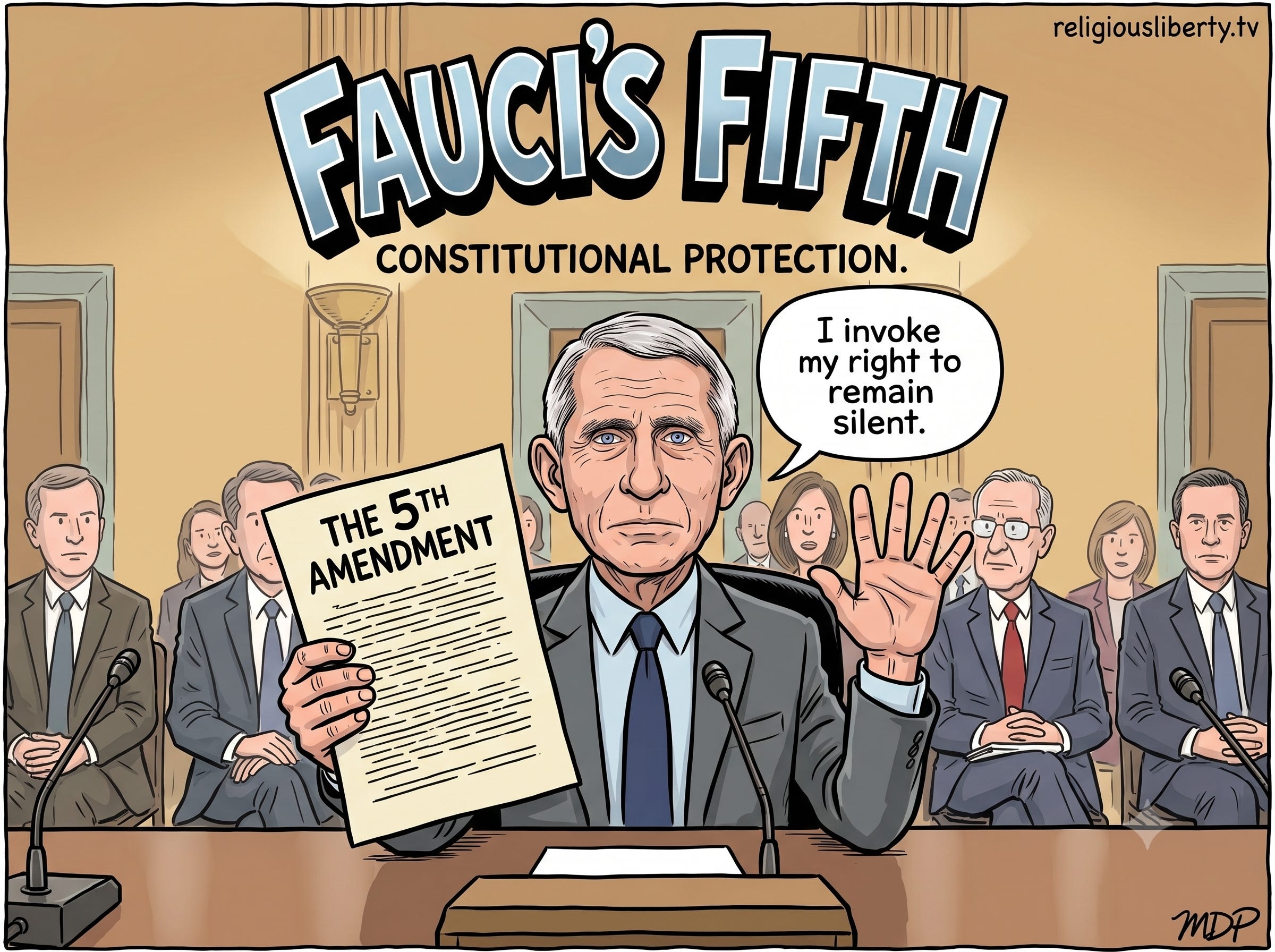
Anthony Fauci was sworn in before the Senate Homeland Security and Governmental Affairs Committee on July 29 and delivered a short opening statement accusing the chairman of an obsession with putting him in prison. Then he read a sentence of 24 words. On the advice of his attorneys, he said, he would invoke his Fifth Amendment right to refrain from answering.1
He repeated it for more than two hours. Published tallies vary, with most counts landing above 100.2 Sen. Rand Paul, R-Ky., who had subpoenaed him and who had days earlier released more than 1,100 pages of Fauci’s pandemic notes, scheduled a committee vote for Aug. 5 on holding him in contempt of Congress.3
The commentary since has been unhelpful in the usual way. One camp treats the invocation as a confession. The other treats it as a settled constitutional entitlement immune from criticism. Both are wrong, and the reasons why go back further than the pandemic.
Where the right came from
John Lilburne stood before the Court of Star Chamber in 1637 and refused to swear.
He had been arrested for importing unlicensed Puritan pamphlets. The court did not charge him. It asked him to take the oath ex officio, an oath binding him to answer truthfully any question the court chose to ask, on any subject, known or unknown to him at the moment he swore.4 He declined. On Feb. 13, 1638, the court fined him 500 pounds and ordered him whipped, pilloried and imprisoned until he complied.5
The oath was a machine built for one purpose. A man under it faced three doors. He could lie and damn himself. He could stay silent and be punished for contempt. He could tell the truth and hang. Ecclesiastical courts had used the device for centuries against heretics, and the Crown adapted it for political dissent. Lilburne’s answer became the sentence that echoes through American law: no man’s conscience ought to be racked by oaths imposed.
Parliament abolished the Star Chamber in 1641 and later declared Lilburne’s punishment illegal. Six states wrote the privilege into their constitutions after the Revolution, and Madison carried it into the Bill of Rights.6 The Supreme Court retold this history at length in Miranda v. Arizona.7
What invoking it does and does not prove
The clause is fourteen words. No person shall be compelled in any criminal case to be a witness against himself. It binds the states through the Fourteenth Amendment.8
Three rules govern the popular misunderstanding.
First, the privilege must be claimed. It generally does not execute itself, and a witness who simply goes quiet outside custody may find that silence used against him.9 Fauci’s counsel understood this, which is why he said the words out loud, on the record, question after question.
Second, in a criminal trial the prosecution may not comment on a defendant’s refusal to testify, and the judge may not invite the jury to hold it against him. Griffin v. California settled that in 1965.10 A defendant who asks is entitled to an instruction telling the jury to draw no inference at all.11
Third, and most often forgotten, the Supreme Court has said flatly that the privilege protects the innocent as well as the guilty. One of its basic functions is to protect innocent men who might otherwise be ensnared by ambiguous circumstances.12 Truthful answers from an honest witness hand the government usable material just as efficiently as answers from a wrongdoer.
That is the general rule. Now the complication.
The pardon problem
The Fifth Amendment tracks the risk of prosecution rather than the risk of embarrassment. Remove the prosecution risk and the constitutional basis for silence goes with it. The Supreme Court held exactly that in Brown v. Walker in 1896, and the holding is the foundation of the modern practice of compelling testimony through immunity grants.13
Joe Biden issued Fauci a preemptive pardon on Jan. 20, 2025, covering federal offenses arising from his government service over roughly an eleven-year window.14 Sen. Josh Hawley, R-Mo., cited Brown at the hearing and told Fauci he had no Fifth Amendment rights left as to pardoned conduct.15
On the pardoned window, that argument has real force. Gain-of-function funding decisions, the EcoHealth Alliance grants, prior sworn statements to Congress before January 2025: if federal prosecution for those is genuinely foreclosed, the privilege as to them is thin.
Fauci’s side has answers, and they are not frivolous.
A presidential pardon reaches federal offenses only. It does not touch state prosecution, and Florida’s attorney general has announced an inquiry into whether state charges are available.16 A witness in a federal proceeding may invoke the privilege based on exposure under state law.17 The pardon also ends on its issuance date and does nothing about conduct afterward. And courts extend broad deference to invocations, requiring only reasonable cause to apprehend danger rather than proof of it.18
The weakest link in the public rationale is the perjury-trap framing. Fear that you might commit perjury in the testimony you are about to give is not a valid basis for the privilege. The Fifth Amendment confers no right to lie.19 If the real concern is that truthful answers today would contradict earlier sworn statements, and those earlier statements fall inside the pardon window, the exposure is harder to locate than the framing suggests.
There is also a live waiver question. Paul argued that delivering a substantive opening statement waived the privilege as to the subjects addressed. A witness who testifies to a matter can waive as to its details.20 Whether a general attack on the chairman’s motives counts as testimony on the merits is a question for a court.
Which is the point. These are judicial questions with judicial answers. Congress has two clean paths. It can seek an order from a federal court compelling testimony. Or it can grant use immunity under the federal immunity statutes, which would eliminate the remaining exposure and leave Fauci with no ground to stand on.21 Contempt referral under 2 U.S.C. § 192 is the third path and the least likely to produce information.
One more asymmetry deserves mention. The bar on adverse inference lives in criminal trials. In civil litigation the opposite is true, and a factfinder may draw an adverse inference from a party’s invocation.22 Fauci faces civil exposure that the pardon does not touch. That alone is a rational reason to say nothing.
The reversal test
Here is where the analysis usually stops being legal and starts being tribal.
In September 2016, a presidential candidate told a crowd that the mob takes the Fifth, and asked why an innocent person would do the same. In August 2022, that candidate sat for a deposition with the New York attorney general and invoked the Fifth more than 440 times, explaining in a written statement that he now knew the answer to his own question.23
The lesson available in that sequence is not partisan. It is that the value of the privilege becomes visible at precisely the moment it protects you, and invisible the rest of the time. Members of both parties have praised invocations by their own witnesses and treated invocations by the other side as admissions, often in the same congressional term.
Congress has legitimate authority to investigate and legitimate tools to compel. Use the tools. Get the court order. Grant the immunity. What Congress may not do, and what no committee chairman should want on the record as precedent, is establish by public inference the proposition the Star Chamber established by oath: that a man’s refusal to accuse himself is itself the accusation.
Lilburne worked that out under the whip. The rest of us get it for free, which may explain how casually we spend it.
Ex Officio Oath and the Privilege Against Self-Incrimination, Cornell Legal Info. Inst., Historical Background on Self-Incrimination; see also Mary Hume Maguire, Attack of the Common Lawyers on the Oath Ex Officio as Administered in the Ecclesiastical Courts in England, in Essays in History and Political Theory in Honor of Charles Howard McIlwain 199 (C. Wittke ed., 1936). ↩
The Star Chamber sentenced Lilburne on Feb. 13, 1638. He was flogged on April 18, 1639. Parliament later declared the punishment illegal and voted him reparations. ↩
Leonard W. Levy, Origins of the Fifth Amendment: The Right Against Self-Incrimination (1968). ↩
Massachusetts, New Hampshire, North Carolina, Pennsylvania, Vermont and Virginia embodied the privilege in their constitutions before ratification. Madison’s draft read “nor shall be compelled to be a witness against himself.” A House amendment inserted “in any criminal case.” ↩
Miranda v. Arizona, 384 U.S. 436, 458-59 (1966). ↩
Malloy v. Hogan, 378 U.S. 1 (1964). ↩
Hoffman v. United States, 341 U.S. 479, 486-87 (1951). ↩
Salinas v. Texas, 570 U.S. 178, 181-86 (2013) (plurality opinion). ↩
Griffin v. California, 380 U.S. 609, 614 (1965). ↩
Carter v. Kentucky, 450 U.S. 288 (1981). ↩
Ohio v. Reiner, 532 U.S. 17, 18 (2001) (per curiam). ↩
Id. at 21 (quoting Grunewald v. United States, 353 U.S. 391, 421 (1957), quoting Slochower v. Bd. of Higher Educ., 350 U.S. 551, 557-58 (1956)). ↩
Baxter v. Palmigiano, 425 U.S. 308, 318 (1976). ↩
Slochower v. Bd. of Higher Educ., 350 U.S. 551 (1956). ↩
Garrity v. New Jersey, 385 U.S. 493 (1967); see also Lefkowitz v. Turley, 414 U.S. 70 (1973). ↩
Braswell v. United States, 487 U.S. 99, 105 (1988). ↩
Fisher v. United States, 425 U.S. 391 (1976). ↩
Kastigar v. United States, 406 U.S. 441 (1972). ↩