John Quincy Adams, Abraham Lincoln and an Argument Neither Man Lived to See Settled
By Michael Peabody
Every American schoolchild used to learn how John Quincy Adams died, back when schools still taught that kind of thing. Most of what they were taught turned out to be true, which is rarer than it should be with history.
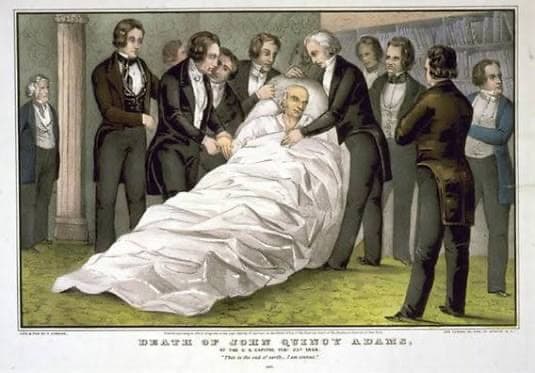
Feb. 21, 1848. The House of Representatives was voting to award ceremonial swords to the generals who had won the Mexican War. Adams thought that war was a land grab dressed up as patriotism, a scheme to drag slavery west under a flag he’d worn as ambassador, secretary of state and president. When his turn came in the roll call, he said “No,” and then he fell out of his chair.
They got him to the Rotunda first, for air, and from there to a small room off the floor that the Speaker used for naps and paperwork. He never fully woke up again, though he came to long enough, by several accounts, to thank the officers of the House for their care. What he actually said as he was dying is disputed, because that is what happens once everyone in the room starts telling the story afterward. One version has him saying, “This is the last of earth. I am content.” Another has him saying something close but not identical: “This is the end of earth, but I am composed.” Adams had kept a diary for 68 years and filled more than 15,000 pages of it. It seems fitting, somehow, that his very last sentence is the one nobody can agree on.
He died two days later, on the evening of Feb. 23. Congress buried him the way it buried presidents then, with a funeral in the House chamber and a procession out to the Congressional Burying Ground. On the committee that arranged it sat a freshman congressman from Illinois that almost nobody in Washington had bothered to notice yet: Abraham Lincoln, serving what would turn out to be his only term in the House, one that ended quietly in 1849.
What ties these two men together isn’t the funeral. It’s the fight Adams had been carrying for 20 years before Lincoln ever got there. Adams spent much of his time in Congress fighting the gag rule, the standing order that let the House throw out antislavery petitions without so much as reading them, and he kept at it from 1836 until the rule finally fell in 1844. In 1841 he stood before the Supreme Court and won freedom for the African men and women who had taken over the slave ship Amistad. None of it settled the underlying argument. It just kept the argument alive long enough for someone else to pick it up.
Lincoln picked it up, though not right away, and not as an abolitionist. His one term in the House is mostly remembered for the Spot Resolutions, a set of demands to know exactly where, on Mexican or American soil, the first shots of that war had actually been fired, a question that annoyed nearly everyone and answered nothing. It took the 1850s, the death of the Whig Party, the Kansas-Nebraska Act and a set of debates against Stephen Douglas to turn that obscure former congressman into the man who ran for president in 1860 on the promise that slavery would spread no further.
Then came the war, and Lincoln discovered, as most people who make promises eventually do, that keeping this one would cost more than he’d planned. The Emancipation Proclamation, effective Jan. 1, 1863, freed enslaved people only in the states still fighting the Union, which is a strange kind of freedom document if you stop to think about it. It took effect exactly where the government had no power to enforce it, and did nothing at all in the loyal slave states, where the government had plenty. It was a war measure, not a cure, and Lincoln knew it. He spent his last year alive pushing a constitutional amendment through a House that did not want to give him one. On Jan. 31, 1865, it passed anyway, 119 to 56, two votes past the two-thirds it needed. Lincoln signed it the next day. He was shot six weeks later and died without ever seeing it ratified. The states finished the job that December. Georgia cast the vote that put it over the top, eight months after Lincoln was in his grave.
Adams never saw the country come apart over the fight he started. Lincoln never saw it come back together, or the amendment that gave his war a reason. Between the two of them the argument outlived everyone who carried it, which might be the only honest thing left to say about freedom in this country: the people who fight hardest for it rarely get to see it finished.