Must Be the Money: The Financial Drive Behind Most Religious Persecution
By Michael Peabody –
We tend to think that persecution is normally about differences in theology or ideology. It is a more elevating subject than money, and it lets everybody keep their dignity: the inquisitor gets a conviction, the martyr gets a crown, and the rest of us get a morality play performed at a safe altitude, up where the ideas live and nobody has to smell anything.
Then you go into the archives. The archives are a knife fight in the parking lot behind a bank. But like the saying goes, you’ve got to follow the money.
Trace almost any campaign against a religious minority back to its opening move and you will find somebody with a ledger who has just worked out that “stamping out heresy” is a cheaper remedy than competition. The believers in these stories were in earnest about heaven. Their accusers were in earnest about the receipts.
The dove concession
Start where the story starts, in the week that ends at Golgotha.
Picture the temple courts at Passover. Tens of thousands of pilgrims, dust in the colonnades, animals complaining, the smell of blood and incense and money. A man walks in and puts the tables on the ground.
The trade he wrecked was legal, licensed and extremely profitable. Every Jewish man owed the annual half-shekel, and the temple preferred to be paid in a Tyrian coin stamped with the head of a Phoenician god, on the wonderfully practical ground that its silver ran purer. Read that again. The holiest treasury on earth took its revenue in the currency of a pagan deity because the money was good. Piety required an exchange. An exchange required a rate. The rate belonged to somebody.
Then there were the doves. Doves were the offering of the poor, the sacrifice you brought when a lamb was out of reach. A widow saved for that bird. Vendors sold them in the courts, and the birds sold in the courts cleared inspection with a reliability that birds carried in from the countryside somehow never achieved. The system had a gift for finding the coins of people who had almost none.
He cleared it out in an afternoon. Mark tells you what happened next in a single sentence. The chief priests and the scribes heard about it and started looking for a way to kill him.
Then read the charges. The council said blasphemy. Pilate heard sedition. Both indictments leave out the tables. Theology showed up after the decision, the way a prosecutor assembles a theory once the target has been picked. And the same account hands you the other half of the argument. One man in that story had a price. Thirty pieces of silver, weighed out by the officials who ran the concession. Judas had a number. The man he sold did not.
Silversmiths and screaming
Twenty years later in Ephesus, a silversmith named Demetrius called a meeting of the men who made souvenir shrines of Artemis for the pilgrim trade. Some preacher had been going around saying that handmade gods are no gods. Demetrius laid out his agenda in strict order of importance. Item one: the craft is in danger. Item two: also, come to think of it, the temple of the great goddess might be despised. The mob took item two into the theater and screamed it for two hours, which is a long time to scream anything. Item one is why they were standing there.
Philippi is the same transaction in miniature. Paul freed an enslaved girl whose fortune-telling paid her owners’ bills, and her owners had him stripped, beaten and jailed for promoting customs unlawful for Romans to observe. Their complaint runs to several charges. Lost revenue appears in none of them.
Rome filed the identical report from the other side of the desk. Around the year 112, Pliny the Younger wrote to Trajan asking how to handle the Christians in his province, described executing the ones who would not recant, and then turned to results with the quiet pride of a regional manager. The temples were filling up again. The rites had resumed. There was a market once more for sacrificial animals, which had lately gone begging for buyers. Pliny believed he was defending the gods. He measured it in livestock.
The debtor’s remedy
Medieval Europe ran the racket through credit. The church forbade Christians to lend at interest. The trade fell to the Jews because somebody had to do it. The trade then became the proof of Jewish wickedness, which is the kind of logic that only ever runs in one direction.
English kings taxed that community to the bone. Edward I banned Jewish lending in 1275, which killed the livelihood and left every debt owed to it standing upright and collectible. In 1290 he expelled every Jew in England and gave them until All Saints’ Day to get out. The debts fell in to the Crown. Parliament, that same season, voted him one of the fattest tax grants of the century. Say what you like about medieval kingship. The accounting was superb.
Philip IV of France read the English precedent and improved on it. He robbed and expelled his own Jews in 1306. The following year he sent sealed orders to officers across the kingdom with instructions to open them on the same morning, and on Oct. 13, 1307, the Knights Templar were arrested in every commandery in France before breakfast. The Templars ran what amounted to an international bank. Philip was their largest debtor. The charges: heresy, idolatry, spitting on the cross, the whole standard menu. Torture produced confessions. Confessions produced fires. Jacques de Molay took his confession back and burned for it in Paris in 1314, an old man on a scaffold in the middle of the Seine. The order’s estates passed to the Knights Hospitaller, less a substantial deduction for Philip’s costs in prosecuting the case. He billed them for the fire.
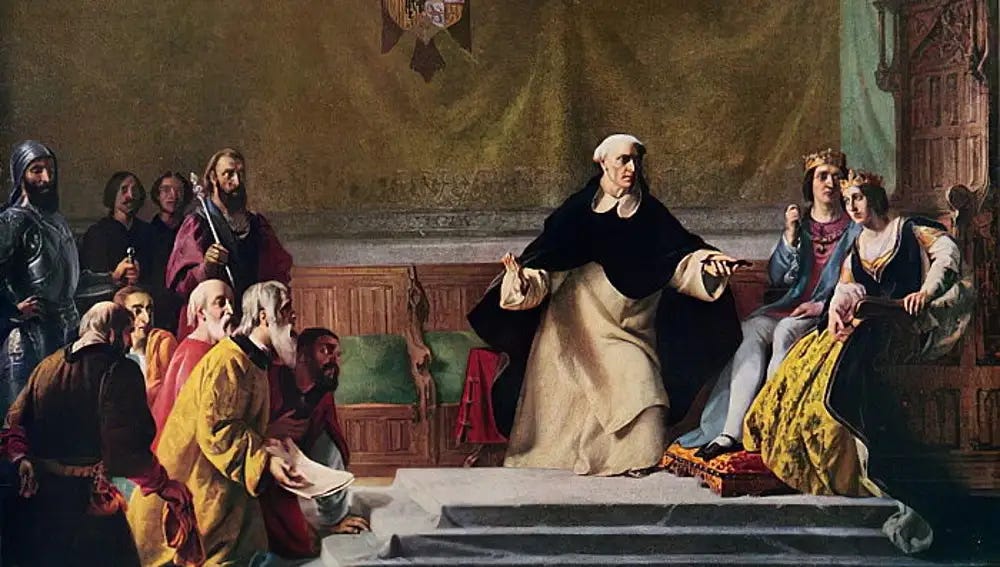
Spain industrialized the thing. The tribunals of the Inquisition drew part of their funding from the confiscated property of the condemned, an arrangement that gave the Holy Office a permanent institutional interest in discovering that prosperous men were heretics. Guess what it discovered. The early defendants were overwhelmingly conversos, Jews who had converted under duress and their children, who happened also to be merchants, physicians and royal officials.
England left the cleanest paper trail in Europe. In 1535 Thomas Cromwell sent commissioners out to value the income of every religious house in the kingdom, down to the rents and the silver plate. The reports on monastic vice arrived afterward. So did the theology. Within five years the Crown held the land and was selling it to gentlemen whose loyalty to the new religious settlement came bundled with the deeds. Faith was reformed. The property moved. Ask which one moved first.
Toleration while it paid
Run the film backward and the thesis survives. Louis XIV put up with his Protestants far longer than his theology can account for, in large part because Jean-Baptiste Colbert, his finance minister, knew perfectly well that Huguenot weavers, shipwrights and merchants were carrying a serious share of French manufacturing. Usefulness bought them years. It bought them nothing permanent. The king revoked the Edict of Nantes in 1685, and 150,000 to 200,000 Huguenots walked out of France carrying the one asset the state could not seize, which was what they knew how to do. Brandenburg had land and tax relief waiting inside of a month. Amsterdam and London took the rest. France bought uniformity and paid for it with a generation of industrial capacity, the most expensive purchase in the history of French piety.
Real estate and the Sabbath
America ran the same play in a lower key. Mormon settlers in Missouri in the 1830s held strange doctrines, and they also bought land in quantity, voted as a bloc and traded among themselves in ways that shut their neighbors out of their own economy. Gov. Lilburn Boggs signed an order in October 1838 directing that they be driven from the state or exterminated. Exterminated. That is the word in the document. The doctrines survived the trip to Illinois. The farms stayed behind.
Fifty years later Congress wrote the mechanism into a statute and made no attempt to disguise it. The Edmunds-Tucker Act of 1887 dissolved the corporation of the Church of Jesus Christ of Latter-day Saints and escheated everything it held above $50,000 to the United States. Escheat is the rule that hands property to the state when it has no lawful owner, and Congress produced that condition by announcing it. The Supreme Court blessed the arrangement in 1890. Think what you like about plural marriage. Then look at the remedy. They prosecuted the practice and took the buildings.
The competitor version is quieter, far more common, and it wears a badge. Through the late 1880s and 1890s, Seventh-day Adventist farmers and tradesmen in Tennessee, Arkansas and Georgia were indicted under Sunday closing laws for working on the first day of the week after resting on the seventh. R.M. King of Obion County, Tennessee, was convicted for plowing his own field, on his own land, where the only person who could hear him was a neighbor who went looking for the sound. Adventists in Rhea County went to the chain gang for farm work done in their own fields.
Now read the complaints. The Lord’s Day starts to look thin. Merchants who closed on Sunday resented neighbors who closed on Saturday and then worked while they rested. A rival Sabbath is a competitive advantage. The criminal law was sitting right there, and it came cheaper than lowering prices.
The bill comes due in dollars
The instruments got bigger. China has justified its campaign against Uyghur Muslims almost entirely in the language of counterterrorism, and the camps have come with labor transfer programs that moved detainees and their neighbors into cotton fields and factories that feed supply chains belonging to brands you have heard of. A persecution that produces a workforce develops an interest in continuing. That interest has nothing whatever to do with God.
In America the sanction is financial and it arrives in an envelope. Adell Sherbert lost her job at a South Carolina textile mill in 1959 when the plant went to six days and she would not work Saturday. The state denied her unemployment compensation on the ground that she had refused suitable work. Picture the arithmetic on that kitchen table. A mill wage, a conscience, and a letter from the state explaining that the conscience was her own problem. The Supreme Court ruled for her in 1963, on the understanding that a benefit withheld can coerce as thoroughly as a fine imposed. Sixty years later the court took up a mail carrier in Pennsylvania who would not deliver on Sunday, in a case that existed at all because the Postal Service had signed a contract to move Amazon packages on the Lord’s Day. The Sabbath question of 2023 arrived by way of a logistics agreement.
The accusation as confession
Now notice what the accusations have in common. Jewish lenders were charged with avarice by kings who owed them money. The Templars were charged with corruption by their principal debtor. The monasteries were charged with luxury by a Crown that wanted the rents. Mormon settlers were charged with grasping after land by neighbors who ended the decade holding the land. Adventist farmers were charged with taking unfair advantage by competitors who borrowed the sheriff to settle a business dispute. Whoever moves first on the money will nearly always accuse the other party of loving money. It is the most reliable tell in the entire record, and it has never gone out of fashion.
Before anybody gets comfortable, the reflex is alive and thriving inside religious institutions, right down to the ones wearing the nice suits at the annual session. Anyone who has sat through a denominational committee meeting from almost any religious tradition knows exactly where the wire is buried. A member can hold peculiar views on prophecy, worship, the age of the earth, or sexuality and the machinery will idle along without much curiosity. Let that same member ask to see an audit. Let them propose that offerings travel by some other channel. Then watch the room. Committees convene. Letters go out. Credentials come up for review. Almost anything will pass. The treasury is the third rail, and every officer in the building knows precisely where it runs.
True as the needle to the pole
Here is where the argument turns, and it turns on something older than economics.
The people worth persecuting on these terms are the people the terms cannot reach. A believer with a price would have been bought years before anyone drafted an indictment, quietly, at a discount, with no fuss and no fire. Fines, license denials, lost shifts, withheld benefits: every one of those instruments is addressed to a person who calculates. Sherbert was offered a straightforward trade and refused it at the cost of her wages. King went to court over a field he could have left unplowed.
The reason is old and simple. You cannot buy what has already been purchased. Paul told the Corinthians they had been bought at a price and that the transaction was closed, and a soul acquired at that valuation is off the market for good. Every persecutor in this essay was making an offer. Every believer who held the line had already been sold.
Ellen White set the standard in a sentence Adventist schoolchildren have recited for more than a century. The greatest want of the world, she wrote in 1903, is the want of “men who will not be bought or sold; men who in their inmost souls are true and honest; men who do not fear to call sin by its right name; men whose conscience is as true to duty as the needle to the pole; men who will stand for the right though the heavens fall.”
The needle is a compass needle, and the figure is exact. A compass is a fragile instrument. You can crush one under a boot in about a second. What you cannot do, at any price, is talk it into pointing somewhere else.
This is even more true when it comes to the final test, the Mark of the Beast in Revelation 13:16-17. On one side, you’ve got people who think only in terms of money – they’re sure that people will change their minds when the financial pressure is increased. They think that people will surrender their inmost convictions if they’re forced to choose between their beliefs and their wallets. After all, money is the measure of everything – taking money away is the modern form of punishment, giving money is the modern form of award. But those who stand firm on their convictions during that time aren’t phased by money. They can’t be bought or sold. So then the threat moves on to the last thing that can be taken away – their lives. This has been the pattern of persecution throughout history.
The duller instruments
Which leaves a test for anyone watching a campaign against a religious community take shape, and you can run it at home. The stated reason in all the rhetoric will be lofty, general and sincere. The beneficiaries will be specific, local and easy to name if you are willing to look. Ask who collects.
In America the answer will seldom involve a confiscated abbey. It will involve a zoning variance. An occupational license. An accreditation standard. A tax exemption. A contract renewal. A shift schedule. These instruments are typically boring, with the added advantage that nobody writes poetry about a denied permit and no one lights a candle for the woman who lost her shift on a Friday afternoon in Modesto. But persecution announces itself first in somebody’s revenue projections. That’s why we pay attention.