Parents Beware: Arizona High Court Gives Churches Blanket Immunity in Abuse Case
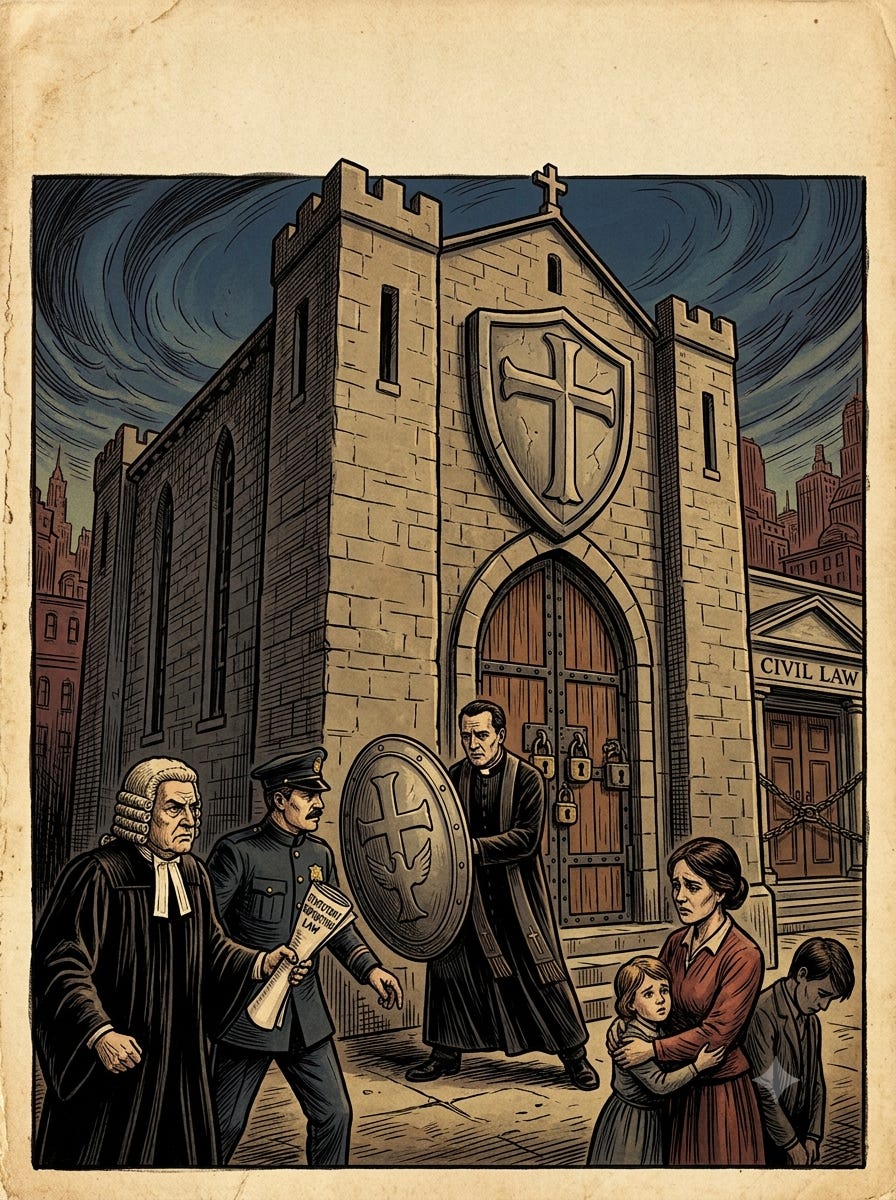
You’ve probably heard the bromide that a church isn’t an institution, but rather the people that compose it. That’s true to the extent that the rights of the “people” in that church don’t conflict with the institution itself, in which case the institution must prevail in order for there to be what’s called “religious freedom.”
With that backdrop:
In what will likely be called a “victory” for religious institutions, the Arizona Supreme Court handed religious institutions a golden shield against secular child abuse reporting laws. The First Amendment explicitly blocks civil courts from enforcing mandatory reporting mandates against clergy if silence is demanded by church doctrine.
Religious leaders who intercept confessions or confidential communications can legally bury the truth if their faith deems it necessary. Typically this was considered in priestly confessionals, but in this case it extended to church council meetings.
The ruling severely limits judicial scrutiny over the statutory clergy exemption. Secular courts cannot question a church’s internal definition of what constitutes a protected religious communication absent overt secular fraud. For abuse victims, the courtroom doors are slammed shut if the church stamps the file “confidential.” Defense counsel everywhere should take note: ecclesiastical autonomy remains an impregnable fortress against civil liability.
Case Info:
Caption: Jane Doe I, Jane Doe II, and John Doe v. The Corporation of the President of The Church of Jesus Christ of Latter-day Saints, et al.
Date: July 30, 2026
Decision: Opinion – CV-25-0213.pdf
The Arizona Supreme Court holds that the First Amendment categorically prohibits factfinders from inquiring into a clergy member’s application of internal religious doctrine regarding the mandatory reporting of child abuse. Clergy members are permitted to conceal confessions and confidential communications if they independently determine secrecy is reasonable and necessary under their faith. The ruling prohibits civil courts from questioning a church’s definition of clergy, confession, or confidential communication absent explicit fraud.
This case cements the absolute supremacy of religious autonomy over secular state mandates designed to protect the vulnerable. It proves that within the modern judicial machinery, the First Amendment’s Free Exercise Clause operates as an unyielding trump card against statutory civil liability, establishing a definitive precedent for institutional accountability.
How does this ruling impact the Application of Mandatory Reporting Laws?
This ruling violently neuters the application of state child abuse reporting laws against religious leaders, prioritizing the Free Exercise Clause over the state’s mandate whenever a church classifies ecclesiastical proceedings as confidential.
Facts of the Case:
Around 2011: Paul met privately with Bishop John Herrod and admitted to sexually abusing one of his children.
Shortly thereafter: Bishop Herrod held a second meeting with Paul and his wife Leizza, where Paul once again admitted the abuse.
In 2012: Bishop Robert “Kim” Mauzy replaced Bishop Herrod as the bishop of the Bisbee Ward, and Herrod informed Mauzy of Paul’s admissions.
2012 Disciplinary Action: Bishop Mauzy convened a formal disciplinary council where Paul admitted his horrific abuse to several church members serving on the council.
Following the disclosures: Bishop Mauzy excommunicated Paul from the Church, yet the abuse was never reported to authorities.
In 2017: The Department of Homeland Security unearthed a video of Paul’s abuse online, resulting in federal indictments for both Paul and Leizza.
Pre-trial: Paul confessed his abuse to law enforcement but took the coward’s way out, committing suicide in jail prior to trial.
What are the arguments presented by the Does and the Church Defendants?
The Does argued that the sheer presence of non-clergy members at the disciplinary council vaporized any vestige of clergy-penitent privilege. Because of this supposed waiver, the plaintiffs insisted the church leaders were legally bound to report the abuse to authorities under Arizona’s mandatory reporting statute.
The Church Defendants countered with cold, institutional efficiency: Paul’s admissions were confidential communications and confessions received squarely in the Bishops’ roles as clergy. They asserted that the church’s own doctrine strictly requires bishops to maintain absolute confidentiality over confessions and disciplinary councils, making their silence reasonable and necessary within their religious framework.
Summary of the Legal Arguments
The plaintiffs bet the farm on the secular legal concept of privilege waiver, arguing that spilling secrets in front of laymen shatters confidentiality and triggers state reporting laws. The defense played the First Amendment defense to the hilt, arguing that the church—and only the church—gets to define what is a holy secret, and the state has zero jurisdiction to peek behind the ecclesiastical curtain.
What did the court decide in this matter?
The Arizona Supreme Court delivered a total victory to the Church Defendants, vacating the court of appeals’ decision and affirming the trial court’s grant of summary judgment that dismissed the claims.
The Court’s Reasoning
The court reasoned that the First Amendment grants religious institutions total independence from secular meddling over matters of faith and doctrine. The justices declared that civil courts must exercise deep, unquestioning deference to a church’s own doctrinal definition of “confession” and “confidential communication”. Because the Church explicitly classified Paul’s admissions to the bishops and the disciplinary council as strictly confidential under its own rules, the court concluded these communications firmly triggered the state statute’s clergy exemption. Forcing a jury to evaluate if the bishops faithfully followed their own doctrine by keeping the abuse a secret would unconstitutionally entangle the government in a purely theological fistfight.
The Arizona Supreme Court has effectively handed theocratic institutions a blank check for absolute immunity. By relying entirely on the “ecclesiastical abstention” doctrine, the court has declared that as long as a church maintains the proper paperwork—framing its internal disciplinary proceedings as matters of divine law—civil courts are paralyzed. From a defense perspective, it is a brilliantly executed maneuver. The defense counsel perfectly leveraged the First Amendment, ensuring that the plaintiff’s reliance on secular privilege waiver died on the vine because the mandatory reporting statute’s clergy exemption is vastly broader and entirely insulated from secular jury review.
The long-term radioactive fallout for civil liberties is stark and sobering. We are witnessing the fortification of parallel legal systems: one for the secular masses who must immediately report a crime or face the wrath of the state, and another for the robed elect who answer only to the heavens. This ruling solidifies the reality that hierarchical religions can operate black-site tribunals within their walls, managing the crimes of their flock under the guise of “confidential communications” while leaving the civil justice system completely locked out. The Free Exercise clause has been weaponized into a titanium shield for institutional self-preservation.
The plaintiffs’ strategy was fundamentally flawed from the jump, relying on the flimsy crutch of the evidentiary clergy-penitent privilege rather than attacking the core machinery of the mandatory reporting statute’s exemption. They tried to fight a theological war using secular rules of evidence. Meanwhile, the appellate court’s bizarre attempt to use the church’s own handbook to suggest a jury should decide if the bishops violated their own rules to prevent “serious injury” was a spectacular judicial overreach that practically begged the Supreme Court to swat it down. You cannot invite a secular jury to interpret the holy texts; it is a blatant Establishment Clause violation, and the defense knew exactly how to exploit that fatal error.
Ultimately, we are left with a brutal, unavoidable doctrine resembling caveat emptor. When crossing the threshold of a religious institution, understand that the laws of man are subservient to the bylaws of the denomination. Parents, congregants, and victims cannot expect the civil courts to act as a backstop when religious leaders choose institutional silence over child safety. Without clear, unyielding internal policies that voluntarily hand abusers over to the police, churches remain legally fortified sanctuaries. The law will not save you here; the Supreme Court has made it abundantly clear that the altar is beyond the reach of the gavel.
What to expect next:
With the civil claims against the Church Defendants formally dismissed via summary judgment, the only remaining active litigation is a separate, pending petition regarding a dismissed medical services defendant in the lower court.
Citations
Supreme Court of the State of Arizona. Jane Doe I, Jane Doe II, and John Doe v. The Corp. of the President of The Church of Jesus Christ of Latter-Day Saints. No. CV-25-0213-PR, 30 July 2026, [Opinion – CV-25-0213.pdf].
Subscribe
Join ReligiousLiberty.TV to receive breaking news, case summaries, and expert constitutional analysis. Subscribers gain direct access to legal updates as they happen.