The Wall Before Jefferson
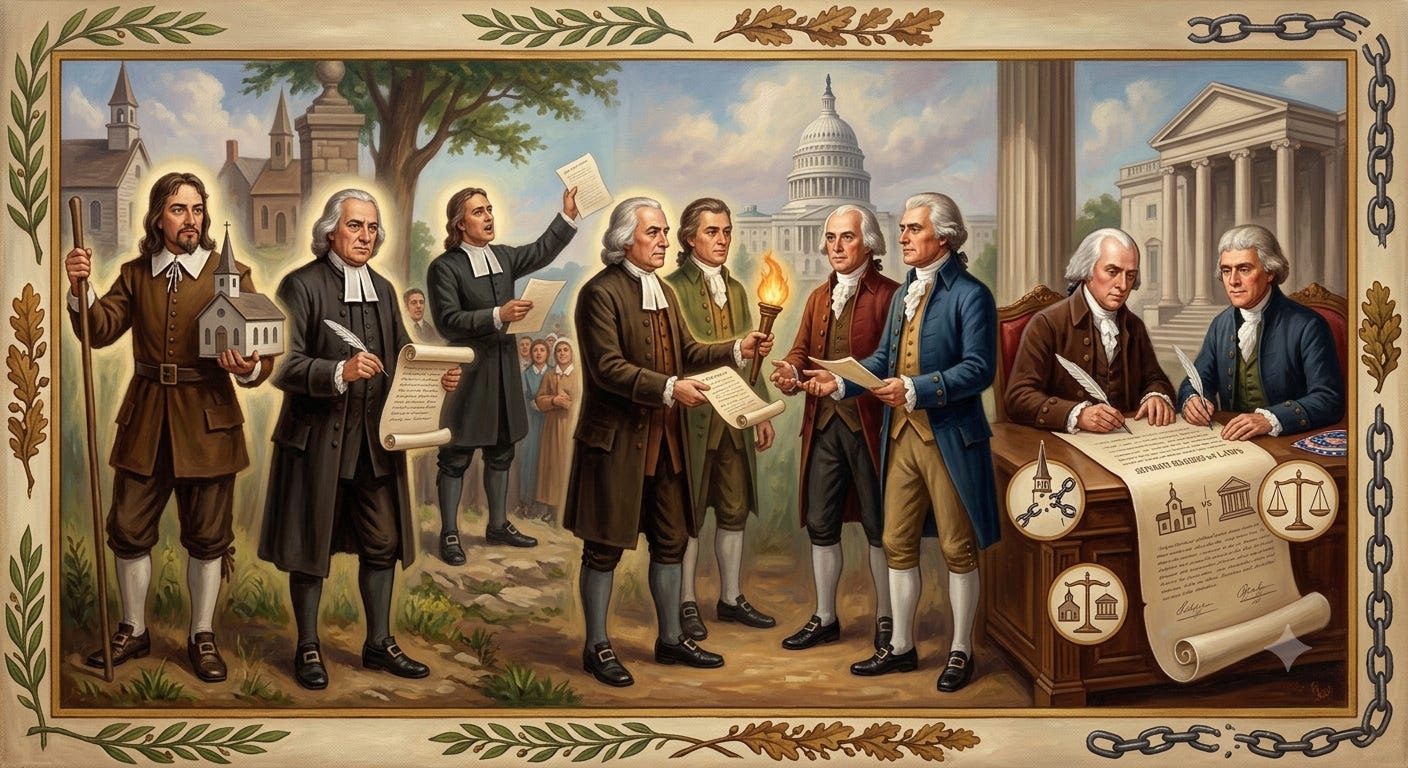
Roger Williams left Massachusetts Bay in the winter of 1636 with a sentence of banishment behind him and no destination ahead. The General Court had convicted him the previous October of broaching “newe & dangerous opinions,” a category that included his insistence that civil magistrates had no jurisdiction over the first four commandments, the ones that govern a person’s duty toward God rather than toward a neighbor. He also argued that the king could not grant title to land he had never purchased from the people living on it. That second opinion probably worried the magistrates more than the first.
Williams later wrote that he was tossed about for 14 weeks in bitter weather, not knowing what bread or bed meant. The Narragansett sheltered him. He bought land from them, named the place Providence, and set about testing a proposition that almost no one in the English-speaking world then accepted: that a civil government could survive without an official religion, and that a church could survive without a civil sword.
The proposition traveled. It reached Virginia a century and a half later, and from there it entered the Constitution. How it traveled is a question worth taking seriously, because the answer cuts against a story that gets told in both directions. Separation of church and state was not smuggled into American law by skeptics who wanted religion weakened. It arrived through preachers who wanted religion left alone, and who had been jailed, whipped and taxed for saying so.
Soul liberty and the garden
Williams’s argument was theological before it was political. In “The Bloudy Tenent of Persecution, for Cause of Conscience” (1644), written against John Cotton, he held that compelled worship is worse than no worship at all, because it produces hypocrisy and offends God. Conscience belongs to God alone. A magistrate who punishes heresy is claiming an authority he was never given.
The wall metaphor is his, and its direction has been reversed so often that the original is worth restating. In his 1644 reply to Cotton, Williams described a hedge or wall of separation between the garden of the church and the wilderness of the world. The wall protected the garden. Williams feared what the state would do to the church, not what the church would do to the state. When the wall came down, he wrote, the garden reverted to wilderness.
His other image is more practical and gets quoted less. In a 1655 letter to the town of Providence, Williams compared civil society to a ship carrying passengers of many faiths, Protestant, Catholic, Jewish and Muslim. The captain cannot compel any passenger to attend the ship’s prayers. He can compel every passenger to obey the ship’s rules, pay his fare and keep order, and he can put a mutineer in irons. Liberty of conscience is not anarchy. It marks the line where civil authority stops.
Rhode Island’s 1663 royal charter carried the principle into positive law, describing a “lively experiment” to prove that a flourishing civil state could stand, and best stand, with full liberty in religious concernments. For decades the colony was a byword for disorder among its neighbors. It did not collapse.
Backus recovers Williams
The chain from Providence to Philadelphia is not a chain of citations. There is no letter in which Thomas Jefferson reports reading Williams, and scholars who have looked for one have come back empty. Mark DeWolfe Howe argued in “The Garden and the Wilderness” (1965) that the Supreme Court had secularized a metaphor whose origins were evangelical, and that the Court’s version of the wall carried a meaning Williams would not have recognized. Howe was right about the origins. Whether the idea reached Virginia by direct transmission or by convergence is a genuinely open historical question, and anyone who claims otherwise is filling a gap with confidence.
What can be traced is the man who put Williams back into circulation. Isaac Backus was born in Norwich, Connecticut, in 1724, converted during the Great Awakening, left the standing Congregational order with the Separates, and became a Baptist in 1751. He spent the next half century fighting the Massachusetts certificate system, an arrangement under which dissenters could avoid the parish tax that supported the established Congregational minister only by filing paperwork proving membership in an exempt congregation. Officials lost the certificates. Assessors ignored them. Baptists went to jail over sums that were often trivial. Backus’s own mother was jailed in Norwich for refusing the rate.
In 1773 Backus published “An Appeal to the Public for Religious Liberty,” and its argument was designed to catch New England patriots where they lived. Massachusetts was refusing to pay taxes to a Parliament in which it had no voice. Massachusetts was simultaneously taxing Baptists to support a church they had not chosen and could not control. Backus asked the colony to notice the resemblance.
He pressed the point in person. In October 1774, as agent for the Warren Association’s Grievance Committee, Backus met the Massachusetts delegation to the First Continental Congress at Carpenters’ Hall in Philadelphia. By his account, John Adams told the room that the Massachusetts establishment was a very slender thing, and that the Baptists might as well expect a change in the solar system as expect Massachusetts to give up its establishment. Adams was right about the timing. Massachusetts did not disestablish until 1833.
The deeper contribution came in Backus’s “History of New England with Particular Reference to the Denomination of Christians called Baptists,” published in three volumes between 1777 and 1796. Backus wrote Roger Williams back into American memory as a founder rather than a crank. Before Backus, Williams survived mainly in the hostile accounts of the men who exiled him. After Backus, Williams was the origin point of a usable dissenting tradition, and American Baptists knew the story of Providence the way they knew the story of Jerusalem.
Backus was not a modern separationist and it distorts him to say so. He wanted the civil order to remain recognizably Christian. His concern ran to Protestant dissenters more than to Catholics, Jews or unbelievers. He attended the Massachusetts ratifying convention in 1788 and spoke in favor of Article VI’s ban on religious tests for federal office, which was a real position and a minority one. He was building a doctrine he did not live to see completed.
Leland in Orange County
John Leland was born in Grafton, Massachusetts, in 1754 and preached in Virginia from 1776 to 1791, which placed him in the exact county and the exact decade where American religious liberty law was being drafted.
In March 1788 the Baptist General Committee of Virginia resolved that the proposed federal Constitution did not adequately secure religious liberty. James Madison, running for the Virginia ratifying convention and then for a seat in the First Congress, needed Baptist votes in Orange County and knew it.
Here the documentary record and the legend diverge, and the distinction matters. The legend has Leland meeting Madison under an oak tree near Gum Spring, withdrawing his own anti-federalist candidacy, and extracting a promise of amendments in exchange. The story appears in reminiscences recorded decades later, at some remove from anyone who was present. It may be substantially true. It is not evidence in the way a document is evidence.
The document exists, and it is better than the legend. On Jan. 2, 1789, Madison wrote to the Rev. George Eve, a Baptist minister in Culpeper, stating that he now favored amendments to the Constitution and specifically named the rights of conscience among the provisions he would support. Eve took the letter to a Baptist gathering and argued Madison’s case. Madison defeated James Monroe for the seat. In June 1789 he introduced the amendments in the House. The bargain was real whether or not the oak tree was.
Leland then wrote the most radical sentences any American had yet published on the subject. In “The Rights of Conscience Inalienable” (1791), he held that government has no more to do with the religious opinions of men than it has with the principles of mathematics. He argued that every man should be free to worship one god, three gods, no god or twenty gods, and that government’s only job was to protect him while he did it. No Virginia gentleman had put it that starkly. It took a Baptist itinerant with no property and no Latin.
Leland’s final appearance in the record is the strangest. A 1,235-pound cheese produced by the dairy farmers of Cheshire, Massachusetts, rolled into Washington on Dec. 29, 1801, and Leland presented it to President Jefferson at the President’s House on New Year’s Day, an offering from a Baptist town in a Federalist state to the man Federalist clergy had spent two years calling an infidel. Two days later Leland preached in the House chamber with Jefferson in the congregation.
The address from the Danbury Baptist Association of Connecticut reached Jefferson on Dec. 30, in the middle of all this, and he began drafting a reply the same day. He dated the finished letter Jan. 1, 1802. It contains the sentence about a wall of separation between church and state.
Jefferson was writing to Baptists. He was borrowing an image that Baptists had been using for a century and a half. The letter was a political document, edited on the advice of Attorney General Levi Lincoln to avoid alienating New England Republicans, and Jefferson knew exactly which audience would recognize the phrase.
What Madison took from the dissenters
Madison’s education on this subject began at home. In January 1774 he wrote to his friend William Bradford about the persecution raging in the next county, where five or six well-meaning men sat in the Culpeper jail for publishing their religious opinions. Madison called it a diabolical, hell-conceived principle. He was 22 and he never got over it.
Two years later he made his first substantive contribution to American constitutional law with a single word change. George Mason’s draft of Article 16 of the Virginia Declaration of Rights promised the fullest toleration in the exercise of religion. Madison struck toleration and substituted the free exercise of religion according to the dictates of conscience. Toleration is a permission a majority extends and can withdraw. Free exercise is a right the government did not grant and cannot revoke. Every free exercise case decided since rests on the distinction Madison drew at 25.
The general assessment fight of 1784 and 1785 supplied the rest. Patrick Henry proposed a tax to support teachers of the Christian religion, with each taxpayer designating his own denomination. It was moderate, ecumenical and popular, which is what made it dangerous. Madison’s “Memorial and Remonstrance Against Religious Assessments” answered that the religion of every man must be left to the conviction and conscience of every man, and that a legislature able to tax three pence for religion could establish any religion it chose.
The essay is famous. The petition campaign that defeated the bill is not, and it should be. Madison’s Memorial circulated in 13 copies and drew 1,552 signatures. Separate petitions written in plainer language and evangelical in origin drew considerably more, and the surviving records at the Library of Virginia show thousands of Virginians signing something against the assessment that season. The bill died without a final vote. In January 1786 Madison brought Jefferson’s Virginia Statute for Religious Freedom, drafted in 1777 and stalled ever since, to passage.
Jefferson counted the statute among the three achievements he wanted on his tombstone. He did not write it alone in the sense that matters. It passed because Baptists and Presbyterians in the Virginia backcountry had spent a decade signing petitions, and because some of them had been preaching through the bars of county jails while they did it.
The line that runs through
The modern argument treats separation as a secular imposition on a religious people. The history runs the other way. The doctrine was assembled by a banished Puritan who thought the state would corrupt the church, a Baptist historian who thought a church tax was the same offense as a stamp tax, and an itinerant preacher who thought government had no more business with theology than with arithmetic. Madison and Jefferson gave the argument its legal architecture. They did not originate it.
None of the three would recognize every use to which the wall has since been put. Williams built it to keep the wilderness out of the garden. Backus wanted a Christian commonwealth that stopped short of a Christian tax collector. Leland would have found much of the modern Establishment Clause docket beside the point, and he would have had opinions about the rest.
The claim they shared is narrower and harder than the slogans on either side. Conscience is not the government’s property. A state that decides which prayers are true has already decided which citizens are suspect. That argument was made in America first by people the state had punished for making it, and it is worth remembering whose argument it was.
Primary sources
Roger Williams
Williams, Roger. The Bloudy Tenent of Persecution, for Cause of Conscience Discussed. London, 1644. Source for the argument that compelled worship produces hypocrisy and that the magistrate holds no authority over the first table of the Decalogue. Modern edition: Richard Groves, ed. Macon, Ga.: Mercer University Press, 2001.
Williams, Roger. Mr. Cottons Letter Lately Printed, Examined and Answered. London, 1644. Contains the hedge or wall of separation passage. The wall protects the garden of the church from the wilderness of the world, and Williams describes the garden reverting to wilderness once the wall is breached. This is the text to cite for the metaphor, not the Bloudy Tenent, and the two are frequently confused.
Williams, Roger. The Bloody Tenent Yet More Bloody. London, 1652. The reply to John Cotton’s answer.
Williams, Roger. Letter to the Town of Providence, January 1655. In The Correspondence of Roger Williams, edited by Glenn W. LaFantasie, 2 vols. Providence: Brown University Press and University Press of New England, 1988. The ship-at-sea analogy. Liberty of conscience for passengers of every faith, full civil authority over order, fares and mutiny.
The Complete Writings of Roger Williams. 7 vols. New York: Russell and Russell, 1963.
Shurtleff, Nathaniel B., ed. Records of the Governor and Company of the Massachusetts Bay in New England. Vol. 1. Boston, 1853. The October 1635 banishment order and its charge of new and dangerous opinions.
Charter of Rhode Island and Providence Plantations, July 8, 1663. Source for the lively experiment language and the guarantee of liberty in religious concernments.
Isaac Backus
Backus, Isaac. An Appeal to the Public for Religious Liberty, Against the Oppressions of the Present Day. Boston: John Boyle, 1773. The parallel between the parish rate and parliamentary taxation.
Backus, Isaac. A History of New England, with Particular Reference to the Denomination of Christians called Baptists. 3 vols. Boston, 1777, 1784, 1796. Second edition edited by David Weston, 2 vols., Newton, Mass.: Backus Historical Society, 1871. The work that returned Roger Williams to American memory as a founder rather than a heretic.
McLoughlin, William G., ed. Isaac Backus on Church, State, and Calvinism: Pamphlets, 1754–1789. Cambridge: Harvard University Press, 1968. The convenient modern collection, with McLoughlin’s introduction.
McLoughlin, William G., ed. The Diary of Isaac Backus. 3 vols. Providence: Brown University Press, 1979. The source for the Carpenters’ Hall meeting of October 1774 and the remark attributed to John Adams about the solar system.
John Leland
Leland, John. The Virginia Chronicle. Fredericksburg, Va., 1790.
Leland, John. The Rights of Conscience Inalienable. New London, Conn., 1791. Contains the comparison of religious opinion to the principles of mathematics and the passage on one god, three gods, no god or twenty gods.
Leland, John. Some Events in the Life of John Leland. Pittsfield, Mass., 1838. Leland’s own late account, and one of the sources behind the Madison meeting tradition.
Greene, L. F., ed. The Writings of the Late Elder John Leland. New York: G. W. Wood, 1845. The standard collected edition.
Sandoz, Ellis, ed. Political Sermons of the American Founding Era, 1730–1805. 2 vols. Indianapolis: Liberty Fund. Reprints Leland alongside the wider sermon literature.
Madison and Jefferson
Madison, James. To William Bradford, Jan. 24, 1774. The Papers of James Madison, vol. 1. The diabolical, hell-conceived principle of persecution, and the Baptist preachers jailed in Culpeper County.
Virginia Declaration of Rights, June 1776, with Madison’s substitution of free exercise for George Mason’s toleration in Article 16. The Papers of James Madison, vol. 1.
Madison, James. Memorial and Remonstrance Against Religious Assessments, ca. June 20, 1785. The Papers of James Madison 8:295–306. Editorial note in the same volume covers the anonymity, George Mason’s role in printing and distribution, and the returns from individual counties.
Madison, James. To George Eve, Jan. 2, 1789. The Papers of James Madison 11:404–05. The documented pledge to support amendments securing the rights of conscience. This letter, and not the oak tree story, is the evidence for the Baptist bargain.
Madison, James. “Detached Memoranda.” Edited by Elizabeth Fleet. William and Mary Quarterly, 3d ser., 3, no. 4 (October 1946): 534–68. The retired Madison against congressional chaplains and presidential religious proclamations, useful for establishing that his mature position was stricter than his legislative one.
Jefferson, Thomas. A Bill for Establishing Religious Freedom, drafted 1777, enacted January 1786. The Papers of Thomas Jefferson, vol. 2.
Jefferson, Thomas. To the Danbury Baptist Association, Jan. 1, 1802. The Papers of Thomas Jefferson, vol. 36.
“Presentation of the ‘Mammoth Cheese’” and “Reply to the Danbury Baptist Association,” editorial notes. The Papers of Thomas Jefferson, vol. 36. Available through Founders Online. These establish the chronology used in the article: the cheese reached Washington on Dec. 29, 1801, the Danbury address reached Jefferson on Dec. 30, the cheese was presented at the President’s House on Jan. 1, and Jefferson dated the reply that day. Popular accounts collapse these into a single date and get it wrong.
Legislative Petitions, 1776–1865. Library of Virginia. The surviving petitions from the 1785 assessment fight, searchable by county.
Secondary literature
On Williams
Barry, John M. Roger Williams and the Creation of the American Soul: Church, State, and the Birth of Liberty. New York: Viking, 2012. Makes the strongest case for a direct line from Williams to the founding generation. Read alongside the skeptics.
Davis, James Calvin. The Moral Theology of Roger Williams. Louisville: Westminster John Knox, 2004. Takes Williams seriously as a theologian rather than as an early liberal.
Gaustad, Edwin S. Liberty of Conscience: Roger Williams in America. Grand Rapids: Eerdmans, 1991.
Hall, Timothy L. Separating Church and State: Roger Williams and Religious Liberty. Urbana: University of Illinois Press, 1998. The most useful single volume for a legal reader.
Miller, Perry. Roger Williams: His Contribution to the American Tradition. Indianapolis: Bobbs-Merrill, 1953.
Morgan, Edmund S. Roger Williams: The Church and the State. New York: Harcourt, Brace and World, 1967.
On Backus and New England dissent
McLoughlin, William G. Isaac Backus and the American Pietistic Tradition. Boston: Little, Brown, 1967. The standard biography, and the source for the article’s caution that Backus was not a modern separationist.
McLoughlin, William G. New England Dissent, 1630–1833: The Baptists and the Separation of Church and State. 2 vols. Cambridge: Harvard University Press, 1971. Exhaustive on the certificate system, the parish rate, and the long delay before Massachusetts disestablished in 1833.
On Leland and Virginia
Butterfield, L. H. “Elder John Leland, Jeffersonian Itinerant.” Proceedings of the American Antiquarian Society 62 (1952): 155–242. Still the essential Leland study. Reprinted in Colonial Baptists and Southern Revivals (1980).
Buckley, Thomas E. Church and State in Revolutionary Virginia, 1776–1787. Charlottesville: University Press of Virginia, 1977. The best account of the petition campaign and the count of surviving petitions.
Buckley, Thomas E. Establishing Religious Freedom: Jefferson’s Statute in Virginia. Charlottesville: University of Virginia Press, 2013. Follows the statute forward into the nineteenth century, where the practice diverged from the text.
Eckenrode, H. J. Separation of Church and State in Virginia. Richmond: Virginia State Library, 1910. Dated, still cited by the Madison editors.
Isaac, Rhys. The Transformation of Virginia, 1740–1790. Chapel Hill: University of North Carolina Press, 1982. Sets the Baptist insurgency in its social context.
Ragosta, John A. Wellspring of Liberty: How Virginia’s Religious Dissenters Helped Win the American Revolution and Secured Religious Liberty. New York: Oxford University Press, 2010. Argues that dissenter military support was the currency that bought religious liberty in Virginia. The most direct scholarly support for the article’s central claim.
Ragosta, John A. Religious Freedom: Jefferson’s Legacy, America’s Creed. Charlottesville: University of Virginia Press, 2013.
Hatch, Nathan O. The Democratization of American Christianity. New Haven: Yale University Press, 1989. Places Leland among the populist preachers who distrusted learned clergy and formal theology alike.
On the wall and its constitutional afterlife
Howe, Mark DeWolfe. The Garden and the Wilderness: Religion and Government in American Constitutional History. Chicago: University of Chicago Press, 1965. The argument the article relies on, that the Supreme Court secularized a metaphor whose origins were evangelical.
Dreisbach, Daniel L. Thomas Jefferson and the Wall of Separation Between Church and State. New York: New York University Press, 2002. Reconstructs the drafting of the Danbury letter and treats it as a political document rather than a constitutional gloss.
Hamburger, Philip. Separation of Church and State. Cambridge: Harvard University Press, 2002. The revisionist case that separation as a constitutional principle is a nineteenth-century construction with nativist elements. Directly contests the continuity argument and should be engaged, not ignored.
Hutson, James H. Religion and the Founding of the American Republic. Washington: Library of Congress, 1998.
Hutson, James H. “‘A Wall of Separation’: FBI Helps Restore Jefferson’s Obliterated Draft.” Library of Congress Information Bulletin 57, no. 6 (June 1998). The forensic recovery of the passage Jefferson cut on Levi Lincoln’s advice.
Levy, Leonard W. The Establishment Clause: Religion and the First Amendment. 2d ed. Chapel Hill: University of North Carolina Press, 1994.
McConnell, Michael W. “The Origins and Historical Understanding of Free Exercise of Religion.” Harvard Law Review 103 (1990): 1409. The leading originalist treatment of the free exercise clause, and useful on the Mason-to-Madison shift from toleration to right.
Muñoz, Vincent Phillip. God and the Founders: Madison, Washington, and Jefferson. New York: Cambridge University Press, 2009. Reprints the Memorial and Remonstrance and reads the three founders against one another.
Nussbaum, Martha C. Liberty of Conscience: In Defense of America’s Tradition of Religious Equality. New York: Basic Books, 2008. Opens with Williams and builds a philosophical account from him forward.
Esbeck, Carl H., and Jonathan J. Den Hartog, eds. Disestablishment and Religious Dissent: Church-State Relations in the New American States, 1776–1833. Columbia: University of Missouri Press, 2019. State-by-state, which is the only way to see how uneven and slow disestablishment actually was.
Cases
Reynolds v. United States, 98 U.S. 145 (1878). First Supreme Court use of the Danbury letter.
Everson v. Board of Education, 330 U.S. 1 (1947). Where the wall enters Establishment Clause doctrine, and where the Virginia disestablishment story becomes constitutional authority.
Engel v. Vitale, 370 U.S. 421 (1962).
Lynch v. Donnelly, 465 U.S. 668 (1984). Chief Justice Burger’s complaint that the wall is a useless figure of speech.
Town of Greece v. Galloway, 572 U.S. 565 (2014).
Kennedy v. Bremerton School District, 597 U.S. 507 (2022). Replaces the Lemon framework with history and tradition, which puts the sources above back into active litigation.
Notes on contested evidence. When fact checking the article, the software observed the following that are worth pointing out if you intend to use this as a scholarly source:
Three points in the article rest on weaker ground than the rest, and the distinctions are worth preserving in any republication.
Whether Jefferson read Williams. No document establishes it. Barry argues for real influence, Howe argues for shared evangelical origins without direct transmission, and Hamburger argues that the continuity is largely retrospective invention. The article takes the middle position and says so.
The oak tree meeting. The tradition that Leland withdrew his candidacy after meeting Madison near Gum Spring appears in reminiscences recorded well after the fact, including Leland’s own 1838 account. Butterfield handles the problem carefully. The Madison-to-Eve letter of Jan. 2, 1789, is contemporaneous and does the same work without the legend.
Petition signature counts. The figure of 1,552 signatures on 13 copies of the Memorial and Remonstrance is well established. The larger totals for the evangelical petitions vary by source depending on which surviving documents are counted, and Buckley’s Church and State in Revolutionary Virginia is the place to fix a number before publishing one.
One quotation to verify before print. The John Adams remark about expecting a change in the solar system comes to us through Backus’s own account of the Carpenters’ Hall meeting. It is attributed, not transcribed. The article credits it to Backus rather than reporting it as a direct quotation, and that framing should stay.