What 1,141 pages of Anthony Fauci’s diary actually prove about sincerity
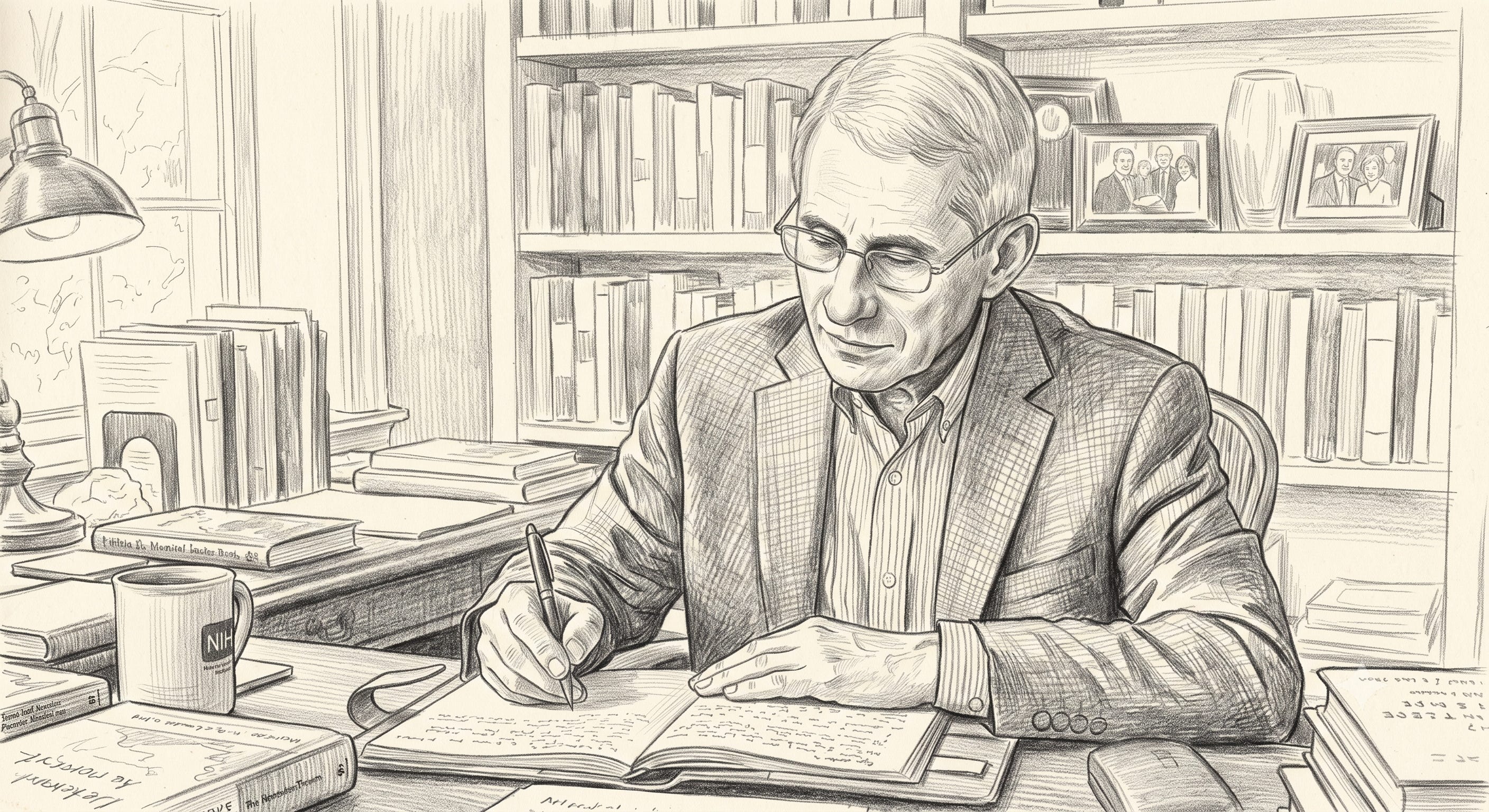
Sen. Rand Paul released roughly 1,141 pages of Anthony Fauci’s personal diary over the weekend of July 25, 2026, three days ahead of Fauci’s subpoenaed appearance before the Senate Homeland Security and Governmental Affairs Committee.1 Paul’s framing was blunt. What Fauci wrote privately and what he told the country, the senator posted, are two different stories.2 By Monday the file had been pulled from the committee website. By Tuesday morning it was back up with redactions.3
(You can read the diary for yourself here.)
The senator is right that the diary contradicts the public record in places. He is wrong about what that contradiction demonstrates.
Read the whole thing and a different figure emerges from the one Paul is prosecuting. The diary shows a man who was frequently mistaken, occasionally paternalistic, deeply vain about press coverage, and contemptuous of his critics in language he never would have used on camera. It also shows a man who wrote down the most damaging evidence against himself, kept it, and then behaved for the next two years exactly as someone would behave who believed his own advice.
That distinction matters more than the partisan scorekeeping around it. Sincerity and correctness are separate questions. The diary answers the first one clearly.
The entry Paul built his case on
On Jan. 26, 2020, Fauci recorded that the first Wuhan infection appeared in early December and had no connection to the seafood market. His conclusion: the market was not the source, it was the amplifier. He added immediately that somewhere the virus jumped from animals to humans.4
Five days later comes the entry that carries the weight of the entire release. On Jan. 31, 2020, Fauci wrote that Jeremy Farrar called him sounding very concerned and conferenced in Kristian Andersen of Scripps. The scientists on that call believed the mutations around the furin cleavage site of the spike protein could not have occurred naturally, since natural emergence would require an evolutionary jump they found nowhere in bat isolates. They raised the possibility of deliberate insertion followed by accidental release, which they considered the likelier of the two release scenarios. Farrar was calling for advice. Fauci recorded his own answer: convene a larger group of qualified evolutionary biologists and virologists under some neutral body and examine the question carefully.5
He then called Brian Harrison and Garrett Grigsby to arrange a conversation with Secretary Azar about what to do. Azar rejected the World Health Organization as convener out of concern that Tedros would alert Beijing. The group settled on a two-track approach at the suggestion of Robert Kadlec, who argued that the United States had its own security obligation to investigate.6
The Feb. 1 call followed with twelve participants, and Fauci listed every one of them by name and institution. His summary of the discussion: there was not total agreement about the likelihood of deliberate insertion. Ron Fouchier dissented and said the sequence could arise naturally. Christian Drosten sided with Fouchier. The rest of the group considered deliberate insertion possible, and Fauci noted the reason it could not be dismissed, which was Zheng-Li Shi’s years of coronavirus gain-of-function work in Wuhan aimed at adapting the spike protein to bind the human ACE2 receptor.7
Set aside the politics for a moment and consider what kind of document that is.
Fraud does not keep a ledger
Paul’s theory requires a man executing a deliberate deception about the origins of a pandemic. That man wrote the deception’s indictment into his own daily record, in his own hand, and preserved it for six years across two congressional investigations, a document production, an email release, and a subpoena.
People running frauds do not do this. They destroy records or they never create them. The Jan. 31 entry survives because Fauci did not understand it as incriminating. He understood it as what it plainly describes, which is a phone call about a technical anomaly and a decision to refer the anomaly to specialists. Whether that referral was adequate is a fair fight. Whether the referral was staged is a much harder claim, and the diary undercuts it rather than supporting it.
The same pattern repeats across the file. In April 2020, Fauci wrote that the government had probably been too strong in saying masks do not work, and noted that he had said so that morning on CNN.8 That is a man logging his own error into the permanent record while correcting it in public on the same day. In August 2021 he recorded his reaction to the intelligence community’s origins assessment, called it good news that bioengineering had been ruled out, acknowledged that a lab leak remained open, and dismissed the FBI’s contrary lean as resting on no data at all.9 The dismissal was too quick. It was also written down.
The private register
Much of the coverage this week has fixed on the press logs. Nearly every entry ends with a list of the day’s television and radio hits, and the file also records awards, honorary citations, Slate ranking him the most influential American over 80, and late-night monologues transcribed verbatim.10 Fox News called it a fixation on fame. That reading says more about the reader than the writer.
Media appearances were the job. The White House had made him the government’s science spokesman by the end of January 2020 because Robert Redfield came across poorly on camera, and Fauci recorded that decision at the time.11 A man whose assignment is public communication logs what he communicated and how it landed. Anyone holding that post would have kept the same list, and most would have enjoyed the flattering items more openly than he did.
The genuinely revealing material is elsewhere. Fauci is far harsher on paper than any public appearance suggested. Rand Paul is “his usual stupid self.” Tucker Carlson is “a total asshole.” Critics on the right are “total nut cakes.” After a July 2021 hearing exchange, he wrote that he finished by looking Paul in the eye and telling him that if anybody was lying it was he.12
Set that against his conduct on camera during the same weeks, which was uniformly measured. The gap between the two registers is the one gap in this diary that nobody should find surprising. Contempt kept private and courtesy kept public is ordinary professional discipline, and the alternative would have been worse for everyone.
The behavioral evidence
Now consider what he did with his own body.
In June 2022, Fauci contracted COVID-19. His diary records the cost in terms nobody stages for posterity. He missed his daughter Megan’s wedding in New Orleans, and he wrote that this was more painful and disturbing than the fact that he had a disease that could possibly kill him. He watched the ceremony by live stream and worked the reception over FaceTime. Two days later he was recording the depression and sadness of it.13
His course was mild. He started Paxlovid, tested negative June 20, rebounded with symptoms June 25, started a second course, and cleared on July 1.14 Then, in October 2022, he took his updated booster on camera in a Duane Reade pharmacy after walking out of the Colbert studio mid-taping, and wrote that the response to the segment had been phenomenal.15
The lungs, since people are asking
A related question is circulating this week, so it is worth answering from the document. The diary records no lung disease of any kind in Anthony Fauci.
Across 1,141 pages there is no asthma, no chronic obstructive pulmonary disease, no pneumonia, no hospitalization, no supplemental oxygen, no chest imaging, and no pulmonary consultation involving Fauci himself. Every reference to lungs in the file concerns other people or the pathophysiology of the disease generally, including a long 2021 entry working through why T cell memory protects the lower airway longer than serum antibody protects the upper.16 His own June 2022 illness produced a flushing sensation, one bad night, and what he described as some cough. Nothing more. He later told the New York Times he believed Paxlovid kept him out of the hospital.17
The absence matters for two reasons.
First, it removes a possible innocent explanation for his caution. An official with compromised lungs has a private stake in aggressive mitigation, and a critic could argue that personal vulnerability shaped public policy. The record forecloses that argument. His risk profile was ordinary for his age.
Second, and cutting the other way, his risk profile was not actually ordinary in one respect. Fauci was 81 when he was infected. He had been carrying polymyalgia rheumatica since early 2020 and was on prednisone for it by that April, meaning he was taking a systemic corticosteroid with immunosuppressive effect into a respiratory pandemic.18 An 81-year-old on prednisone had every reason to want the intervention he was recommending to work. He took it. He kept taking it. He got infected anyway, told the public he had been infected, and reported the rebound rather than concealing it.
People do not run that experiment on themselves when they know the answer.
Reader, that is not the conduct of a man who believes he is poisoning the public. Whatever else the diary establishes, it forecloses the theory that Fauci knowingly promoted an intervention he understood to be dangerous. He took it. He took it again. He took it on television.
One claim requires correction
Some accounts circulating this week suggest the diary documents vaccine injury to Fauci himself. It does not, at least not in the released text.
Fauci does record a chronic inflammatory problem. On or about March 12, 2020, he wrote that he might have polymyalgia rheumatica or a bad case of Crestor myalgia, meaning statin-associated muscle pain.19 By April 18, 2020, he was on prednisone for it and had lost eight pounds.20 Both entries predate the first authorized COVID-19 vaccine by roughly nine months. Whatever caused his polymyalgia, a vaccine that did not yet exist is not a candidate.
Accuracy cuts in every direction or it is not accuracy. The strongest case against Fauci does not need help from a claim the documents refuse to support, and the case is weakened whenever its advocates reach for one.
Where the diary does damage
Sincerity is a floor. Clearing it does not make a man right, and one entry in this file should trouble anyone who cares about how public health talks to the public.
In 2021, Fauci raised his stated herd immunity threshold from a range of 70 to 75 percent up to 70 to 85 percent. Sen. Marco Rubio publicly called him a liar for it. The diary contains Fauci’s private answer, and the private answer is worse than the public one. He gives a scientific rationale first, extrapolating from measles, where a 98 percent effective vaccine begins losing herd immunity around 89 to 90 percent coverage, and reasoning that a 94 to 95 percent effective vaccine should push the number higher. Then he gives the other reason. He wanted to encourage people to get vaccinated.21
Read it again. The number moved for a communications purpose alongside a scientific one, and he recorded both motives without appearing to notice that the second one contaminates the first.
That is the tell. It is not corruption. It is the assumption that the public is an audience to be managed toward a correct outcome rather than a body of citizens entitled to the actual state of the evidence, uncertainty included. The mask reversal has the same structure. The initial guidance was shaped partly by supply anxiety about protective equipment for hospitals, and the correction came only after the guidance had already spent its credibility.
Trust is capital. Every managed message draws it down. By 2021 the account was overdrawn, and no amount of sincerity at the individual level could refinance it.
The reversal test
Apply the standard symmetrically or admit it is not a standard.
Suppose these diaries belonged to an official whose conclusions you liked. Suppose the entries showed a Christian appointee recording early doubts about a policy, referring the doubts to experts, accepting the experts’ conclusion, defending that conclusion too confidently in public, and privately calling his critics idiots. Would you call that fraud? Or would you call it a public servant working with incomplete information under enormous pressure and behaving badly on the margins?
The answer has to be the same in both cases. Anyone who reads the Jan. 31 entry as proof of conspiracy when the author is Fauci, and would read an identical entry as proof of diligence when the author is an ally, is not applying a principle. He is applying a preference.
That cuts against Fauci’s defenders too. The people insisting these documents are unremarkable would find them shocking if the subject were a religious conservative. The diary shows real misconduct in the currency of public trust, and it deserves a hearing on Wednesday that neither side is likely to give it.
Why this matters for conscience
Religious liberty advocates have a stake in getting this right, and the stake runs opposite to the direction most of the movement is running.
The argument for conscience protection has never depended on proving that health authorities act in bad faith. It depends on something more durable, which is that no authority possesses the certainty its mandates presuppose. The Fauci diaries make that case better than any accusation of fraud could. Here is the most powerful public health official in the country, sincere by every behavioral measure available, personally exposed to every risk he asked others to accept, and wrong repeatedly about masks, about thresholds, about origins, about how much confidence the evidence would bear.
Sincere authority is still fallible authority. That is the entire argument for reserving a sphere the state cannot compel.
Religious liberty entails freedom of conscience, and that those exercising it must respect the equivalent rights of all others, and government is God’s agency to protect individual rights and conduct civil affairs. Officials discharging those duties are entitled to respect and cooperation. Both halves apply here. Fauci is owed the respect due a man who bore an impossible job and paid for it. The citizens who declined his recommendations on grounds of conscience were owed a government that acknowledged the limits of its own knowledge, and did not get one.
Conscience protections exist because sincere people in power make mistakes at scale. Fauci proved it. He proved it while telling the truth to his diary the entire time.
SUBSCRIBER CALL TO ACTION
If you want religious liberty analysis that applies the same standard to every side, please consider upgrading. Paid subscribers get full archive access and every legal analysis piece in full.
SEO TAGS
Fauci diaries, Rand Paul, COVID-19 origins, furin cleavage site, Kristian Andersen, Jeremy Farrar, lab leak, gain-of-function, Senate Homeland Security Committee, public health credibility, herd immunity threshold, religious liberty, freedom of conscience, vaccine mandates, IRLA Declaration of Principles, reversal test, church and state
Footnotes
-
Rand Paul, The Reading Room, U.S. Senate (July 24-27, 2026), https://www.paul.senate.gov/readingroom/; see also Selena Simmons-Duffin, Rand Paul Releases Anthony Fauci’s Pandemic-Era Diary Notes, NPR (July 27, 2026). ↩
-
Sen. Rand Paul (@RandPaul), X (July 25, 2026), quoted in NPR, supra note 1. ↩
-
NPR, supra note 1 (noting the package was removed Monday evening and reposted Tuesday morning with redactions). ↩
-
Anthony S. Fauci, Diary Entry (Jan. 26, 2020), in Tony’s Diary Package, released by Chairman Rand Paul, at 300 (line ref., extracted text). ↩
-
Fauci Diary Entry (Jan. 31, 2020), supra note 4. ↩
-
Id. ↩
-
Fauci Diary Entry (Feb. 1, 2020), supra note 4 (listing Collins, Fauci, Farrar, Vallance, Andersen, Drosten, Holmes, Rambaut, Fouchier, Garry, Ferguson and Koopmans). ↩
-
Fauci Diary Entry (Apr. 2020), supra note 4. ↩
-
Fauci Diary Entry (Aug. 28, 2021), supra note 4. ↩
-
Fauci Diary Entries (Dec. 22, 2020; June 15-17, 2022), supra note 4 (recording the Slate ranking and late-night monologues); see also Fox News, Read the Diaries: Documents Unveil Fauci’s Thoughts on Lab Leak Debate, Mask Doubts, Testing Failures (July 28, 2026) (characterizing the entries as a fixation on fame). ↩
-
Fauci Diary Entry (Jan. 31, 2020), supra note 4 (recording that the White House had settled on Fauci as the government’s science and health spokesman because Robert Redfield communicated poorly). ↩
-
Fauci Diary Entries (July 20, 2021; June 16, 2022; June 18, 2022), supra note 4; see also CBS News, Fauci Diaries, Released by Sen. Rand Paul, Touch on COVID Origins and Tense Relationship With Trump (July 28, 2026). ↩
-
Fauci Diary Entries (June 15, 2022; June 18, 2022), supra note 4. ↩
-
Fauci Diary Entries (June 20, 2022; June 25-26, 2022; June 30, 2022; July 1, 2022), supra note 4. ↩
-
Fauci Diary Entry (Oct. 6, 2022), supra note 4. ↩
-
Fauci Diary Entry (2021), supra note 4 (discussing T cell memory and protection against pulmonary involvement). ↩
-
Fauci Diary Entry (June 30, 2022), supra note 4 (reproducing Sheryl Gay Stolberg, Fauci Says He Believes Paxlovid Kept Him Out of the Hospital, N.Y. Times (June 30, 2022)). ↩
-
Fauci Diary Entries (Mar. 12, 2020; Apr. 18, 2020), supra note 4. ↩
-
Fauci Diary Entry (Mar. 12, 2020), supra note 4. ↩
-
Fauci Diary Entry (Apr. 18, 2020), supra note 4. ↩
-
Fauci Diary Entry (2021), supra note 4 (recording the 70-75 to 70-85 percent revision, the measles extrapolation and the encouragement rationale, in response to Sen. Marco Rubio’s public accusation). ↩