
At ReligiousLiberty.TV, our mission is to deliver the most current news when it happens, ensuring you stay informed as legal and cultural landscapes shift. Many other publications will wait until the next day, or weeks or even months, but we exist as an immediate resource, and base most of our analysis on the legal decisions themselves. For instance, this case was decided yesterday, on Friday, February 20, 2026, and we’re one of the first out of the gate with a useful analysis – not just reporting the result, but explaining why it happened and what it means. We want to help create an informed reader base, not just shape opinions.
Our algorithm prioritizes answering the specific questions our audience is asking, stripping away bias to provide objective, clear, and credible reporting on the cases that define our fundamental freedoms.
Please like, subscribe, and share our content to help spread the word and support a more informed public dialogue. If it is valuable to you, please consider a paid subscription to help defer the costs.
TLDR (Too Long / Didn’t Read Summary)
The U.S. Court of Appeals for the Fifth Circuit has vacated a preliminary injunction that previously blocked Louisiana from enforcing House Bill 71. This law requires every public school classroom to display the Ten Commandments by early 2026. In a divided en banc decision, the court ruled that the plaintiffs’ legal challenge is not yet “ripe” for judicial review. Because school boards have discretion over the “nature” of the displays, the majority argued that courts cannot evaluate the constitutionality of the posters in the abstract. This decision allows the law to take effect while leaving the door open for future lawsuits once specific posters are actually displayed. The ruling emphasizes a shift toward requiring concrete factual records in First Amendment cases involving religious symbols in schools.
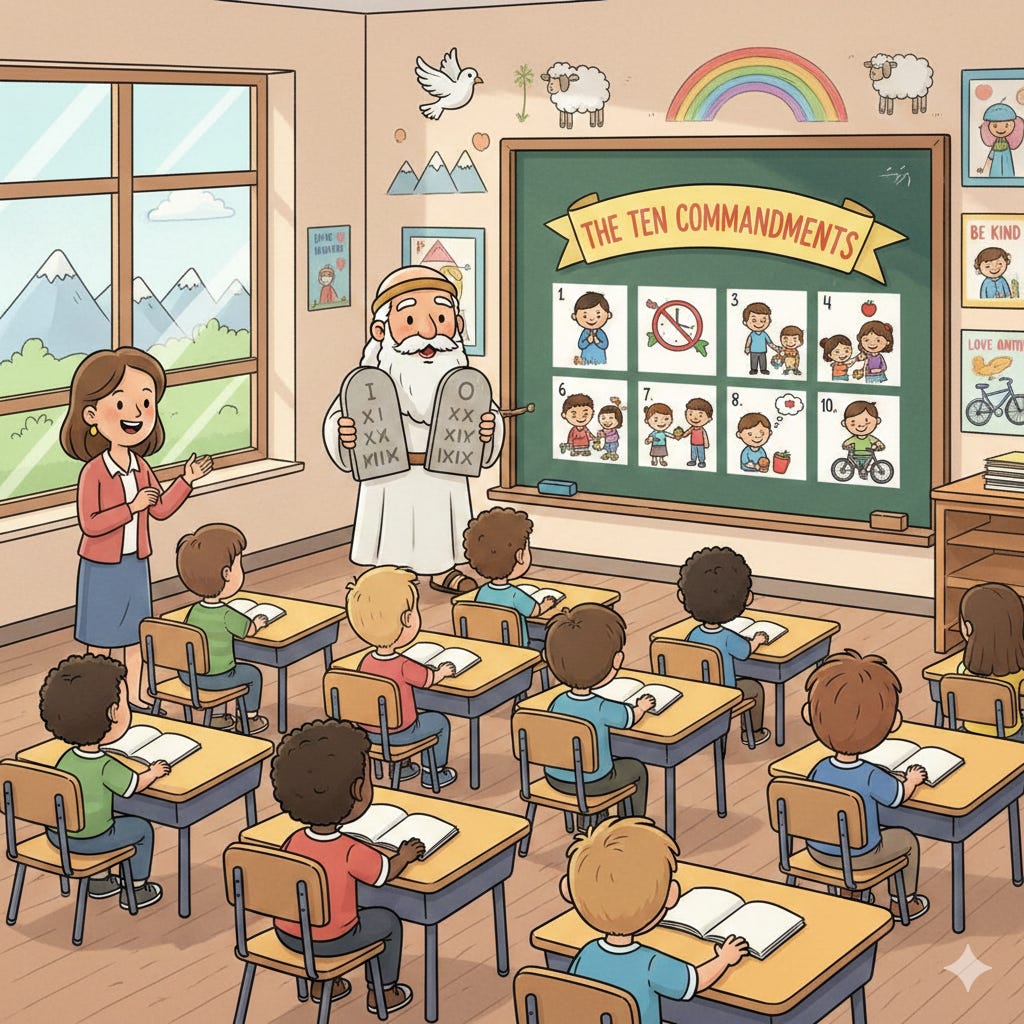
Case Info: Roake v. Brumley, No. 24-30706 (5th Cir. Feb. 20, 2026).
Louisiana public schools can proceed with plans to display the Ten Commandments in every classroom following an en banc ruling by the Fifth Circuit. The court found that because the displays do not yet exist, it is impossible to determine if they violate the Establishment Clause or Free Exercise Clause. This ruling vacates a lower court’s injunction, effectively allowing the state to implement the law while the litigation continues.
This story matters because it represents a major test of how modern courts apply the First Amendment to religious displays in schools. After the Supreme Court moved away from older legal tests in recent years, states like Louisiana and Texas have passed laws testing the boundaries of “history and tradition” in education. This ruling provides a roadmap for how appellate courts may handle “pre-enforcement” challenges to these controversial statutes.
What did the Fifth Circuit rule?
The court vacated the preliminary injunction on the grounds of ripeness, meaning the case was brought too early. The majority argued that because no posters have actually been hung, it is impossible to determine their “nature” or “context”. They ruled that constitutional issues must be resolved through concrete facts rather than imagination.
Is the Louisiana law (HB 71) currently in effect?
Yes. By vacating the injunction, the Fifth Circuit allows Louisiana schools to move forward with the January 2025 deadline for displaying the text. However, the court explicitly noted that this “narrow holding” does not prevent future as-applied challenges once the statute is implemented and a record exists.
Why do critics say the law is unconstitutional?
The dissenting judges and plaintiffs argue that the law violates the Establishment Clause. Key arguments include:
-
Mandatory Nature: Unlike historical monuments, these are permanent displays in classrooms with compulsory attendance.
-
Religious Purpose: Legislative records show sponsors framing the law as a way to teach children “what God commands”.
-
Denominational Preference: The law prescribes a specific Protestant version of the text, which Jewish plaintiffs argue erases foundational parts of their faith, such as the deliverance from Egypt.
How does this differ from the Texas monument case?
The majority distinguished this case from Van Orden v. Perry, which upheld a monument on the Texas State Capitol grounds. They noted that a monument in a park is a “far more passive” use of the text than a classroom display where students are impressionable and forced to view it every day.
Is it legal to post the Ten Commandments in public schools?
Under this specific ruling, the Louisiana law is currently enforceable because the court declined to rule on its underlying constitutionality. The majority held that the Ten Commandments have a “dual character,” serving as both a religious text and a foundation of the American legal system. Because the law allows schools to include other historical documents like the Mayflower Compact or the Declaration of Independence, the court argued that the context of each display will determine its legality. However, the dissenting judges argued that a 1980 Supreme Court precedent, Stone v. Graham, already established that such displays are unconstitutional when they are not part of a specific secular curriculum.
What is the Louisiana Ten Commandments law (HB 71)?
House Bill 71 requires all public elementary, secondary, and post-secondary classrooms to display a poster or framed document of the Ten Commandments. The law mandates that the text be the “central focus” and printed in a large, easily readable font on a document at least eleven by fourteen inches. The statute prescribes specific Protestant-leaning language for the text. It also requires a “context statement” explaining that the Ten Commandments were a prominent part of American public education for three centuries. Schools may use private donations to fund the posters.
Why did the Fifth Circuit vacate the injunction?
The court vacated the injunction based on the doctrine of “ripeness”. The majority opinion stated that courts should not decide constitutional questions in the abstract. Since local school boards have the power to decide exactly what the posters look like and what other materials surround them, the court found the parents’ challenge was “premature”. The court noted that it does not yet know how prominently the displays will appear or how teachers might use them in class. One concurring judge went further, stating the law is constitutional on its merits because it aligns with the nation’s founding traditions.
How does this ruling affect religious freedom for students?
The ruling creates a temporary period where students will be exposed to the displays while further legal challenges are developed. The majority argued that students are not currently suffering “concrete harm” because the law does not yet require them to do or refrain from doing anything. Conversely, the dissenting judges expressed concern that the law forces children to confront government-endorsed religion in a setting where attendance is compulsory. Jewish and minor-faith plaintiffs in the case argued the state is “misappropriating” sacred texts and creating a “religious hierarchy” in the classroom.
Commentary
The court’s reliance on ripeness is a classic “passive virtue.” By avoiding a final ruling on the merits, the majority is waiting for the perfect test case. This strategy forces plaintiffs to wait for an actual poster to be hung before they can sue again. It shifts the burden from the state to the parents, who must now monitor thousands of individual classrooms to find a display that crosses the line.
The core of the dispute is the “context” requirement. If a school surrounds the Ten Commandments with the Bill of Rights and the Magna Carta, the court is likely to view it as a historical exhibit. If the Commandments sit alone next to the chalkboard, it looks more like a religious mandate. The Fifth Circuit is essentially saying they cannot judge the “shades of grey” until the paint is on the wall.
There is also a significant debate here about Supreme Court precedent. The dissenters are right that Stone v. Graham has never been formally overruled. However, the majority is signaling that the legal landscape has shifted so much that Stone may no longer be the “fixed star” it once was. They are leaning into a new era where “history and tradition” carry more weight than the old concerns about “secular purpose.”
Ultimately, this case is headed back to the district court or to the Supreme Court. By vacating the injunction, the Fifth Circuit has signaled that it is skeptical of broad, facial attacks on religious-themed legislation. Expect a wave of “as-applied” challenges the moment the first posters appear in Louisiana schools this January.
Citations
-
Roake v. Brumley, No. 24-30706 (5th Cir. 2026).
-
Stone v. Graham, 449 U.S. 39 (1980).
-
Van Orden v. Perry, 545 U.S. 677 (2005).
-
Kennedy v. Bremerton School District, 597 U.S. 507 (2022).
Subscription Call: Like and share this report to help others stay informed about religious liberty. Subscribe to ReligiousLiberty.TV for breaking news and exclusive case information delivered to your inbox.
Disclaimers: AI Disclaimer: This article was assisted by AI. Legal Disclaimer: This does not constitute legal advice. Readers are encouraged to talk to licensed attorneys about their particular situations.