Juneteenth: Two and a Half Years Late, and Paid in Blood
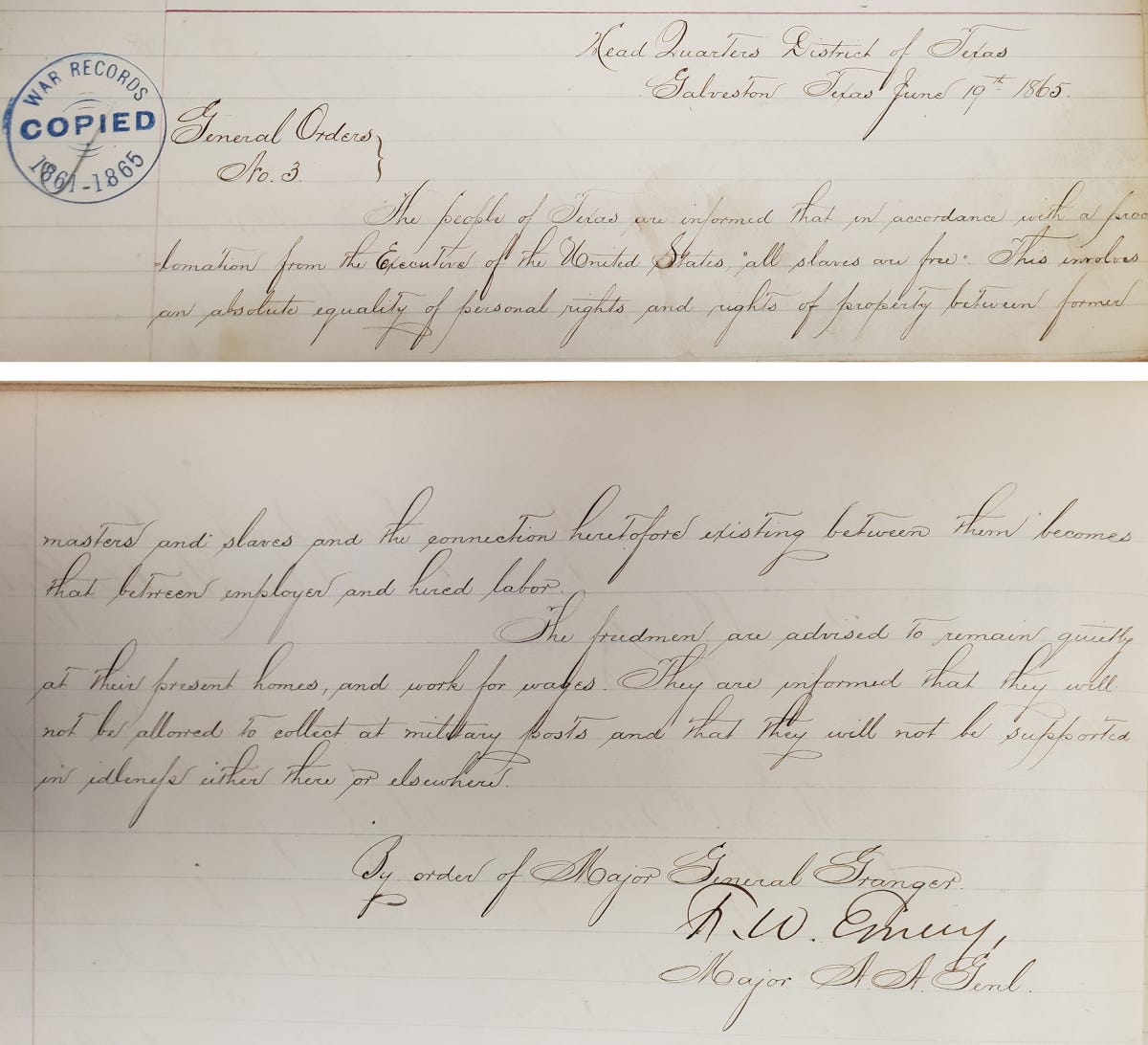
Picture: General Order 3 – June 19, 1865
On June 19, 1865, Major General Gordon Granger stood in Galveston, Texas, and read aloud an order that should have been unnecessary. General Order No. 3 informed the people of Texas that everyone held in slavery was now free. The Emancipation Proclamation had said the same thing two and a half years earlier. The difference between the proclamation and the order was the difference between a promise and its enforcement, and the thing that closed that gap was the United States Army.
That is what Juneteenth marks. The day the law finally arrived behind the men who could make it true.
Texas was the far edge of the Confederacy. Union armies had never pushed deep into it, and slaveholders used the distance to keep men, women and children in bondage long after Lincoln’s words took legal effect on January 1, 1863. Some planters moved the people they claimed to own into Texas for exactly that reason, because the war had not come there. Roughly 250,000 people were still enslaved in the state when Granger landed. Freedom existed on paper across the South. In Galveston it existed only once around 2,000 federal troops arrived to make it stick.
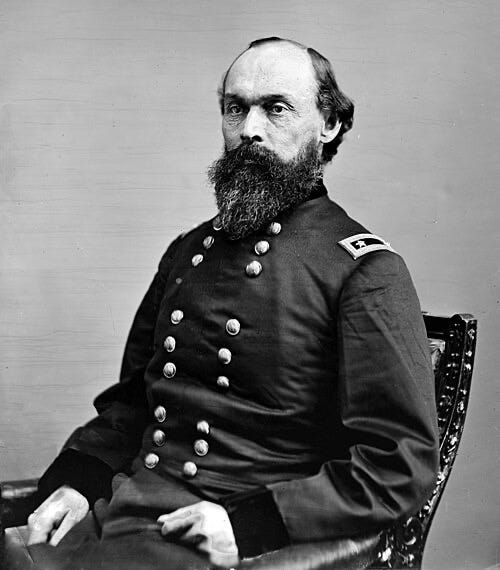
Picture: General Gordon Granger
The proclamation had been an act of war as much as an act of conscience. Lincoln issued it under his power as commander in chief, and it freed people in the states still in rebellion, where he had no practical means to free anyone at all. The document was a battlefield instrument. It became real one county at a time, wherever Union soldiers advanced. Every mile of that advance was paid for.
The bill ran higher than the country could absorb. For more than a hundred years historians settled on roughly 620,000 dead, North and South combined. The demographic historian J. David Hacker reworked the census records in 2011 and put the figure closer to 750,000. Either number is staggering. The United States in the 1860s held about a tenth of today’s population, so the same proportional loss now would mean something near 7.5 million American dead. Disease killed more men than bullets did. They died in camps and field hospitals, of dysentery and typhoid and infected wounds, far from anyone who loved them.
Most of the men who filled the Union ranks had never owned another human being and stood to gain nothing personal from the question of who did. Nearly half of them were farmers, the single largest trade in the army. They left fields half-worked and walked away from livestock and debt and growing families to enlist. A good many began the war caring only about holding the country together and ended it convinced that slavery had to die. Their letters home track the turn. Men who marched south to save the Union saw the plantations up close, met the people held on them, and came around to emancipation first as a war aim and then as a matter of conscience.
Among the dead were tens of thousands of Black soldiers fighting for their own freedom and their families’. Frederick Douglass argued that the war could not be won, and ought not be won, without them. “He who would be free must himself strike the blow,” he said, and his own sons enlisted. By the end of the war between 180,000 and 200,000 Black men had served in the United States Colored Troops. Close to 37,000 of them died.
They fought knowing the rules bent against them at every turn. A Black soldier captured by Confederate forces faced enslavement or execution rather than a prisoner exchange. At Fort Pillow, Tennessee, in April 1864, troops under Nathan Bedford Forrest killed Black soldiers who had already surrendered, and “Remember Fort Pillow” became a Union battle cry throughout the North for the rest of the war. The men of the 54th Massachusetts understood the stakes when they charged the parapets of Fort Wagner in July 1863 and lost nearly half their number in a single evening. Their colonel, Robert Gould Shaw, was buried by the Confederates in a mass grave with his men, meant as an insult that his family and history both received as an honor.
It is worth asking what kind of conviction sends a man toward that wall. For many in the Union ranks, the answer was moral and it was religious. American abolitionism had grown for decades out of the pulpit and the prayer meeting, and its ranks were Black and white together. Quakers had testified against the trade since the previous century. Revival sent white converts into the cause by the thousands. William Lloyd Garrison ran The Liberator under constant threat. Theodore Weld and the Grimké sisters preached and organized and put the argument into print. The movement buried its martyrs well before Fort Sumter. Elijah Lovejoy, an abolitionist printer, was shot dead by a pro-slavery mob in Alton, Illinois, in 1837 while defending his press. John Brown went to the gallows in 1859 after trying to arm a slave uprising at Harpers Ferry, and Union soldiers later marched south with his name set to music.
These people understood slavery as the complete inversion of the command to love your neighbor, the flat denial of the rule that you treat others as you would have them treat you. For most of the republic’s life that agency had guarded the wrong party. Juneteenth is the day it began, at gunpoint and far too late, to guard the right one.
The scale of it tells you something. More than 3 million men took up arms across those four years, over 2 million of them in Union blue, and the great majority enlisted as volunteers rather than as conscripts. They kept coming by the hundreds of thousands while the casualty lists from Shiloh and Antietam ran in the newspapers and the odds only worsened. The Republic founded in 1776 had announced that all men are created equal, then written slavery into its laws and let it stand for nearly another century. The men who filled these armies, the farmers and the freedmen and the abolitionist sons, were the ones who finally closed the gap between what the country had said about itself in 1776 and what it had been willing to do. Lincoln stood at Gettysburg and called the result a new birth of freedom. He meant that the unfinished work was getting finished at last.
The Thirteenth Amendment finished what the army started. Ratified December 6, 1865, it abolished slavery throughout the United States and lifted the question beyond the reach of any future proclamation, court or election. The amendment was the law. The graves were the price.
We remember the order and forget what it cost to carry it. Granger’s announcement in Galveston ran only a few sentences. Making those sentences mean anything took four years of war and the better part of a million lives, many of them belonging to men the old system had refused to count as fully human. The freedom announced that morning had already been bought and paid for. The only debt left is remembering by whom.