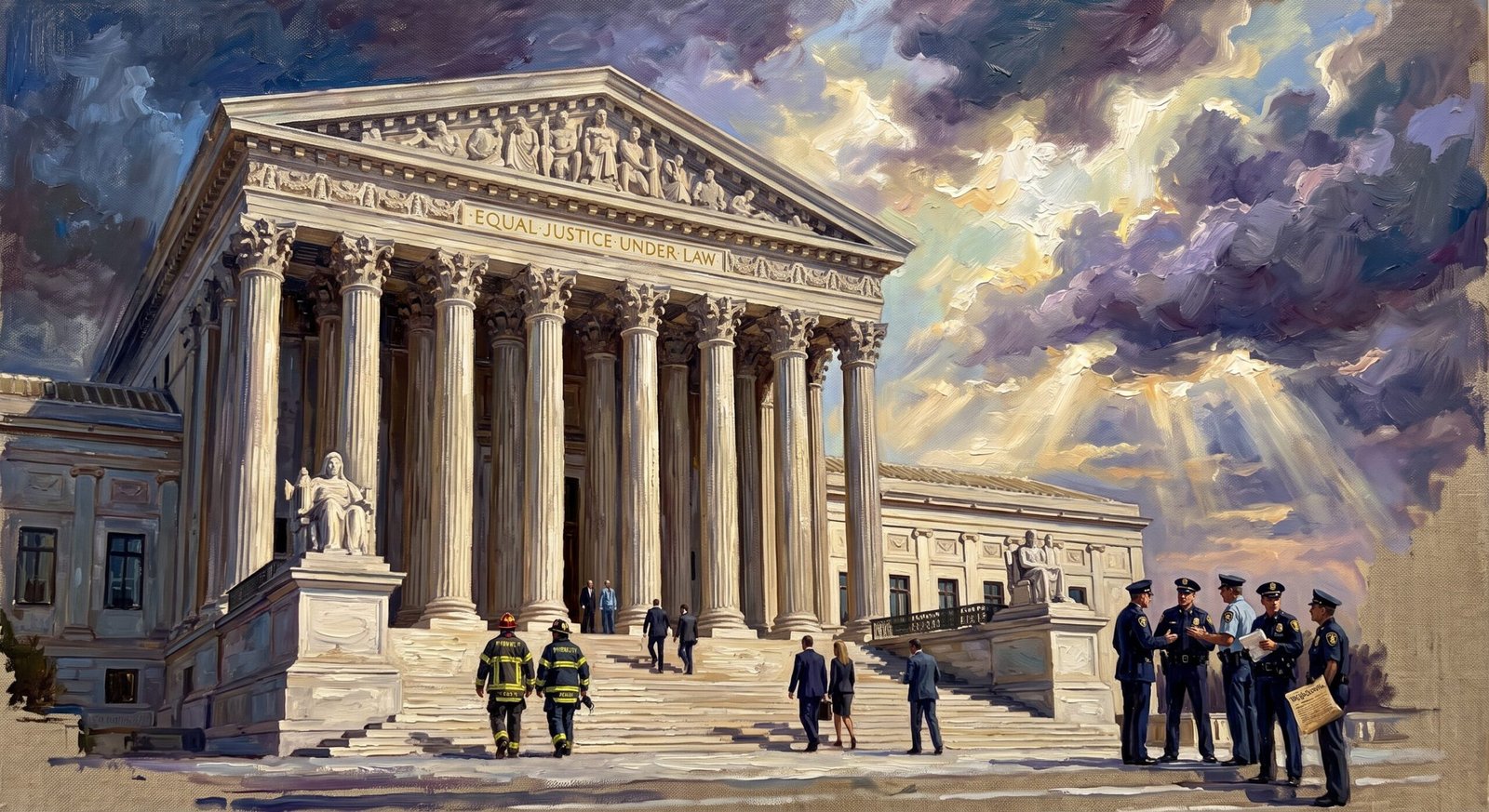
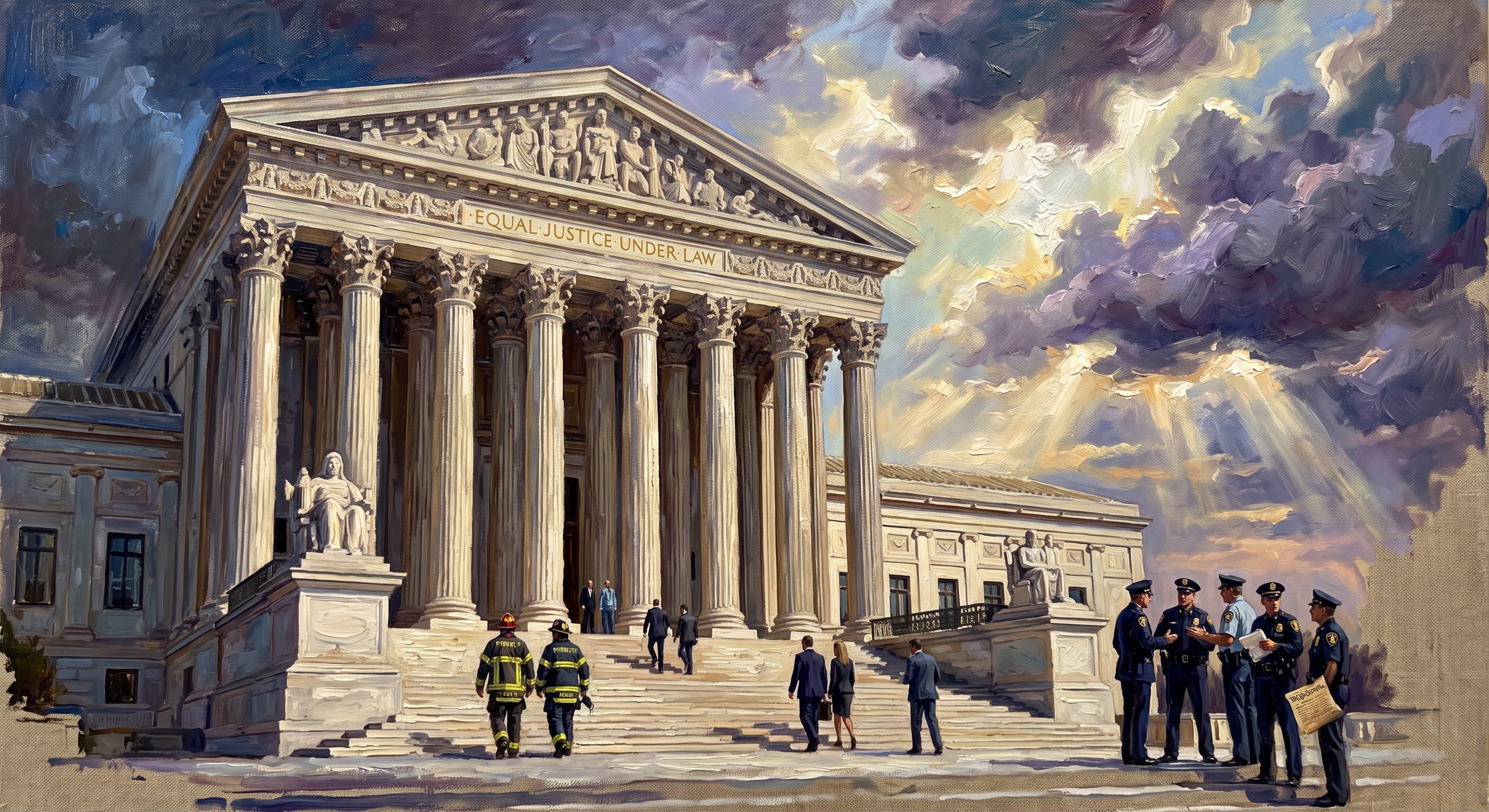
When eight veteran firefighters in rural Snohomish County, Washington requested religious exemptions from a 2021 COVID-19 vaccination mandate, they offered to continue the strict safety protocols they had used for the prior twenty months: regular testing, masking, and personal protective equipment. Instead of granting the exemptions, Snohomish Regional Fire & Rescue (SRFR) placed the firefighters on unpaid leave for nearly seven months. During that exact period, neighboring fire departments granted identical accommodations without operational disruption—and one neighboring department even hired one of the laid-off firefighters, David Petersen, to fight fires side-by-side with SRFR crews. When SRFR eventually ended the mandate and allowed the firefighters back to work without vaccinating, the firefighters sued under Title VII to recover lost wages and benefits.
The legal battle escalated when the Ninth Circuit affirmed summary judgment in favor of the fire district. Rather than requiring SRFR to demonstrate actual, concrete burdens, the appellate panel ruled that an employer needs only a “reasonable concern” that an accommodation might cause undue hardship. Under this standard, the court deemed the firefighters’ empirical evidence – including proof of zero safety disruptions, the hypothetical nature of potential lawsuits, and neighboring departments’ successful accommodations – to be legally irrelevant “hindsight”.
This ruling deepens an entrenched 3–3 split among federal appellate courts over the standard established in Groff v. DeJoy. While the Third, Seventh, and Eighth Circuits require employers to prove actual, demonstrable undue hardship to defeat Title VII claims, the First, Sixth, and Ninth Circuits shield employers that assert prospective, reasonable fears. By asking the Supreme Court to grant certiorari, the petitioners and supporting amici argue that allowing employers to prevail on speculative risk resurrects the repudiated de minimis standard and threatens religious liberty protections for millions of American workers.
Caption: Petersen v. Snohomish Regional Fire & Rescue
Supreme Court Docket and Case Materials: https://www.supremecourt.gov/docket/docketfiles/html/public/25-1210.html
More Detailed Information
The Ninth Circuit affirmed summary judgment for the employer, Snohomish Regional Fire & Rescue. The court ruled that an employer satisfies the Title VII undue hardship defense by showing a reasonable concern of operational, safety, or financial burdens. The ruling prohibits courts from considering comparator evidence that shows the accommodation did not cause actual hardship for neighboring employers.
This case addresses the application of the Supreme Court’s 2023 decision in Groff v. DeJoy. Federal appellate courts are split 3-3 on whether employers must prove actual hardship or merely a reasonable concern of hardship. Resolving this standard determines the evidentiary burden employers face when attempting to deny religious exemptions at the summary judgment stage.
How does this ruling impact Title VII religious accommodations? The Ninth Circuit’s ruling lowers the threshold for employers to deny religious accommodations. Under this standard, employers can reject requests by pointing to future risks, such as potential liability or contract loss, without proving those risks materialized. For minority religions, this means practices falling outside the cultural mainstream may face bans based on speculative safety or operational forecasts.
Timeline
-
August 2021: The Washington governor issued a COVID-19 vaccine mandate for healthcare workers.
-
October 2021: Eight firefighters submitted religious accommodation requests, asking to continue masking and testing.
-
October 21, 2021: SRFR denied the accommodations, citing health risks, a potential loss of a contract with the Department of Corrections (DOC), and uninsurable liability risks. The firefighters were placed on unpaid leave.
-
May 9, 2022: SRFR reversed its decision and allowed the unvaccinated firefighters to return to work, despite no changes to DOC policy or insurance coverage.
-
November 22, 2022: The firefighters sued SRFR under Title VII for religious discrimination.
-
January 25, 2024: The District Court granted summary judgment to SRFR.
-
September 2, 2025: The Ninth Circuit affirmed the decision, ruling that SRFR had reasonable concerns of hardship.
-
April 16, 2026: The firefighters petitioned the Supreme Court for a writ of certiorari.
What are the arguments presented by the Petitioners and Respondent?
The firefighters argue that Title VII requires employers to prove an actual undue hardship, not just a reasonable fear. They assert that the Ninth Circuit ignored evidence showing nearby fire departments safely accommodated unvaccinated firefighters simultaneously. They also note that the DOC had a policy allowing for religious accommodations and the fire department’s insurance chief admitted COVID liability lawsuits were rare. The fire department argues that emergency responders must make rapid risk assessments without waiting for a disaster to occur to prove a hardship. They claim the potential loss of a $400,000 contract and the threat of uninsurable lawsuits constituted legitimate, substantial burdens. The department also argues the differing circuit court decisions stem from unique case facts rather than a fundamental legal split.
What did the Ninth Circuit Court of Appeals decide in this matter?
The Ninth Circuit decided in favor of the fire department. The court reasoned that SRFR only needed a “reasonable concern” that granting the accommodations would cause an undue hardship. Because SRFR reasonably worried about losing their DOC contract and facing liability, the court ruled the denial was legally justified. The court determined that comparator evidence showing how other fire departments handled similar requests was irrelevant “hindsight”. The court concluded that SRFR’s decision-making process was justifiable at the time it occurred, fulfilling the legal standard for undue hardship.
The Ninth Circuit’s decision functionally shifts the Title VII inquiry from a factual evaluation of burden to a review of the employer’s subjective risk assessment. By framing comparative evidence of successful accommodations as inadmissible “hindsight,” the court insulates employers from having their hardship claims scrutinized by a jury. This approach treats speculative forecasts as equivalent to realized costs, diluting the “substantial increased costs” requirement established in Groff v. DeJoy.
If the Supreme Court allows the “reasonable concern” standard to stand, civil liberties protections for religious minorities will likely contract. Unfamiliar religious practices (such as specific prayer schedules, non-Sunday Sabbath observance, or religious attire) often trigger risk aversion in corporate and public management. If employers can legally deny these accommodations based solely on unverified, predictive apprehensions about safety or workflow disruptions, they could easily bypass Title VII’s mandate.
The Ninth Circuit’s logic in excluding comparator evidence appears structurally flawed for a summary judgment analysis. Summary judgment requires drawing all reasonable inferences in favor of the non-moving party. By categorizing the success of neighboring fire departments as irrelevant hindsight, the court preemptively shielded the employer’s risk assessment from factual challenge. Demonstrating that an identical employer safely implemented the exact same accommodation is standard, probative evidence that a hardship is not actually undue.
Currently, a worker’s right to a religious accommodation depends heavily on geography. Employees in the Third, Seventh, and Eighth Circuits benefit from a standard requiring employers to present concrete proof that an accommodation will cause actual disruption. For employees in the First, Sixth, and Ninth Circuits, a well-documented, reasonable fear of disruption from management is legally sufficient to deny an accommodation request.
What to expect next
The petition for a writ of certiorari is fully briefed following the firefighters’ reply brief filed on August 17, 2026. The Supreme Court will consider the petition in an upcoming conference for the October Term 2026 to decide whether to grant review.
Citations
Petersen v. Snohomish Regional Fire & Rescue, Petition for Writ of Certiorari, No. 25-1210 (U.S. filed Apr. 16, 2026). https://www.supremecourt.gov/docket/docketfiles/html/public/25-1210.html
Petersen v. Snohomish Regional Fire & Rescue, Reply Brief for Petitioners, No. 25-1210 (U.S. filed Aug. 17, 2026). https://www.supremecourt.gov/docket/docketfiles/html/public/25-1210.html
Petersen v. Snohomish Regional Fire & Rescue, Brief of Amicus Curiae Jewish Coalition for Religious Liberty, No. 25-1210 (U.S. filed May 26, 2026). https://www.supremecourt.gov/docket/docketfiles/html/public/25-1210.html
Petersen v. Snohomish Regional Fire & Rescue, Brief Amicus Curiae of the General Conference of the Seventh-Day Adventist Church, No. 25-1210 (U.S. filed Jun. 2026). https://www.supremecourt.gov/docket/docketfiles/html/public/25-1210.html
Subscribe and Support ReligiousLiberty.TV
Join ReligiousLiberty.TV to receive breaking news, case summaries, and expert constitutional analysis. Subscribers gain direct access to legal updates as they happen.
Legal Disclaimer: This does not constitute legal advice. Readers are encouraged to talk to licensed attorneys about their particular situations.
