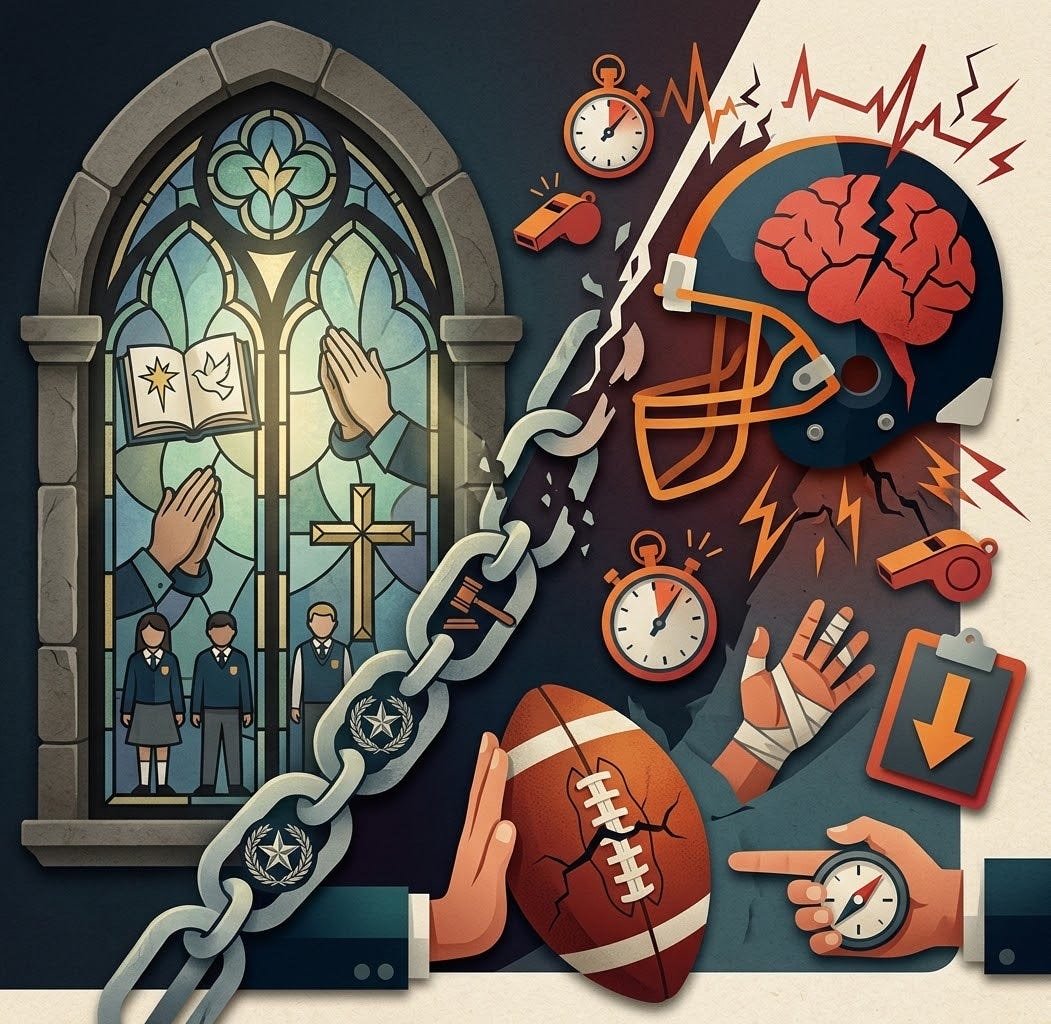
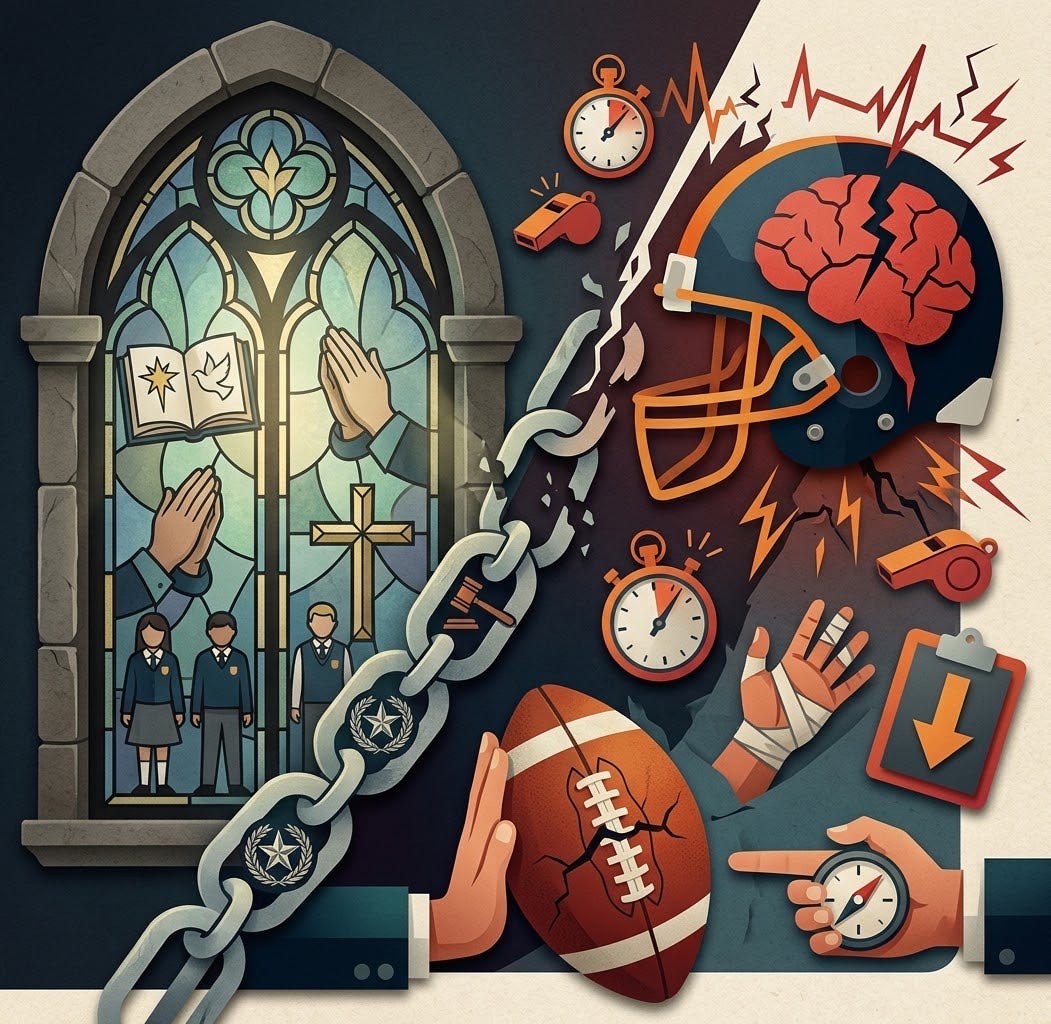
HOUSTON — When a high school football practice in Sugar Land, Texas, devolved into an alleged assault, it set off a chain reaction that ultimately forced a state appellate court to untangle a thorny constitutional question: Where does the authority of a religious school end and the jurisdiction of civil courts begin?
In an opinion issued on Tuesday, the Fourteenth Court of Appeals in Houston ruled that while the First Amendment shields faith-based institutions from lawsuits over internal policies like bullying and academic curriculum, it does not immunize them from secular player-safety commitments.
The ruling partially untethered the Fort Bend Christian Academy from a sprawling civil lawsuit brought by Scott and Lyndsey Hagan, whose son, B.H., suffered a traumatic brain injury during a varsity football practice in late 2024.
A Practice Field Assault
According to court documents, the dispute began during B.H.’s sophomore year at the Academy, a private, college-preparatory Christian school that promises a “biblically-based curriculum” aimed at modeling “Christ-like leadership.”
In January 2025, the Hagans filed suit following an incident where a teammate allegedly “violently” head-butted B.H. during football practice. The coaching staff allegedly witnessed the assault but “did nothing,” according to the plaintiffs’ petition.
In the days that followed, B.H. exhibited classic symptoms of a concussion—worsening headaches, light sensitivity, and cognitive decline. The Hagans alleged that the coaching staff failed to trigger the school’s emergency medical plan, exacerbating a traumatic brain injury that ultimately forced them to withdraw their son and enroll him in a specialized school for students with disabilities.
The Hagans sued the Academy for negligence on behalf of their son, seeking personal injury damages. In their individual capacities, they also sued for breach of contract and deceptive trade practices, arguing that the school failed to uphold its own handbook policies regarding bullying, academic accommodations, and safety protocols.
The Shield of Ecclesiastical Abstention
The Academy pushed back, filing a “plea to the jurisdiction.” It argued that under the First Amendment’s “ecclesiastical abstention doctrine,” civil courts are forbidden from meddling in the internal governance and spiritual frameworks of religious bodies. While the school did not challenge the student’s direct negligence claim, it sought to throw out the parents’ contract-based claims.
Writing for the appellate panel, Judge Brad Hart drew a sharp line down the middle of the parents’ grievances;
“The ecclesiastical abstention doctrine prevents the trial court from exercising jurisdiction over the plaintiffs’ claims based on the Academy’s internal policies on academic accommodations, bullying, harassment, and discipline…”
The court noted that the Academy’s anti-bullying handbook explicitly outlines a framework of “discipline that [is] Bibliocentric,” aimed at helping students “grow in discipleship.” To evaluate whether the school handled bullying properly, the court reasoned, would require a judge or jury to unconstitutionally interpret religious doctrine and interfere with church governance.
Similarly, the court threw out claims regarding the school’s failure to provide academic accommodations, noting that deciding how and when the school alters its “biblically-based curriculum” is a purely ecclesiastical matter.
Where Faith Meets Concussion Protocols
However, the Academy’s constitutional shield cracked when it came to the football field.
The Hagans pointed out that Fort Bend Christian Academy is a voluntary member of the Texas Association of Private and Parochial Schools (TAPPS), a secular governing body that dictates stringent concussion-management policies for student-athletes. Under TAPPS rules, any player showing signs of a concussion must be immediately removed from play and cleared by a medical professional.
The school’s athletic trainer testified in a deposition that despite B.H. exhibiting symptoms, no coaches initially reported the incident, delaying his evaluation.
The appellate court ruled that because TAPPS applies to all member schools—secular or religious—the safety mandates could be evaluated under “neutral principles of law.”
“Because all member schools—religious or not—must comply with TAPPS’s by-laws, resolving these claims would not require inquiry into religious doctrine,” Judge Hart wrote, adding that holding otherwise would be “subversive to good order.”
What Comes Next
The mixed ruling represents a partial victory for both sides. The court conditionally granted a writ of mandamus, ordering the lower 240th District Court of Fort Bend County to dismiss the claims tied to bullying and academic adjustments.
However, the core of the Hagans’ legal battle lives on. The school must still face the parents’ claims regarding the mishandling of the concussion protocol, alongside the separate, ongoing negligence lawsuit filed on behalf of B.H. for his physical injuries.
The case underscores a legal boundary line, confirming that while the state will fiercely protect the autonomy of religious education, it will not allow the First Amendment to act as a waiver for the secular safety obligations of high school sports.
Caveat Emptor: What Private School Parents Need to Know About Legal Liability
For parents enrolling their children in religious private schools, the recent Texas appellate ruling serves as a vital reminder of the legal doctrine known as caveat emptor—buyer beware. While many families choose faith-based institutions specifically for their moral frameworks and close-knit communities, they may not realize that doing so often means stepping outside the traditional protections of the civil justice system.
When signing an enrollment agreement, parents should carefully consider the following legal realities:
The First Amendment Shield: Under the ecclesiastical abstention doctrine, civil courts generally cannot intervene if a religious school violates its own handbook policies regarding student discipline, bullying investigations, or academic accommodations. If an issue is tied to the school’s spiritual mission or internal governance, secular judges are constitutionally barred from second-guessing those decisions.
The Contract Illusion: A student handbook may look like a binding legal contract, but if its promises are grounded in “biblically-based” frameworks or religious values, those promises are often legally unenforceable in a court of law. In the eyes of the court, enforcing them would require unconstitutional meddling in religious matters.
The Secular Safety Exception: As seen in this case, religious schools are generally only held civilly liable when they voluntarily bind themselves to independent, secular organizations (such as state athletic associations) or when a claim relies entirely on neutral tort principles, like basic physical negligence.
The Bottom Line: Before signing an enrollment contract, parents must understand that a religious school’s internal grievance process is often the final word. If a dispute arises over how the school handles a non-physical crisis like bullying or academic failure, you may have no recourse in a civil court.
This does not constitute legal advice. Contact a local attorney to discuss your situation.
