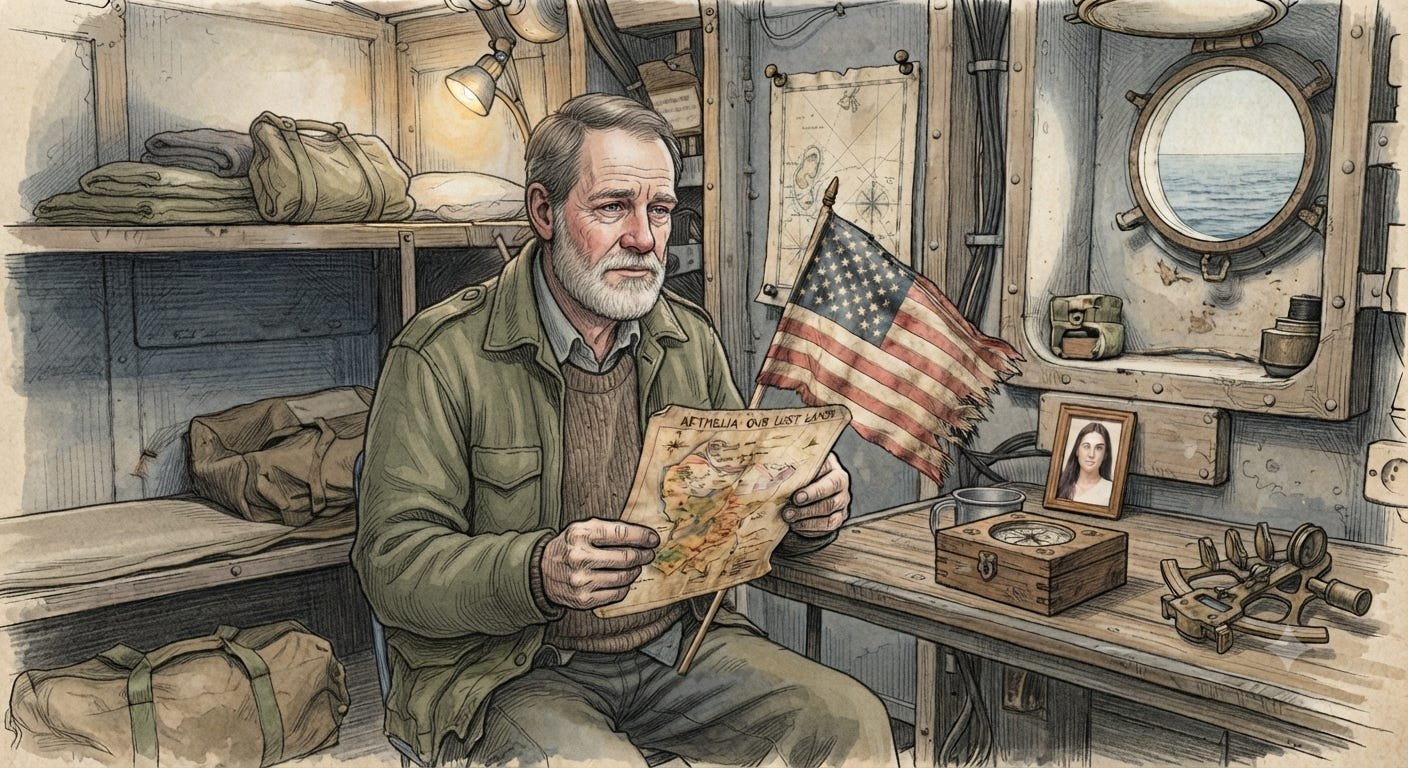
A note before we begin: This story borrows its shape from Edward Everett Hale’s fictional short story, “The Man Without a Country,” published in The Atlantic Monthly in December 1863. Hale wrote it in the middle of the Civil War, when the nation’s stitching had come apart at the seams, to remind readers what it costs to curse the place that raised you, and what it’s worth to come home to it. What follows isn’t a translation of his story. It’s the same bones dressed in today’s clothes, arriving, as it happens, on the eve of the country’s 250th birthday.
-Michael Peabody
I suppose few people scrolling through the obituaries that week stopped long enough to notice the two lines wedged near the bottom of the page, between a retired schoolteacher from Tulsa and a Korean War veteran from Biloxi:
NOLAN. Died aboard USNS Wanderer, at sea, on July 2. Philip Nolan, 76, civilian mariner. No services planned. Burial at sea.
I noticed. I have a good memory for names, and I had reason enough to remember this one. If the officer who filed that report had known the whole of it, and chosen to write it plain, he might have put it differently: “Died, at last, the man who spent 51 years without a country.” That was what a few of us called him, quietly, in the years I served alongside him, though never where he could hear it. Most of the young sailors who crossed his path never learned his name was Nolan at all. To them he was just the quiet civilian contractor who kept to himself, ate alone, and flinched, every so often, at something nobody else in the room seemed to notice.
There’s no reason for secrecy now, so I’ll tell what I know of him. I pieced most of it together over 30 years, the way you piece together a man from what other men remember of him, a little here and a little there, none of it quite lining up. But now that he’s gone, and given that the country he loved and lost turns 250 years old tomorrow, it feels like the right week to set it down.
* * *
Philip Nolan was 26 years old and an Army first lieutenant in 1975, stationed at a dusty post near the Arizona line, the kind of assignment that convinces a young man his whole career is a waiting room. That was where he met General Merrick Sallow.
Sallow had resigned his commission in disgust the year before, tired, he said, of watching Washington lose wars it never should have started and abandon men it never should have promised to bring home. He spent that year touring the Southwest in a borrowed Winnebago, addressing VFW halls and county fairs and the back rooms of steakhouses, talking about something he called the Second Union: a loose confederation of western states that would look after their own borders, their own water, their own young men, and stop waiting on permission from a capital three time zones away. He had a way of talking that made lonely, restless men feel like the last honest patriots left standing. Nolan was lonely and restless, and he fell for it the way a man falls down a stairwell, all at once and without deciding to.
By the following spring, Nolan was helping move crates of surplus rifles off an Army depot and onto a truck bound for Sallow’s people out west. He told himself it was nothing much, that the rifles were headed for scrap anyway, that a man had to belong to something bigger than a supply requisition form. He believed this for about four months, right up until an inventory clerk in El Paso noticed the numbers didn’t add up.
* * *
They court-martialed six men that spring. Sallow himself walked, protected by a technicality and a very good lawyer, which struck Nolan as the whole rotten proof of everything Sallow had ever said about the country being broken. Nolan alone among the six had nothing clever to offer in his own defense. When the presiding officer, a colonel named Osgood Traverson who had buried a younger brother outside Khe Sanh eight years before, asked him at the close of testimony whether he had anything to say that might demonstrate his continued loyalty to the United States, Nolan stood up and said the thing that would follow him to his grave.
“Forget the United States,” he said. “Strike her off my file for all I care. I hope to God I never hear her name again as long as I live.”
Nobody in that room laughed. Traverson’s face went the color of a bedsheet. He called a recess, and when he came back 40 minutes later, he read a sentence unlike anything in the manual, unlike anything any of us had heard of before or since.
“The court has decided,” he said, “to grant the lieutenant his wish.”
The order that followed Nolan from that day forward, ship to ship, posting to posting, for the rest of his working life, read in part:
You will take into your custody the person of Philip Nolan, former lieutenant, United States Army, whose sentence by general court-martial has been approved.
Nolan expressed, under oath, before this court, the wish that he might never again hear the name of the United States. The court has seen fit to grant him that wish.
You will provide him quarters, rations and treatment appropriate to a man of his former rank. He is to suffer no indignity beyond the sentence itself.
You will ensure that no one under your command speaks to him of the United States, in any particular, nor permits him access to any material, printed or broadcast, that names her.
This order transfers with him to whatever vessel or posting next receives him, until further notice.
Further notice never came. Sometime in the 1990s, when the Pentagon digitized its old paper files, the order fell through a crack nobody ever went looking for, and the legal authority behind Nolan’s sentence simply evaporated. By then it hardly mattered. The men who had custody of him had turned the order into something closer to an unwritten oath, passed quietly from one commanding officer to the next the way a family keeps handing down a Bible nobody quite remembers how to stop passing along. Somewhere in there the sailors started calling him No-Flag, never to his face, and the name held for half a century.
* * *
I want to tell you what that looks like in practice, in an age when the whole world is supposedly one search away. It looks like a paperback with a page cut clean out because the flip side ran an ad for a car dealership back home. It looks like a satellite phone with half its apps disabled and its browser locked to weather and shipping charts. It looks like movie night on the mess deck of some support ship in the Indian Ocean, an old black-and-white war picture flickering on the screen, everyone half asleep, until the last reel turns out to be a homecoming: a band playing, a flag going up a pole, a mother running across a platform toward her son. Nolan got up without a word that night and didn’t come out of his cabin for the better part of two weeks. He never came to another movie night again. Not once, not in 51 years.
It looks, too, like an evening at some embassy reception years later, dress whites and cheap champagne, when a woman he’d once courted back in Tucson recognized him across the room. She’d married well since then, and when he asked her, almost before he could stop himself, what she’d heard from home lately, she looked at him the way you’d look at a stranger who’d said something obscene in church. “I thought you were the one who never wanted to hear that word again,” she said, and walked back to her husband. He didn’t dance again that night, or any night after, that I ever heard of.
* * *
There is a happier story, and I believe it, because three different men who weren’t given to embellishing told it to me the same way. It happened during a typhoon off the Philippines sometime in the late 1990s, when Nolan was working as a ship’s engineer, the Navy having long since folded him into civilian mariner status the way you fold a hard problem into a drawer. A fire broke out belowdecks. Men were hurt. In the chaos, it was Nolan, of all people, who organized the fire party, directed the wounded to the sick bay, and stayed with the hose crew until the flames were out, calm the whole time, the way some men just are when everything else is falling apart.
The captain wanted to put him in for a commendation. He mentioned Nolan by name in the incident report. Word came back down through channels nobody could quite trace that his name should be removed from the official account. He never got the medal. If it bothered him, he never once said so where anyone could hear.
* * *
The story that undid me, though, the one I still can’t tell without my voice catching, happened in the South China Sea years before the fire, when I was young enough to still be learning what kind of man I wanted to become. We came across a fishing boat, overloaded and adrift, some 40 refugees aboard, most of them Vietnamese, all of them terrified. Someone was needed who could translate, and it turned out Nolan, of all the men on that ship, had picked up enough of the language decades earlier, in another life, before any of this had happened to him.
He went over in the launch. I went with him. And I watched him kneel on that filthy deck and listen to an old man beg him, through tears, to take them somewhere, anywhere, that wasn’t this boat, wasn’t this ocean, wasn’t this waiting. “He says he has a wife in Da Nang,” Nolan told our officer, his voice cracking on every third word. “He says his daughter doesn’t know if he’s alive. He says he only wants to go home. That’s all any of them are asking. Just to go home.”
Afterward, alone with me at the rail, he said the closest thing to a confession I ever heard pass his lips.
“You let that show you something, son,” he said. “There is nothing on this whole earth worse than not having one place that has to take you back. Whatever they tell you, whatever it costs you to feel like you belong somewhere, don’t you ever let anybody talk you out of loving the place that’s yours. It’ll forgive you things you can’t forgive yourself. Mine won’t anymore. That’s on me, not her.”
I was 23 years old, and it scared me more than the typhoon had. I never repeated it to anyone until now.
* * *
I tried, years later, when I’d made rank and thought I had some pull, to get his case reopened. I wrote letters. I called in favors. Every door I found led to a clerk who couldn’t confirm the man existed in any file they could locate, and a polite suggestion that I was mistaken. It was, as somebody once told me about a different kind of ghost, like trying to spring a man from a jail that had officially never held him.
He aged the way rope ages at sea: slow and even, until the day it just gives. I wrote to him twice a year for three decades. He answered maybe a dozen times in all, always briefly, always kind, and never once mentioning what both of us knew he was missing.
* * *
The last letter I ever got about him came from a young ensign named Marcus Doyle, aboard the Wanderer, dated the day before he died. I’ll let him tell it, because I couldn’t improve on it if I tried.
Dear Fred,
I don’t know how to make this easy, so I won’t try. It’s over for old Nolan. I’d been with him more on this deployment than any before, and I understood for the first time everything you used to hint at but never quite explained. The doc had been watching him close for a week, and yesterday morning he told me Nolan hadn’t left his cabin, which none of us could remember happening before. He asked for me.
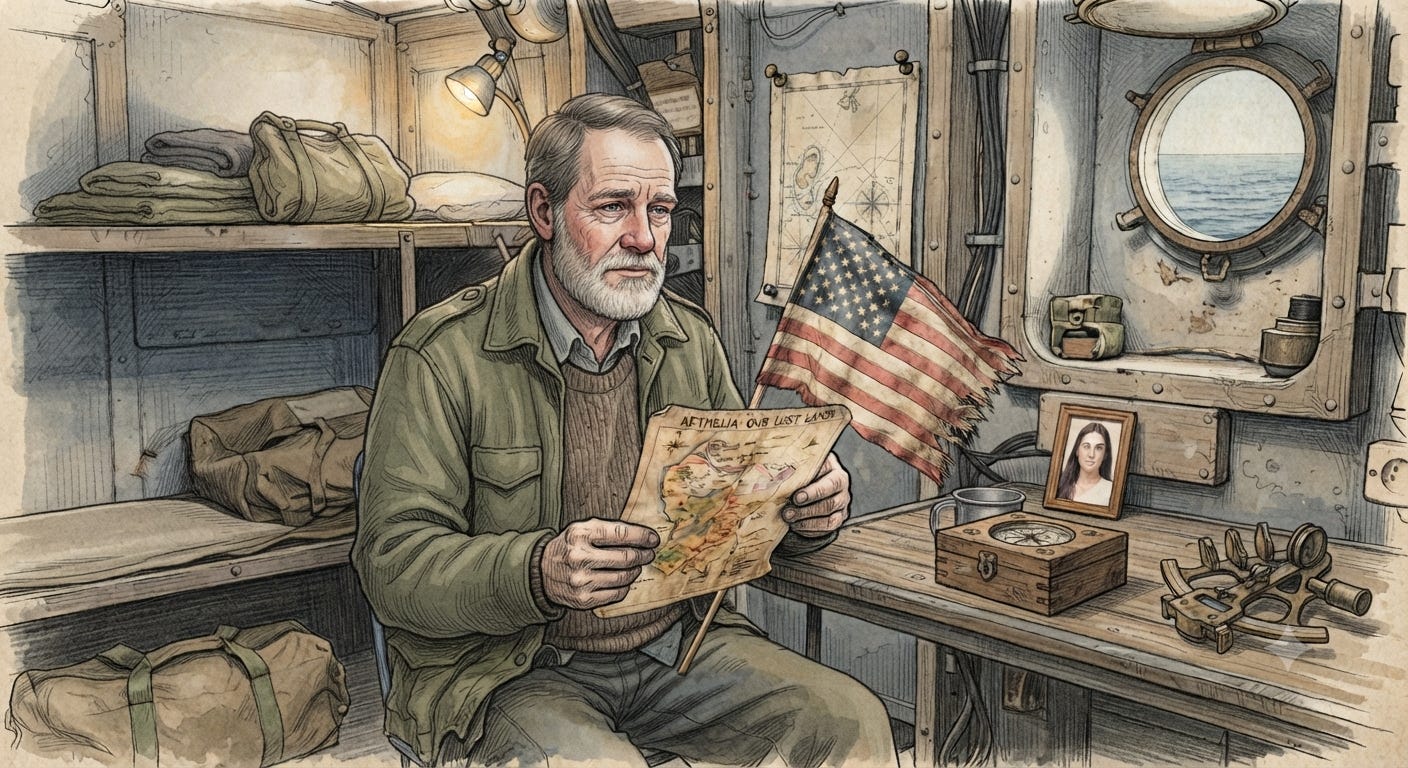
I went in and found him propped up in his rack, smiling like always, but thin as a reed and gray around the mouth in a way I didn’t like. And there, tucked into the corner where his footlocker meets the bulkhead, was the strangest little shrine I’ve ever seen a grown man keep. A flag, folded the proper way, tacked up behind a hand-drawn map of the 50 states, every one penciled in from memory, question marks scattered across places he must not have trusted himself to remember right. A photograph, worn so soft it looked more like cloth than paper. He caught me looking and said, with the saddest smile you ever saw, “Here, you see. I do have a country.”
“Doyle,” he said, “I know I’m going. I can’t get home now, so I’m asking you. Tell me everything. Don’t leave anything out.”
And Fred, I felt about two inches tall, realizing I’d been keeping a 51-year-old secret from a dying man out of nothing but habit. So I told him. I started with what he half suspected already, that the flag still carried 50 stars, same as the day they took it from him, not one added and not one lost the whole time he’d been gone, and I have never in my life seen a man look so relieved by a plain fact. Then I told him the rest.
I told him about the fall of Saigon, and the hostages in Iran, and the Wall coming down in Berlin while half the world cried in the streets. I told him about the Gulf, and the towers falling, and the wars that followed that seemed to never quite end. I told him about the internet, and the phone in my pocket that could talk to a satellite, and how a man could watch his own hometown parade live from the middle of the Pacific Ocean if he wanted to, though I didn’t say why I mentioned it that way. I told him there’d been 10 presidents since his court-martial, some he might have recognized coming up the ranks and most he never would have believed if I’d drawn him a picture. I told him about small towns I’d passed through growing up, the diners that closed and the ones that somehow hung on, the high school football stadiums still packed on a Friday in October like nothing else in the world mattered more, because for three hours, in a lot of those towns, nothing else did.
He drank it in like a man dying of thirst, which I suppose he was, in his own way. Near the end he asked what day it was, and when I told him, he went quiet a long moment, working the arithmetic in his head.
“Tomorrow,” I said, before he could ask, “the whole country turns 250 years old.”
He didn’t say anything to that. He just closed his eyes, and I thought for a second I’d lost him already. But he squeezed my hand hard and asked if I’d read to him. Not the news. His Bible, a passage he’d marked so long ago the pages had gone soft right at the crease. We read it together, his voice barely a whisper under mine, and then he asked me to say the Lord’s Prayer with him, which we did. Then he said he thought he’d sleep a while.
I didn’t think it was the end. I thought he was only tired. I know now he was happy, and I believe he wanted to be alone with that a moment before he went.
The doc found him an hour later, gone easy in his sleep, a small folded corner of that flag pressed against his chest where his hand had come to rest. In his Bible we found a slip of paper tucked at the place he’d marked, and on it, in his own hand, this:
“Bury me at sea. It has been the only country that never once asked me to prove myself twice. If anyone wants to mark my memory, say only this: He loved this country as much as any man who ever wore her uniform. He asked less of her than she offered him, and gave back less than he owed her. She forgave him anyway. That’s the whole of what a country’s for.”
* * *
Tomorrow morning, somewhere off in the Pacific, they’ll commit Philip Nolan’s body to the sea he chose over any shore he was ever allowed to stand on again. And tomorrow afternoon, back on the only ground that ever mattered to him, the whole country he damned in a moment of 26-year-old fury turns 250 years old, flags out on porches from one coast to the other, 50 stars on every one of them, same as the day he lost the right to see them.
I don’t know what to make of a life like that, except to say I believe he made his peace with it long before I understood there was any peace to be made. Maybe that’s the whole of what these stories are for, his and every other one like it, in every war this country has ever fought with itself. Not to tell you never to be angry at her. She’ll earn it, plenty of times, same as any place worth loving does. Just to tell you what it costs to mean it when you say you’re done with her, and to hope you never have to find out for yourself.
Happy birthday, old girl. Nolan’s home now, whether you ever forgave him or not.
