The Shield They Are Dismantling
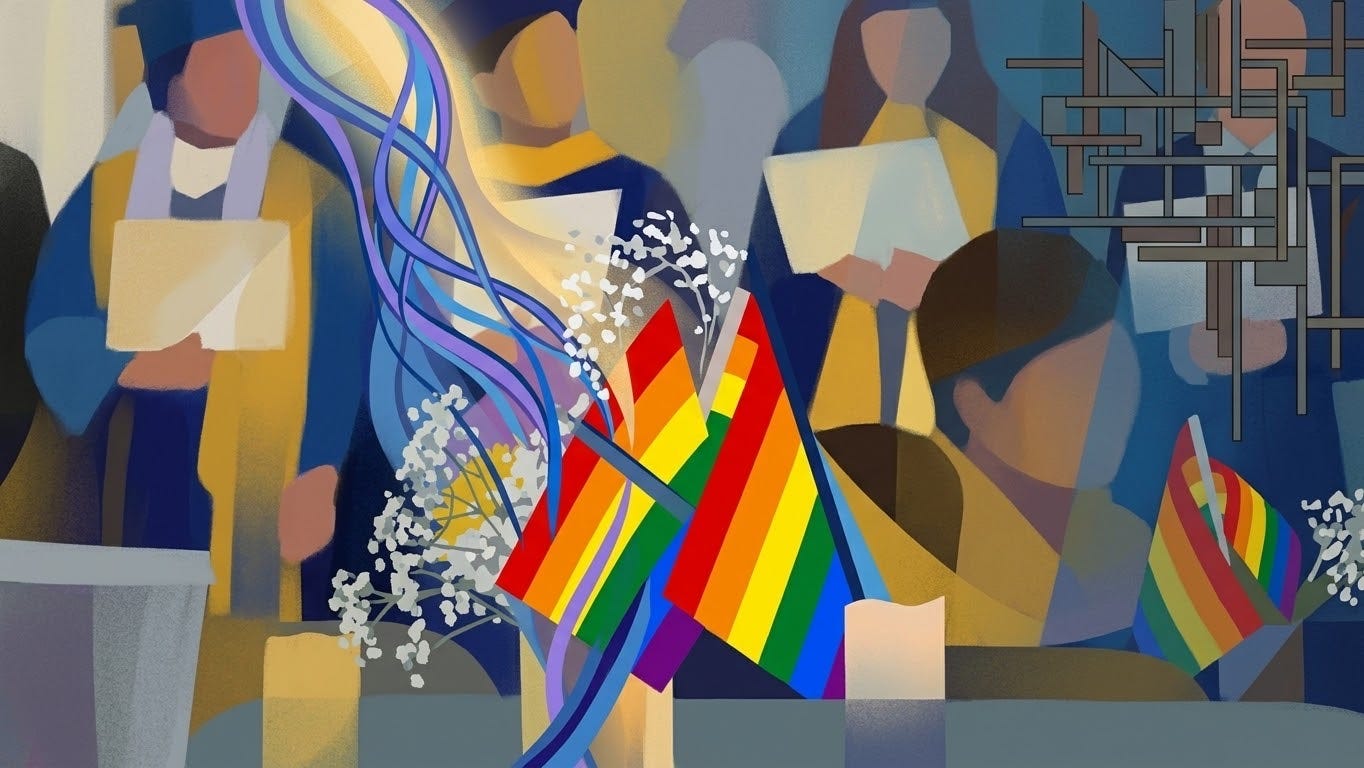
On the evening of June 5, 2026, in a chapel in Riverside, the president of La Sierra University stood before seven graduates and told them, “I am La Sierra,” and that the university “is big enough for all.” The occasion was the sixth annual Lavender Graduation (Spectrum) hosted by the La Sierra University Church’s Kinship Sabbath School, which has gathered LGBTQ members and allies for worship since 2020. Small rainbow flags marked the chapel doors. The senior pastor prayed that the graduates would know they were cherished. An associate pastor asked God to forgive those who “insist on living in black and white.”
The detail that makes this news, noted from the floor by Old Testament professor Wonil Kim, is that this was the first year senior administrators took part. President Christon Arthur and the interim provost did not merely attend. They lent the institution’s authority to the evening, which is what turns a private act of affirmation into a public statement about what the university is.
I have no interest in litigating the graduates themselves. They are named in the coverage, they earned their degrees, and several plan to spend their working lives caring for other people. The argument is narrower and harder to wave away: the families who pay for Adventist institutions are owed an honest account of what those institutions do.
What the Church Actually Says
The denomination’s position is not vague. Fundamental Belief 23 defines marriage as “a lifelong union between a man and a woman.” The General Conference statement on homosexuality, voted in 1999 and revised in 2012, holds that the Bible “makes no accommodation for homosexual activity or relationships.” A companion statement rejects same-sex unions, and the 2014 guidelines reaffirm both. Whatever one thinks of these documents, they are public, official and unrepealed.
Parents who choose Adventist education, often at considerable expense or at the cost of other more academically attractive alternatives, generally do so because they expect the school will support their children in those convictions, not rewire those beliefs under a guise of Adventism. That assumption is the thing they believe they are buying. When a university’s leadership stands beneath pride flags and blesses what the church’s own statements forbid, the product has quietly changed, and the buyers are entitled to know it.
The Case on the Other Side
The affirming community will answer, and not without force, that this is the gospel rather than a departure from it. They point to graduates whose own parents would not come, and to strangers who walked them across the stage instead. One mortarboard read, “Visible for those who can’t be.” A faith with no answer for the rejected has misplaced something near its center, and the people who built this Sabbath school plainly believe they are doing the work of mercy. They may be right.
La Sierra, moreover, has been the denomination’s most theologically independent campus for half a century. No one paying attention mistook it for a seminary. The honest objection is not that the university harbors dissent. It is that dissent practiced quietly and dissent blessed from the platform by the president are different facts, and only the second tells parents where the institution has actually arrived.
A Schism
Notice what is happening. An Adventist university now blesses from its platform what the world church forbids in its statutes, and both fly the same name. This is the sexuality question laid atop the fault lines already straining the denomination: women’s ordination, the authority of Scripture, how far a local conference may defy a General Conference vote. Call it what it is, a slow schism, conducted by press release and quiet practice rather than formal rupture.
And the machinery of discipline runs in one direction. The same church that barred Stephen Bohr and Conrad Vine from pulpits over the content of their preaching, and placed a Michigan pastor on administrative leave for hosting the wrong speaker, finds no equivalent sanction for a campus that stages what its statutes forbid. Enforcement falls on the right; applause greets the left. A church that disciplines only one of its wings is not preserving unity. It is choosing a side and declining to say so.
The Shield Is Conditional
The law protects Adventist education more generously than its critics admit. But every layer of that protection is conditional on the institution behaving like what it claims to be.
Title VII exempts a religious employer, its schools included, from the statute’s bar on religious discrimination, allowing it to hire for genuine religious fit. The Supreme Court’s ministerial exception, expanded in Our Lady of Guadalupe School v. Morrissey-Berru (2020) to reach teachers who perform religious functions, lets a school decide who instructs the young in the faith without judicial second-guessing. And the Religious Freedom Restoration Act, which the majority of Supreme Court justices in Bostock v. Clayton County (2019) called “a kind of super statute,” can override Title VII where compliance would substantially burden sincere religious exercise. In Braidwood Management v. EEOC (2023), the Fifth Circuit held exactly that, ruling that a religious employer could not be forced, after Bostock, to abandon its conduct standards on homosexual and transgender behavior. That ruling binds only the Fifth Circuit, and La Sierra sits in the Ninth, where the question is unsettled, so a California institution leans on a protection it cannot yet count on. The denomination’s own 2014 guidelines stake out this ground in advance, reserving the right to employ people “according to Church teaching about sexual behaviors” and pledging to defend it “in courts of law.”
Read the Braidwood opinion closely, though, and the trap becomes visible. The court could rule for the employer because its sincerity, in the court’s words, “is not at issue.” That is the entire game. After Bostock folded sexual orientation into Title VII’s definition of sex discrimination, the religious defense no longer turns on whether a belief sits on paper. It turns on whether the institution holds the belief sincerely and applies it consistently. A standard invoked against some and waived for others is the textbook mark of pretext, and pretext is what converts a protected religious judgment into unlawful discrimination. The Supreme Court has never squarely resolved how Bostock meets the religious exemption, which is precisely why an institution that wants the shield should not be handing courts reasons to withhold it.
Consider, then, the position La Sierra’s leadership has built. Suppose the university one day declines to terminate an employee for conduct its handbook forbids. That employee’s lawyer will not need to manufacture evidence of insincerity. He will introduce a photograph of the president on a chapel platform, beneath rainbow flags, assuring LGBTQ graduates that “La Sierra is big enough for all.” The handbook says one thing; the president performed another, in front of cameras, with the provost beside him. A church that disciplines a conservative preacher for his theology while celebrating what its own statutes forbid does more than play favorites. It assembles, in public, the exhibit that defeats its own exemption.
Candor, or Nothing
The remedy is not punishment, and it is certainly not the silencing of anyone. It is candor, and consistency. Let institutions say plainly where they stand, in their viewbooks and not only in their chapels, so that a devout family in Loma Linda and a progressive family in Riverside can each choose with open eyes. Let the church name the division it has been managing by euphemism, and apply its rules evenly or admit it has none.
Everyone in this story asked to be seen. The graduates asked, and received it. Parents are asking for the same thing, and they have not always been granted it. Forgive us, the prayer went, when we insist on living in black and white. Fair enough. But families, and the denomination as a whole, deserve to read the full color of what they are paying for, and to decide, in the daylight, whether to write the check.