U.S. Brands Nigeria a Religious Freedom Violator as Christian Death Toll Climbs
Before dawn in Nigeria’s Middle Belt, the roosters do not get to finish. The men arrive with rifles and machetes while the village is still folded in sleep, and by the time the sun clears the hills there is a church standing with its roof burned open to the sky and no one left inside to sing.
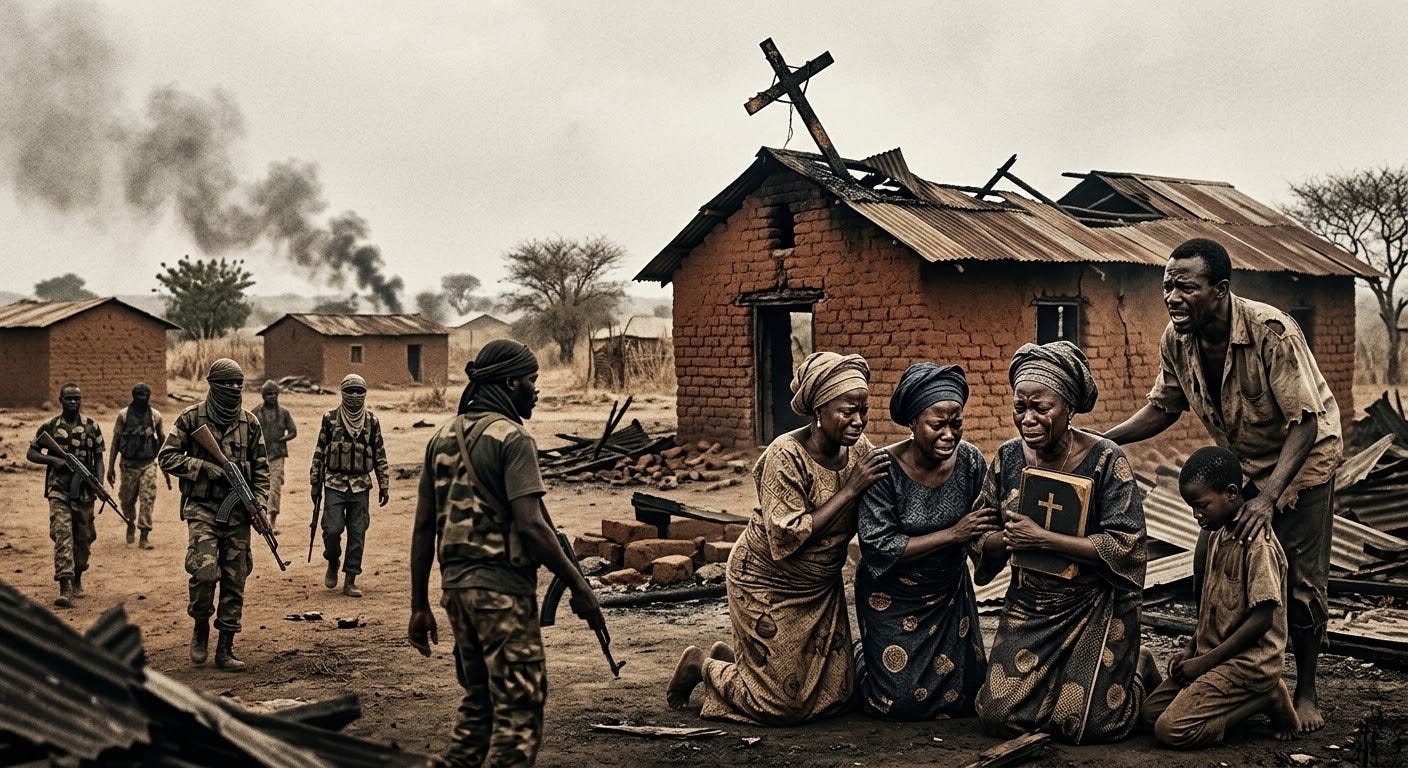
That is what happened in Mbalom, in Benue state, on Easter morning. Seventeen believers gathered for the oldest celebration the faith owns, the one about a stone rolled away and a tomb found empty, and met men who had decided their tombs would not stay empty. A week earlier, in a community outside Jos, at least 30 more were killed on Palm Sunday. The branches had hardly dried.
We are asked to call this something else. A land dispute. Herders and farmers quarreling over grass thinned by a warming sky. Nigeria’s president offers that explanation to other heads of state, and a former American secretary of state told Congress in 2024 that the killing of Christian farmers “has nothing to do with religion.”
That is the kind of sentence a trial lawyer learns to distrust. It is what you say when the file is against you and you are praying the jury will not open it. So open it. Open Doors counted 4,849 Christians killed for their faith worldwide last year. Of them, 3,490 died in a single country. Nigeria holds a small share of the world’s Christians and roughly three-quarters of its martyrs. A disproportion that vast stops being an accident somewhere on the way to the morgue. It becomes a verdict.
The verdict has a paper trail. Twelve northern states enforce blasphemy laws, the legal machinery that can put a young man in prison for a sentence typed into a phone. Set the two facts beside each other. A government that will not send soldiers to a Christian hamlet at midnight will, by morning, prosecute a citizen for an unwelcome opinion about the Prophet. The same instrument that fails to guard the believer is busy policing belief. Cruelty that organized is not the weather. It is a policy.
None of this is a secret to the people whose job is to know. The U.S. Commission on International Religious Freedom has recommended naming Nigeria a Country of Particular Concern every year since 2009, through administrations that listened and administrations that looked away. The designation is not a press release. Under the International Religious Freedom Act it is a lever, a set of tools that lets a president attach a price to atrocity: sanctions, named officials, consequences that reach the men who sign the orders and the men who decline to stop them.
In October the United States named Nigeria again. Naming is where accountability begins, the way an indictment begins a trial. But an indictment that never reaches a courtroom is only a piece of stationery. The question now is whether the word becomes a cost. Whether the governors who shelter the killers find their visas canceled and their accounts frozen. Whether a mother in Plateau who buried a son this spring has any reason to believe the world did more than frown.
Here is the part the policymakers can miss from a hearing room. Grief in Benue does not file quarterly. It arrives at a particular kitchen table, in a particular empty chair, in a child who asks where her father went and gets no answer a parent can bear to give. Multiply that table by the thousands and you do not get a statistic. You get a country bleeding in a language the rest of us have decided not to learn.
And still they sing. This is the thing the gunmen never seem to understand, the miscalculation buried in every burned sanctuary. Sunday comes again. The survivors rebuild the roof, or they meet under the open one, and they sing the same defiant songs over the same fresh graves. The faith that men keep trying to extinguish in Nigeria turns out to be the hardest thing in the country to kill.
The least the watching world can do is refuse to call murder a misunderstanding. Name it. Price it. And say plainly, in the only courtroom that finally matters and in every earthly one we can reach, that the people dying before dawn in the Middle Belt are not a footnote to somebody’s grass. They are the conscience of the age, and they are being killed for keeping it.
The Mbalom, Benue figure of at least 17 killed on Easter Sunday is from International Christian Concern: https://persecution.org/2026/04/06/dozens-killed-in-easter-attacks-across-nigeria/
The Palm Sunday attack near Jos that killed at least 30 is also from ICC: https://persecution.org/2026/03/30/dozens-killed-during-palm-sunday-attacks-in-nigeria/
The kill counts (3,490 of 4,849 Christians killed worldwide died in Nigeria) come from Open Doors’ World Watch List 2026, reported by Catholic World Report: https://www.catholicworldreport.com/2026/01/16/nigeria-accounts-for-72-of-christian-killings-worldwide-new-report-finds/
The Blinken line (“has nothing to do with religion,” May 22, 2024 testimony) is documented in H.Res.860: https://www.congress.gov/bill/119th-congress/house-resolution/860/text
USCIRF’s recommendation of the CPC designation every year since 2009 is in H.R.7457: https://www.congress.gov/bill/119th-congress/house-bill/7457/text
The Oct. 31, 2025 CPC designation by Trump is from USCIRF: https://www.uscirf.gov/news-room/releases-statements/naming-nigeria-country-particular-concern-important