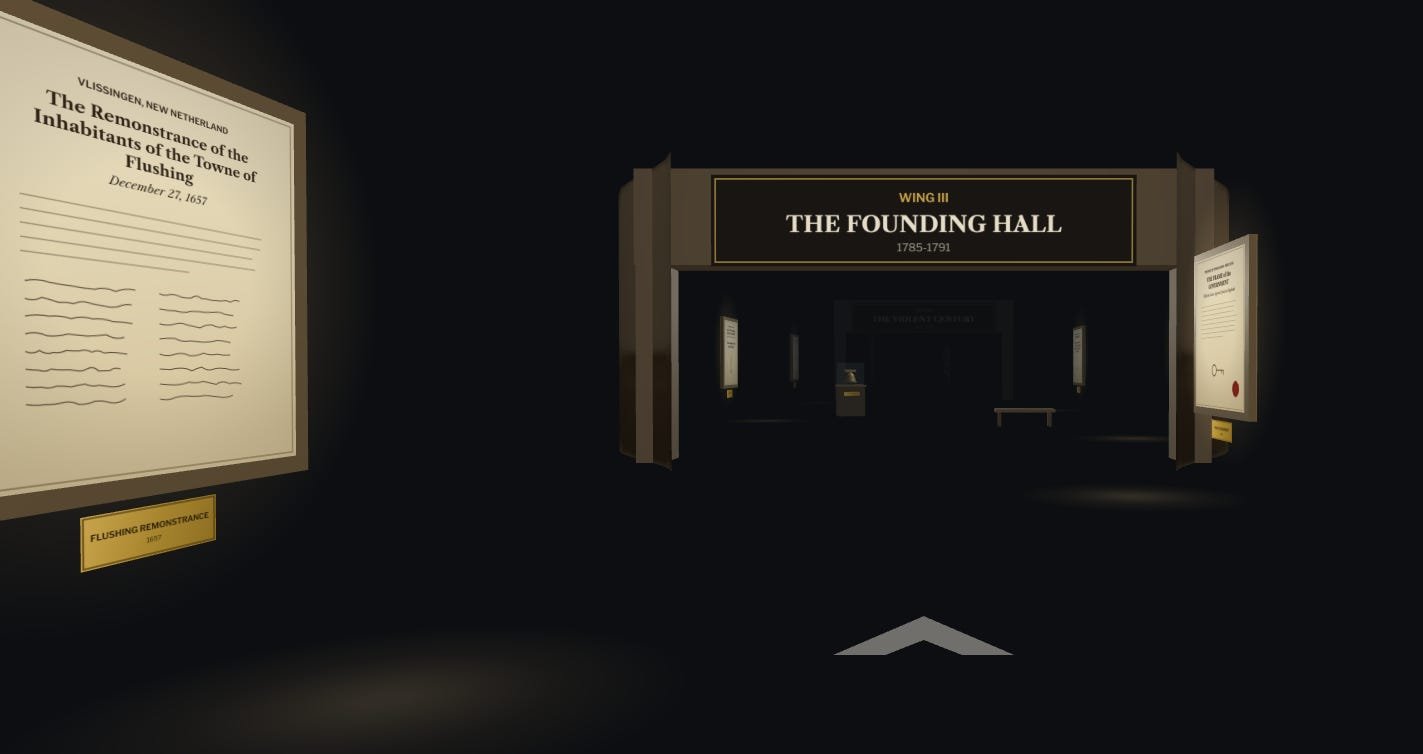
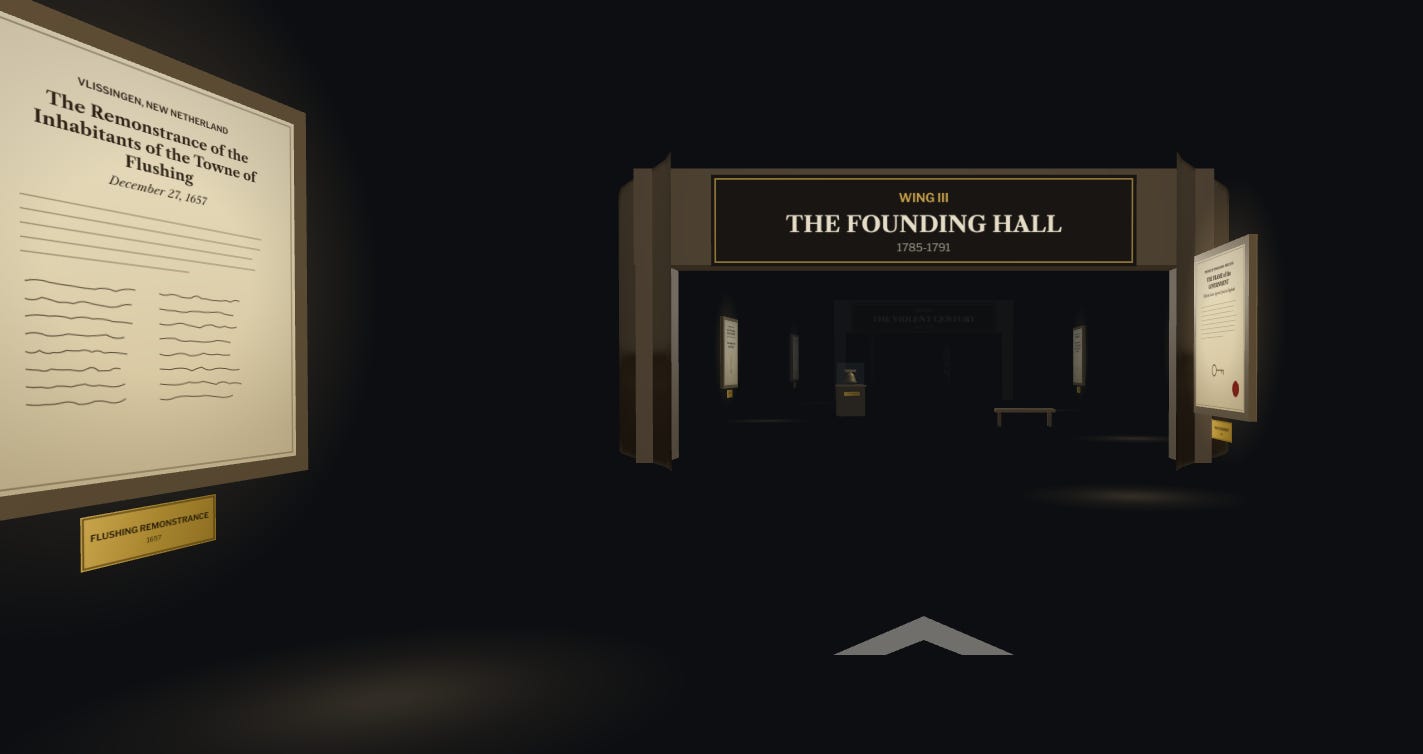
Today, for a limited time, we’re opening The Long Argument, an interactive museum of American religious liberty history that you walk through on your phone. Seven wings, 24 exhibits, from the Peace of Augsburg in 1555 to this year’s Supreme Court docket, and a hallway that narrows where liberty failed and widens where it recovered. Full writeup below, or skip straight to the museum: libertymuseum.netlify.app
Today ReligiousLiberty.TV and Founders’ First Freedom for a limited time are opening The Long Argument, a walk-through museum of America’s fight over conscience, built to move through rather than read past. Open it on a phone and the browser becomes a corridor: seven wings, 24 exhibits, a hallway running from the Peace of Augsburg in 1555 to whatever the Supreme Court decided last term. The architecture keeps score. The hall narrows everywhere the law failed a believer and widens everywhere liberty recovered. You feel the history in your feet before you read a word of it.
Movement works the way Street View works. Tap a chevron on the floor and the corridor glides forward. Wave the cursor to the edge of the screen and the hall turns with you. A gold arrow rises near every frame on the wall and swings you to face it. Approach any exhibit, a colonial statute, a Supreme Court opinion, a newspaper front page from the week Philadelphia burned two churches over which Bible children would read, and three tiers open beneath it: a plaque pitched at an eighth grader, a gallery panel written in the prosecutorial voice regular readers already know, and an archive drawer holding the primary source and a narrated tour, read aloud by a docent who has clearly done this before.
The route runs through the vestibule of the Old World, Augsburg’s formula for sorting believers by postal code, past Roger Williams walking out of Massachusetts in a snowstorm to found a colony with no religious test at all. It stops at the Flushing Remonstrance, signed by roughly 30 men who were not Quakers and defended Quakers anyway, and at Madison’s Memorial and Remonstrance, 15 numbered arguments that killed a tax nobody remembers in order to save a right everybody claims. It walks past the Bible riots of 1844, through Jesse Cantwell’s phonograph record, which insulted the two men he stopped to play it for on a New Haven sidewalk, and under the tablet where the Supreme Court did something it almost never does: reverse itself, on Flag Day, three years after telling two schoolchildren their conscience did not matter. An unfinished wall holds Fulton, Kennedy and Groff at the end, because the docket is still open, and the museum knows better than to pretend otherwise.
It costs nothing, asks for no login, and runs on the phone already in your hand (and better on your PC, Mac, or Chromebook. Walk it and you will notice the argument is still going, in the wing at the very end, in the cases still on the docket, in whichever fight over conscience shows up next. The Constitution does not end arguments. It keeps them from ending us. Now you can walk through why.
Try it: libertymuseum.netlify.app
