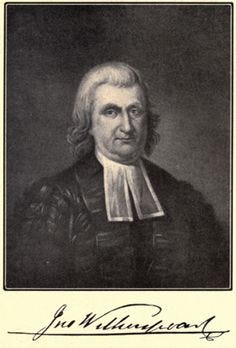
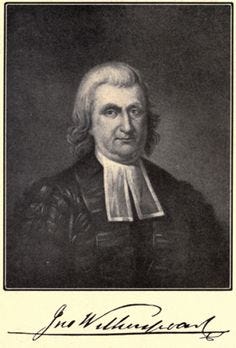
“If your cause is just—you may look with confidence to the Lord and intreat him to plead it as his own. You are all my witnesses, that this is the first time of my introducing any political subject into the pulpit. At this season however, it is not only lawful but necessary, and I willingly embrace the opportunity of declaring my opinion without any hesitation, that the cause in which America is now in arms, is the cause of justice, of liberty, and of human nature. So far as we have hitherto proceeded, I am satisfied that the confederacy of the colonies, has not been the effect of pride, resentment, or sedition, but of a deep and general conviction, that our civil and religious liberties, and consequently in a great measure the temporal and eternal happiness of us and our posterity, depended on the issue. The knowledge of God and his truths have from the beginning of the world been chiefly, if not entirely, confined to those parts of the earth, where some degree of liberty and political justice were to be seen, and great were the difficulties with which they had to struggle from the imperfection of human society, and the unjust decisions of usurped authority. There is not a single instance in history in which civil liberty was lost, and religious liberty preserved entire. If therefore we yield up our temporal property, we at the same time deliver the conscience into bondage.” – John Witherspoon – Signer of the Declaration of Independence, Dominion of Providence Over the Passions of Men (Sermon at Princeton)
Two hundred fifty years after the fact, Americans are once again arguing over what the founders believed, and most of that argument proceeds without anyone rereading the document closely enough to notice it already answered the question. The Declaration of Independence invokes God four times in under 1,400 words. That ratio should embarrass both camps now fighting over the founding: the secularists who treat the invocations as decorative Enlightenment throat-clearing, and the activists eager to read the Declaration as a charter for Christian government. Follow the actual clauses, in the order Congress approved them, and a third story appears, considerably more interesting than either side wants to hear.
The document opens with a jurisdictional claim before it reaches a single grievance. The colonies are entitled to “the separate and equal station” among the nations to which “the Laws of Nature and of Nature’s God” entitle them. That phrase is a legal claim, not throat-clearing. Positive law, the charters and statutes handed down by Parliament and the Crown, can be revoked by whoever granted it. A right traced to nature’s God cannot be, because no earthly government sits above the lawgiver who wrote it. Jefferson needed an authority Parliament could not touch, and he reached for theology to get one.
The second paragraph repeats the maneuver, more famously. Men are “created equal,” and they are “endowed by their Creator with certain unalienable Rights.” Both words matter more than two centuries of quotation have left room to notice. If men are created, something prior to and superior to any king exists. If their rights are endowed by that creator, the rights attach to the person as a condition of existing at all, and no government, including the one about to be formed, can transfer, forfeit or repeal them. This is doctrine wearing the clothes of poetry.
The final two references arrived later, and from a different hand than Jefferson’s. His rough draft included neither phrase. Congress added “the Supreme Judge of the world” and a closing “firm reliance on the protection of divine Providence” during floor debate, layered onto a text already written by a man closer to rational theism than orthodox Christianity. That detail complicates the tidy story favored by both sides of today’s fight. If a deist Enlightenment philosophe had single-handedly written a secular document that believers later misread, Congress would not have made it more religious on its way to a final vote. It did. The convening body, not the individual author, pushed the language toward providence.
That should not surprise anyone who knows how this Congress spent its year. Seven weeks before adopting the Declaration, on March 16, 1776, Congress proclaimed May 17 a day of “humiliation, fasting and prayer” across the colonies, calling on Americans to confess their sins and beg divine protection against the mounting threat from the British government. It was the second of what would eventually be 16 such proclamations before the war ended. The providential language closing the Declaration was not a flourish borrowed for effect. It was how this body talked when nobody outside the chamber was listening.
None of this means the founders agreed on theology, and it would be dishonest to pretend otherwise. Jefferson believed in an active creator but rejected the divinity of Christ. John Witherspoon, the Presbyterian minister who ran Princeton and was the only clergyman to sign the document, believed God intervened directly in the affairs of nations. Adams held his own uneasy ground between the two. The Declaration’s language is deliberately generic: “Nature’s God,” “Creator” and “Supreme Judge” are terms a Calvinist, a rational theist and an Anglican could each sign in good conscience, each reading his own tradition into the same words. That was not evasion. It was the only arrangement under which men who genuinely disagreed about God could agree, sincerely, that rights came from him rather than from Parliament.
That arrangement has a longer history than 1776, and it runs through dissenters rather than skeptics. In 1644, Roger Williams, banished from Massachusetts for arguing that the civil magistrate had no authority over conscience, wrote of a “hedge or wall of separation” meant to keep the garden of the church from being trampled by the wilderness of state power. Williams was not trying to protect the world from religion. He was trying to protect the church from a government that would eventually corrupt whatever it embraced. A century and a half later, the Baptist preacher John Leland picked up the same argument in Virginia, campaigning against a state religious assessment and later working with James Madison toward a constitutional guarantee against establishment, not because Leland doubted the truth of his own faith but because he doubted the state’s capacity to touch it without ruining it. Jefferson borrowed Williams’ phrase directly in his 1802 letter to the Danbury Baptists. The wall did not descend from secular philosophy. It descended from believers who had watched state churches persecute their own congregations and concluded that faith survives disestablishment far better than it survives an official embrace.
That history is worth recovering now for reasons beyond the anniversary. The Justice Department’s own religious liberty commission and the Heritage Foundation’s push for a state-sponsored Sunday day of rest both invoke the founders’ piety to argue that government may finally give religion the support it has too long been denied. Critics on the other side cite the same founders to insist government should acknowledge no religion at all. Both readings assume the founding generation was building either a Christian commonwealth or a secular one. It was doing neither. It was a coalition of dissenting Protestants and rational theists who reached for the same providential vocabulary for different reasons and arrived, not despite their disagreement but because of it, at a settlement that kept government’s hands off any church, their own included.
The Declaration does not invoke the Creator to bless a religious government. It invokes the Creator to disqualify one, since a right that answers to the Almighty cannot be handed out or clawed back by Parliament, Congress or any commission convened in Washington. That is still the argument, 250 years on, and neither side rushing to claim the founders this summer seems to have read far enough to notice that it belongs to neither of them.
To provide the best experience, we use technologies like cookies to store and/or access device information. Consenting to these technologies will allow us to process data such as browsing behavior or unique IDs on this site. Not consenting or withdrawing consent may adversely affect certain features and functions.
Functional
Always active
The technical storage or access is strictly necessary for the legitimate purpose of enabling the use of a specific service explicitly requested by the subscriber or user, or for the sole purpose of carrying out the transmission of a communication over an electronic communications network.
Preferences
The technical storage or access is necessary for the legitimate purpose of storing preferences that are not requested by the subscriber or user.
Statistics
The technical storage or access that is used exclusively for statistical purposes.The technical storage or access that is used exclusively for anonymous statistical purposes. Without a subpoena, voluntary compliance on the part of your Internet Service Provider, or additional records from a third party, information stored or retrieved for this purpose alone cannot usually be used to identify you.
Marketing
The technical storage or access is required to create user profiles to send advertising, or to track the user on a website or across several websites for similar marketing purposes.