Socialism Promises. Communism Collects.
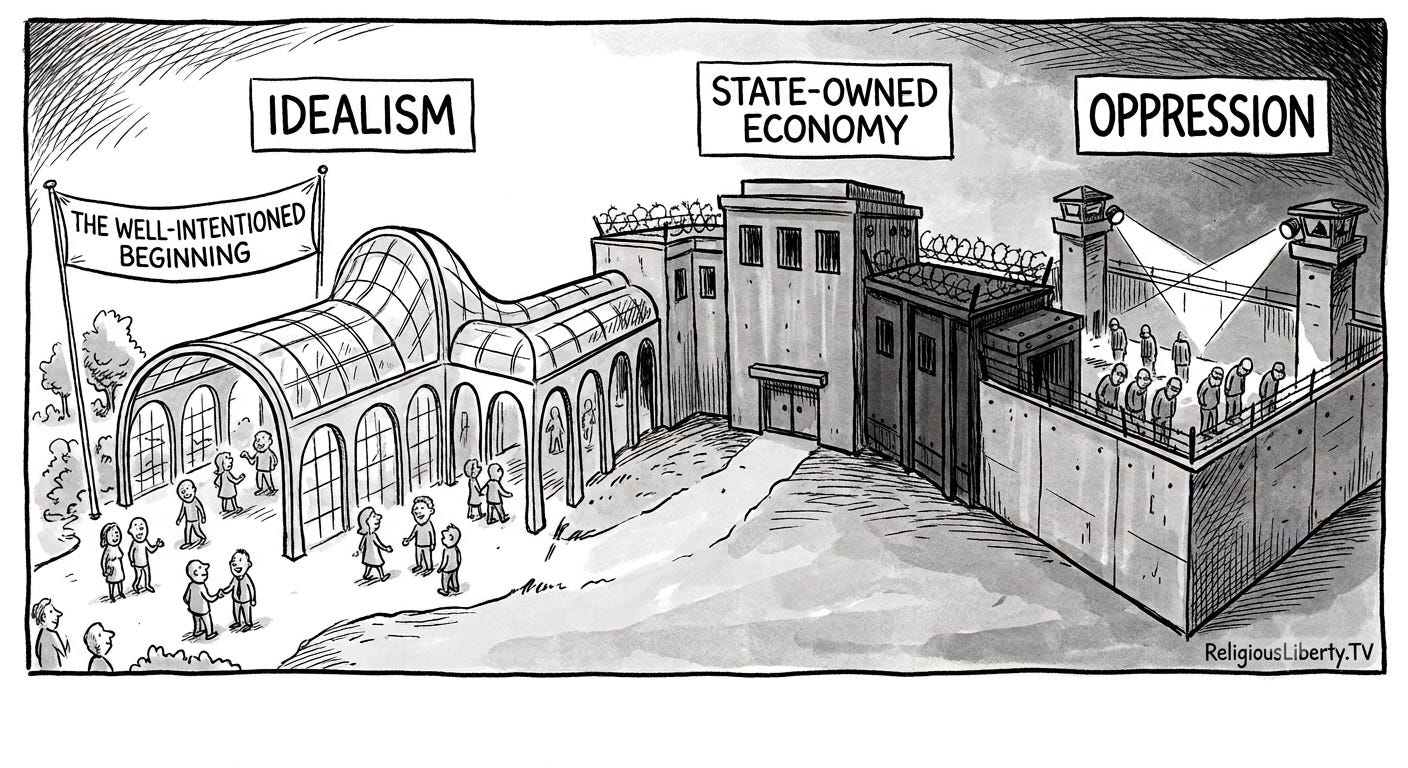
There is a trick that has protected failed utopias better than any secret police force. Socialism and communism, the argument goes, are two different things. Every time socialism ends in terror, the terror gets filed under communism and the ideal walks away clean. The Soviet Union does not count as real socialism. Neither does China, Cambodia, Cuba, North Korea or Venezuela. Real socialism, we are assured, has never been tried anywhere on earth.
This claim survives only because almost nobody defines terms before arguing about them. Socialism is not a public library. It is not Social Security or Medicare. It is the collective ownership of the means of production, and every government that has tried it has tried the same thing Marx described: seize the factories and farms, place them under state control, and call the arrangement transitional. Communism was socialism’s stated destination, not its opposite. Marx called the intervening period the dictatorship of the proletariat and said the state would eventually wither away. Denmark gets dragged into this argument constantly by Americans who have never asked a Dane about it. In 2015, after Bernie Sanders held up Denmark as his model, Danish Prime Minister Lars Lokke Rasmussen corrected the record and described his own country as a market economy. Redistributing what private enterprise produces and abolishing private enterprise are separate projects.
Marx also knew what stood between his revolution and its completion. Religion, he wrote, was the opium of the people, a drug the patient had to be weaned from before the real revolution could begin. Lenin intended in 1917 to free the Russian worker. Within months there was a secret police force, the Cheka. Within five years the party that promised power to the soviets had banned every rival socialist party and shot the sailors at Kronstadt for believing the promise literally. The Orthodox Church went first and hardest. Priests, monks and nuns were executed by the thousands, churches were dynamited or converted into grain silos, and the state organized a League of the Militant Godless to finish in the schools what the firing squads started in the parishes. Stalin found this machine built and pressed the accelerator.
The pattern repeated across continents. Mao promised land to the peasant and delivered the Great Leap Forward, a famine that killed tens of millions on the strength of grain quotas set in Beijing. His Cultural Revolution closed churches, temples and mosques with equal enthusiasm. The Khmer Rouge of Cambodia, sincere and French-educated, emptied the cities in a week, killed a quarter of their country in four years, and came close to erasing the Buddhist monkhood. Castro rode into Havana promising liberation and spent six decades jailing poets while running an officially atheist state. Each movement began with a genuine grievance and a luminous promise. Each ended with an informer on every floor and a padlock on the church door.
Abolishing private ownership relocates economic disagreement rather than resolving it, moving every decision about what gets built and who gets hired into one set of hands, fusing economic power with political power by design. A state that controls employment, housing, ration cards and university placement builds a labor camp eventually, because a total economic claim on society becomes a claim on meaning itself. A congregation is an institution the government does not run. A tithe is money the five-year plan never touches. A Sabbath is a day the economy cannot fully claim. Each is subversive by definition, which is why every regime on this list went to war against them.
Friedrich Hayek made the economic version of this argument in 1944 and was dismissed as a crank. Central planning requires enforcers, he wrote, and the enforcers are rarely the poets who wrote the founding pamphlets. The people who rise to run the apparatus are the ones comfortable running it, a form of natural selection that explains why Trotsky, who helped build the Soviet security state, ended up with an ice axe in his skull in Mexico City. Faith communities are often the last durable institutions standing when the machine turns on its own architects, which is why the machine fears them early.
Venezuela offers the clearest recent case, compressed enough that people now in their forties watched the whole arc unfold. Hugo Chavez won honest elections in 1998 on real grievances about oil wealth and inequality. Within two decades his handpicked successor was running show trials and torture sites, presiding over a collapsing currency, and feuding openly with Catholic bishops who kept criticizing him from the pulpit. More than 8 million Venezuelans, over a quarter of the population, left on foot rather than remain. That migration is the most honest poll a socialist government will ever receive.
Something is shifting in American politics. For decades, socialist was a word politicians avoided as a matter of professional survival. It has become, in certain precincts, a label candidates campaign on directly. This January, on consecutive mornings, two American mayors were sworn in wearing it as a badge. In Seattle, Katie Wilson, a first-time candidate who had never held office, beat an incumbent in the closest race the city has held since 1906. Facing a $175 million budget shortfall six months later, she proposed a new city capital gains tax and said nothing was off the table. She has since backed primary challengers against Democratic legislators considered among the most progressive in Washington, and one of them reports that his own polling shows the Democratic Socialists of America outpolling the Democratic Party in his district.
New York is running the more ambitious version. Mayor Zohran Mamdani took office in January promising city-owned grocery stores, a rent freeze and a $30 minimum wage. The first city grocery store, planned for East Harlem, will pay no rent and no property taxes while competing against bodega owners who pay both. In June, the mayor’s rent board froze rents on roughly a million apartments, and one board member resigned hours before the vote, arguing the outcome had been settled in advance. Nobody is being arrested, and no church is being padlocked in Queens. The early signature of every regime on this continuum has always looked exactly like this: cheap groceries, frozen rent, a government that says it only wants to help. The test comes later, when the plan collides with somebody’s conscience.
Both experiments operate inside real constitutional limits. The Takings Clause requires compensation before government seizes property outright. An attempt to nationalize an industry in the old Chavez style would not survive a week in federal court. Most people underestimate how much room exists inside those limits. Since the New Deal, federal courts have reviewed economic regulation under rational basis review, the most forgiving standard the law offers, asking only whether a policy bears some relationship to a legitimate government purpose. Rent control has withstood constitutional challenge for more than a century, and in 2024 the Supreme Court declined to hear landlord challenges to New York’s rent stabilization scheme. A rent board can freeze a million leases and a mayor can compete against his own taxpaying grocers while the courts largely watch from the sidelines.
Religious liberty claims occupy different terrain, the terrain this publication covers for a living. The Supreme Court has held that a city cannot exclude a faith-based agency from a public program on account of its beliefs, and that government has no voice in who a church selects to minister to its own congregation. A socialist city government will find it considerably easier to freeze rents than to conscript a religious school into its economic plan. The sturdiest legal wall between American democratic socialism and its foreign predecessors is the same First Amendment that every regime on this list had to tear down first, and it will be tested through zoning denials and nondiscrimination rules drafted broadly enough to reach the church basement.
This is not an argument against the food bank or the fire department. A free society can argue about the size of its safety net indefinitely without approaching anything resembling the regimes above. The line sits at the point where the state stops taxing enterprise and starts owning it, because a government that owns the bread eventually decides it has standing to claim the soul as well. Real socialism is a theory of the unlimited claim, and serious faith is the durable rebuttal to it. Marx predicted the state would wither away. In every place his experiment actually ran, the state grew without limit, and the people, along with their churches, withered or fled instead. A theory that produces the identical outcome every time it is attempted has, after a century of trials on four continents, been tested to exhaustion. The verdict is in.