The Religious Liberty Commission’s 224-Page Report: The Good, the Concerning, and the Wall It Wants Torn Down
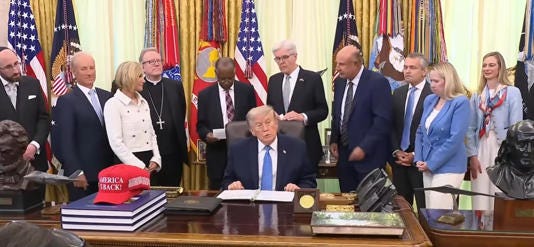
On June 26, in the Oval Office, Lt. Gov. Dan Patrick and Dr. Ben Carson handed President Donald Trump a 224-page draft report, the product of a year’s work by the Religious Liberty Commission he created by executive order in May 2025. The document is now open for 15 days of public comment, a courtesy that, given the report’s length and ambition, borders on the theoretical. Still, a comment period is a comment period, and this report deserves more than a press release’s worth of scrutiny.
The two-page summary the Department of Justice circulated the same day hits the notes you would expect: a Navy SEAL who lost his pension, a nun harassed by New York state, a teacher told to take down a cross. Real grievances, and worth taking seriously. But the summary is a trailer. The report itself, drawn from seven hearings and more than 100 witnesses, is a much more substantial and more mixed document, and it deserves to be read as one.
What the Commission gets right
Start with the legal history, because it is largely accurate, and accuracy on this point matters more than the culture-war framing suggests. The report’s central claim is that the “wall of separation between church and state” is a metaphor, not a constitutional text, and that the Supreme Court’s reliance on it peaked between 1947 and 1980 before beginning a retreat that has not stopped. That is a fair description of what actually happened. Everson v. Board of Education borrowed Jefferson’s 1802 letter to the Danbury Baptists in 1947. Lemon v. Kurtzman built a three-part test on that foundation in 1971.
Then the ground shifted. American Legion v. American Humanist Association in 2019 let a war memorial cross stand. Kennedy v. Bremerton School District in 2022 restored a football coach’s job and, in the same opinion, explicitly buried Lemon. Mahmoud v. Taylor in 2025 gave Maryland parents an opt-out from classroom material that conflicted with their faith. A commission that traces that arc and calls it what it is, a genuine and ongoing doctrinal shift away from strict separationism, is not inventing a grievance. It is reporting one that the Court itself has narrated in its own opinions. Whether the Court was right to retreat that far, and whether the report is right to want the “wall” discarded rather than restored to what it originally meant, is a separate question, and one the report never quite asks.
The report is also strongest when it stops talking about ideology and starts proposing paperwork. Requiring a public official who disciplines someone for “improperly” engaging in religious expression to put the specific legal basis in writing within 30 days is the kind of modest, checkable due-process fix that should appeal to people who agree on almost nothing else. So is directing agencies to post “Know Your Rights” material and stand up complaint hotlines for students, healthcare workers, and service members. None of that requires a court to do anything. It requires an agency to tell people what the law already is, which is cheap, verifiable, and overdue in more than a few school districts I have covered.
The chapter on anti-Semitism is the report’s most disciplined section, and its recommendations, faster Title VI and Title VII enforcement, better incident tracking with the FBI and state authorities, and a Justice Department inquiry into whether some attacks are funded by foreign or terrorist sources, would find support well outside the Commission’s own ideological lane. The same goes for restoring retirement and re-enlistment eligibility to service members who lost pensions and health coverage over religious objections to the COVID-19 vaccine mandate.
Whatever one thought of the underlying mandate, stripping a Navy SEAL of a pension three years from vesting because of a sincerely held religious objection was always going to look, in hindsight, like the kind of thing a religious liberty commission exists to flag. It flagged it.
The faith-based institutions chapter holds up nearly as well, and for the same reason: it deals in documented outcomes rather than argument alone. The Downtown Hope Center, an Anchorage women’s shelter that turned away an intoxicated man in a nightgown one January night in 2018 rather than house him alongside domestic violence and trafficking survivors, won its case when the city tried to force the issue in court, and won again when Anchorage amended its ordinance and came after the shelter a second time. Vermont’s decision to strip Brian and Kaitlyn Wuoti of their foster care license because they would not tell a child in their care that the child had been born in the wrong body ended the same way, with the state eventually rescinding its own revocation after the Wuotis sued. Both are real cases with real, checkable outcomes, not testimony standing in for a legal record, and both illustrate a point the report makes better here than almost anywhere else: a shelter or a foster family does not stop being a legitimate part of the social safety net because it operates on religious conviction instead of secular default, and a state ought to need a considerably better reason than disagreement with that conviction before it intervenes.
Where it should worry its own allies
The trouble starts with Recommendation 5: “Nominate and confirm federal judges with the courage to decide religious liberty cases on the merits where warranted, rather than engage in improper judicial avoidance.” Set aside whether any particular judge has ducked a case.
A presidential commission instructing the White House to select judges for their willingness to rule a certain way on a category of cases is exactly the kind of politicization of the bench that religious liberty litigators have spent decades warning against when it comes from the other direction. Courts earn legitimacy by deciding cases on the record in front of them, not by passing an ideological litmus test set by the branch that appointed them. A report that wants judges to treat Free Exercise claims with the same rigor as any other constitutional claim, which is a defensible ask, undercuts that goal the moment it starts grading “courage.”
The report’s deeper problem is not the case law. It is what it does to the word “wall.” The report treats “wall of separation between church and state” as a phrase secularists lifted from a private Jefferson letter in 1802 and inflated into constitutional command by the Warren and Burger Courts, and it proposes retiring the wall for a “bridge” instead.
That account skips over a century and a half of history that any Baptist or Adventist reader should recognize. Roger Williams used a version of the same phrase in 1644, well before Jefferson, to protect what he called the garden of the church from the wilderness of the world, not the other way around. Williams was a banished dissenter making a religious argument: keep the state’s hands off the church so the church can stay the church. John Leland carried that same argument to James Madison a century and a half later, trading his political support for the Bill of Rights precisely because he distrusted established churches and wanted government kept out of religion altogether, not because he wanted religion kept out of government. That is the tradition Baptists, Adventists, and other dissenting and minority faiths have leaned on for three centuries, not out of hostility to religion but because they knew what happens to a minority sect’s liberty once the state grows cozy with whichever denomination happens to hold the most political power at the moment.
This is not an abstract point for Adventists specifically. When Congress considered the Blair Sunday Rest Bill in the late 1880s, Adventist leader Alonzo T. Jones testified against it, and the denomination organized the National Religious Liberty Association in 1889, the outgrowth of which still publishes Liberty magazine today. Jones was not defending secularism. He was defending Sabbatarian farmers and merchants who kept Saturday and did not want the state enforcing the majority’s day of rest as though it were the only legitimate one.
The people making that argument a century before this report’s authors were sincere believers who understood, because their own liberty depended on it, that the wall protects minority faiths most when the state is tempted to write the majority’s religious preferences into public law. Separation, properly understood, was never a wall meant to keep religion out of public life. It was a wall meant to keep the state’s hands off the church, and it has been degraded from both directions: by the anti-religious overreach this report spends 200 pages cataloging, and by an accommodationist drift, of which this report is itself an example, that treats the wall as an obstacle to dismantle rather than a protection to restore.
None of that is a brief for the specific abuses the report catalogs, the cross ordered off a teacher’s desk, the child told to keep a prayer silent in the cafeteria. Those are real corruptions of the doctrine, not applications of it, and a report that wants to correct the overextension of separationism is entitled to say so. But Recommendation 1, instructing the Department of Justice to issue guidance “clarifying” the Establishment Clause, moves past that correction into something else.
Laid out at length in the “Myth of Secular Neutrality” section is the claim that a secular government and the ideology of secularism are the same threat wearing different clothes. They are not, and the distinction matters more to a Commission of clergy and religious broadcasters than to almost anyone else, since it is the same distinction that has always separated principled disestablishment from state hostility to faith. It is also the same distinction Justice Gorsuch relied on in Bremerton to say the Religion Clauses have “complementary” rather than “warring” purposes.
Collapsing it into a single “ideology of self-invention,” in Bishop Robert Barron’s phrase from the hearings, trades a legal argument for a culture-war one, and a DOJ guidance document built on that framing will not survive contact with a court applying Bremerton‘s actual reasoning, let alone Roger Williams’s.
The report’s evidentiary method deserves its own scrutiny. Its 12 headline recommendations and dozens of sub-recommendations rest overwhelmingly on hearing testimony rather than case records, agency data, or independent verification, which is a defensible way to build a hearing record and a thin foundation for a document that wants to steer Justice Department litigation priorities for years.
The account of Bella Health and Wellness’s “abortion pill reversal” protocol in Colorado is presented as an uncomplicated life-saving success story, more than 20 babies born, a religious provider vindicated in court, without mentioning that the American College of Obstetricians and Gynecologists has raised safety and evidence concerns about the underlying protocol, and that a 2019 clinical trial attempting to study it was halted early. None of that resolves the conscience claim, which stands on its own footing. But a report willing to cite Everson and Lemon by name should be equally willing to show its work on contested medical claims instead of treating one side’s account as settled.
It is worth saying plainly, and without alarm, that this is a commission built entirely from one side of a genuine argument. Dan Patrick, Ben Carson, Franklin Graham, Bishop Barron, Rabbi Meir Soloveichik, Ryan Anderson: serious people, but not a cross-section that includes Americans United for Separation of Church and State, the ACLU, or mainline Protestant and Jewish groups that have opposed some of these same recommendations, including the Johnson Amendment repeal the report calls for in Recommendation 9. That recommendation also arrives more than a year after the IRS already agreed, in a July 2025 consent decree settling National Religious Broadcasters v. Long, not to enforce the Johnson Amendment against two churches for pulpit endorsements to their own congregations. The report barely engages that settlement, which is still confined to two plaintiffs and still being litigated over whether it can be extended further, and asks Congress to go beyond it by statute regardless, which is itself worth pausing over: a tax exemption that comes with a license to fund partisan campaigns is precisely the kind of entanglement between money, politics, and the pulpit that Leland’s disestablishment argument was built to prevent.
None of this makes the report worthless, and none of it should be read as alarmist about where the recommendations, if adopted wholesale, would lead. Most of them will not be adopted wholesale; that is what a public comment period and, eventually, Congress and the courts are for.
The report is at its best when it functions as a compilation of specific, remediable grievances and proposes specific, low-cost fixes for them.
It is at its weakest when it mistakes the cure for the disease, treating separation of church and state itself as the problem rather than the abuse of it, and reaching for a “bridge” when what the doctrine actually needs, after decades of erosion in both directions, is a wall restored to its original height and its original purpose: keeping the state out of the church, not the church out of public life. Both things are true of the same document, and a reader doing this Commission the courtesy of taking it seriously should say so.
TLDR
The report’s legal history holds up: the Supreme Court really has spent the last decade dismantling the framework that governed Establishment Clause cases from 1947 to 1980, and a handful of its cheapest recommendations, “Know Your Rights” postings, a 30-day written-justification requirement for officials who discipline religious expression, restored pensions for service members discharged over vaccine objections, deserve support regardless of where anyone stands on the culture war. Its anti-Semitism and faith-based institutions chapters are the strongest sections because they lean on documented court outcomes rather than testimony alone.
Where the report goes wrong is more basic than any single recommendation. It treats separation of church and state as a 20th-century secularist invention rather than what it actually is, a protection Baptists and Adventists built to keep the state’s hands off the church, not to keep the church out of public life. Recommendation 5’s call for judges with the “courage” to rule a certain way, and Recommendation 1’s push for DOJ guidance built on a philosophy that conflates secular government with hostile secularism, make the same mistake twice: treating separation itself as the disease rather than its abuse as the symptom. The wall needs restoring, not replacing with a bridge.