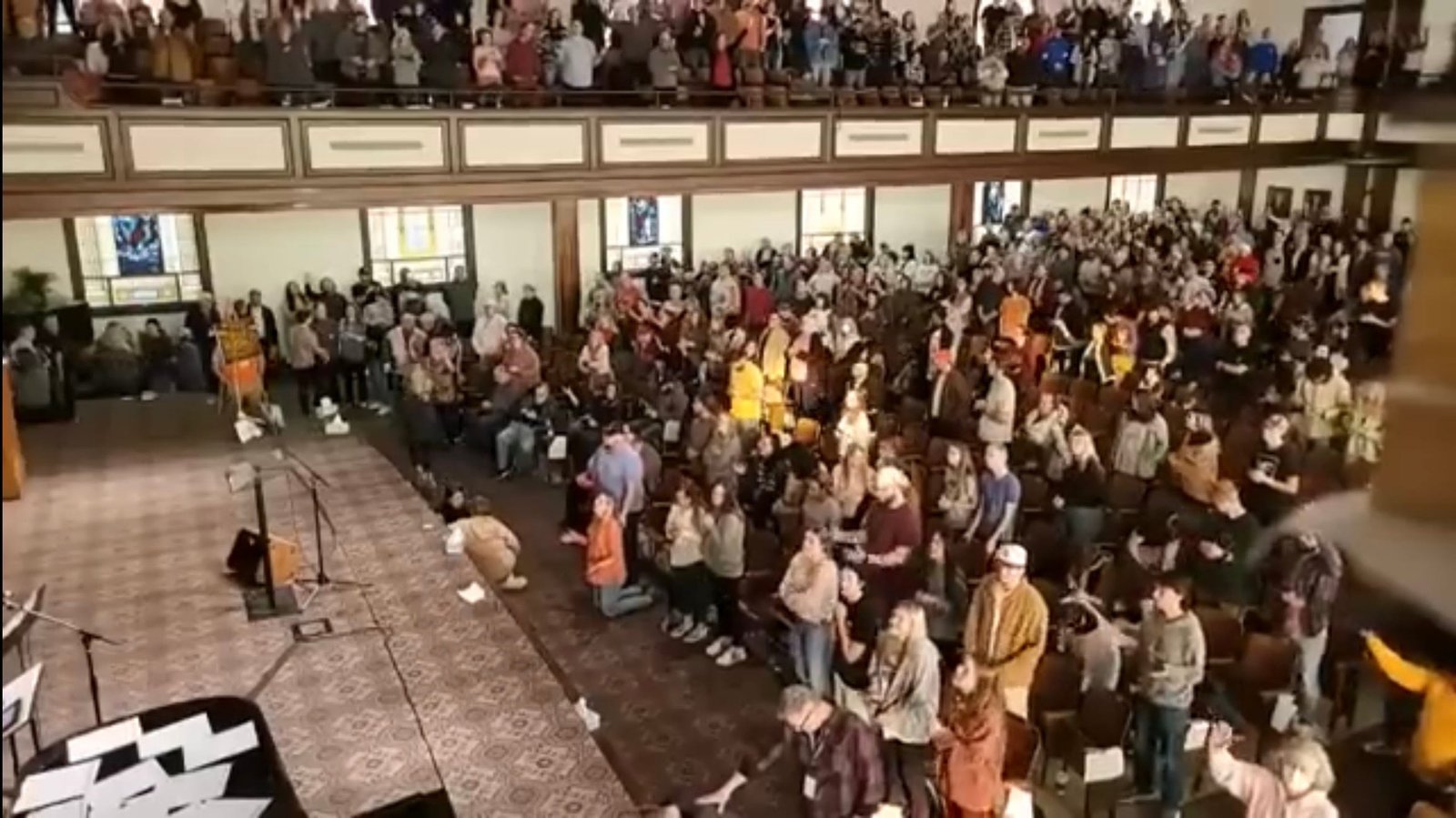
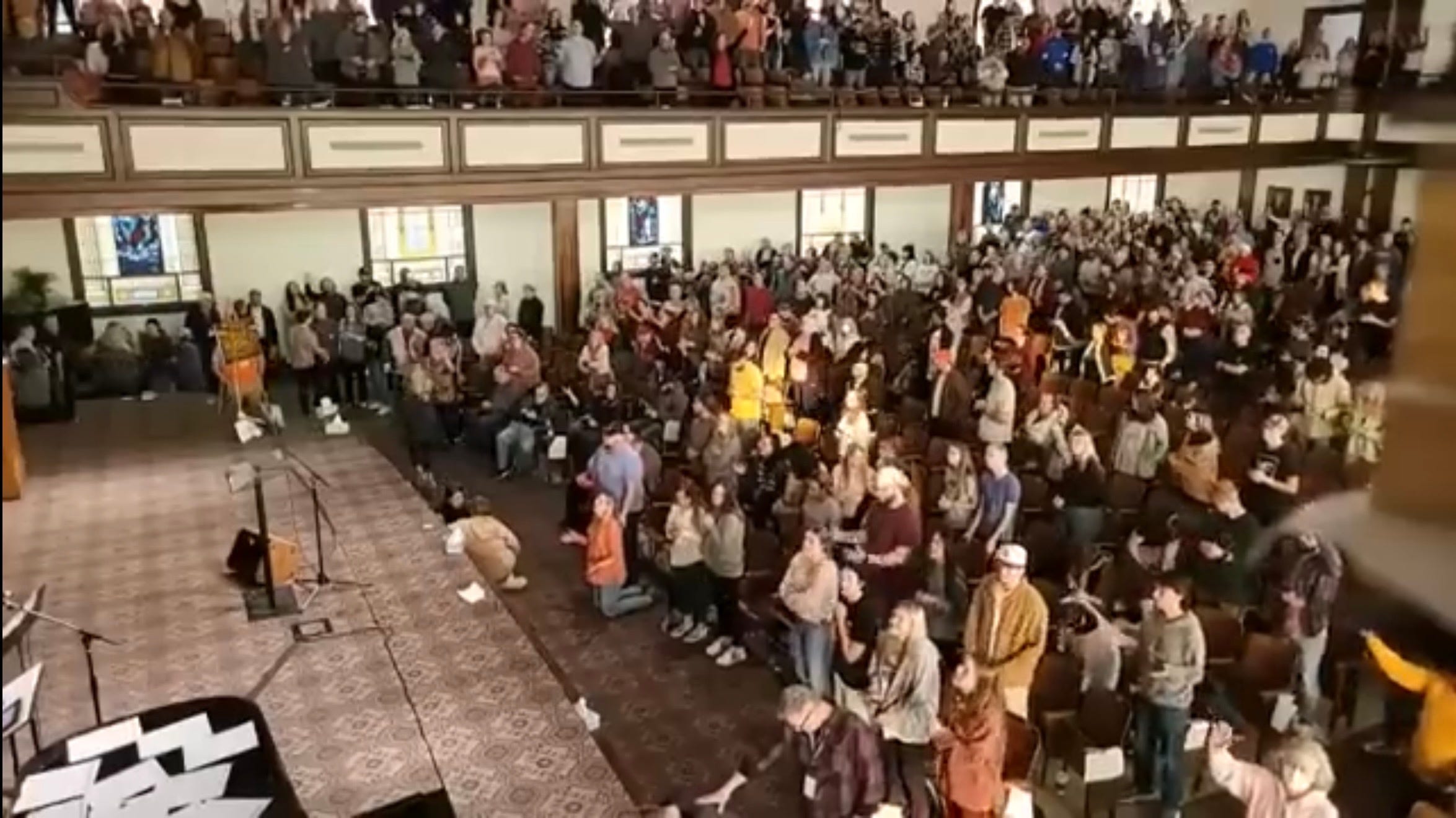
The air inside Hughes Auditorium had grown thick with the scent of damp wool and old wood, but nobody was leaving. It began on an unremarkable Wednesday morning during a routine chapel service, when a few dozen students stayed behind after the benediction. They did not leave for lunch; they did not leave for their afternoon seminars. By nightfall, the room was packed. Within forty-eight hours, the highway leading into Wilmore, Kentucky, was backed up for miles. Total strangers were weeping in the aisles, while others sat in profound, heavy silence. (ReligiousLiberty.TV newsletter, February 13, 2003)
Watch it here.
The 2023 Asbury University revival was a spontaneous religious event that caught the American mainstream completely off guard. For historians of Methodism, the phenomenon was both shocking and entirely predictable. Asbury Theological Seminary and its sister university sit on a specific theological fault line. This moment offers a window into a quiet but potent realignment within American Christianity, where a younger generation is bypassing highly politicized mega-churches in search of something austere, ancient, and intensely personal. The recent decision by the United Methodist Church (UMC) to disqualify Asbury graduates from ordination pipeline status shows that the institutional window for compromise has officially closed.
The Institutional Divorce
The roots of the phenomenon stretch back to the eighteenth century, born from the intense spiritual anxiety of John Wesley. Wesley, an Anglican priest who founded the Methodist movement, focused on the idea of “Christian perfection” or “entire sanctification.” He believed faith should be a felt reality that purges the believer of sin. When Methodism crossed the Atlantic, it abandoned the formal chapels of England for the American frontier. The movement grew through “camp meetings”—massive, multi-day outdoor gatherings in places like Cane Ridge, Kentucky, where thousands of pioneer settlers experienced ecstatic conversions. Asbury Seminary was founded in 1923 to keep this fiery, holiness-focused strain of Methodism alive.
The institutional culture of the Asbury campus functions like a greenhouse for these outbursts. This was not the first time the chapel walls witnessed such a scene; major revivals shook the campus in 1905, 1950, and 1970. The school’s curriculum treats these historical events as part of a living tradition and a spiritual inheritance.
That inheritance is now decoupled from the main denominational body. Following the UMC General Conference vote to eliminate its 52-year-old ban on the ordination of openly gay clergy and same-sex marriage, institutional gears turned quickly. The UMC University Senate announced that its accrediting body will no longer accept seminary graduates from Asbury for ordained ministry. Asbury, an independent evangelical institution, refused to alter its ethos statement, which follows most conservative Christianity in defining marriage strictly as a lifelong union between one man and one woman.
The Battle Over the Text
At its core, this institutional divorce is driven by fundamentally incompatible approaches to biblical interpretation. The debate is not merely political; it is a profound disagreement over how ancient texts speak to modern life.
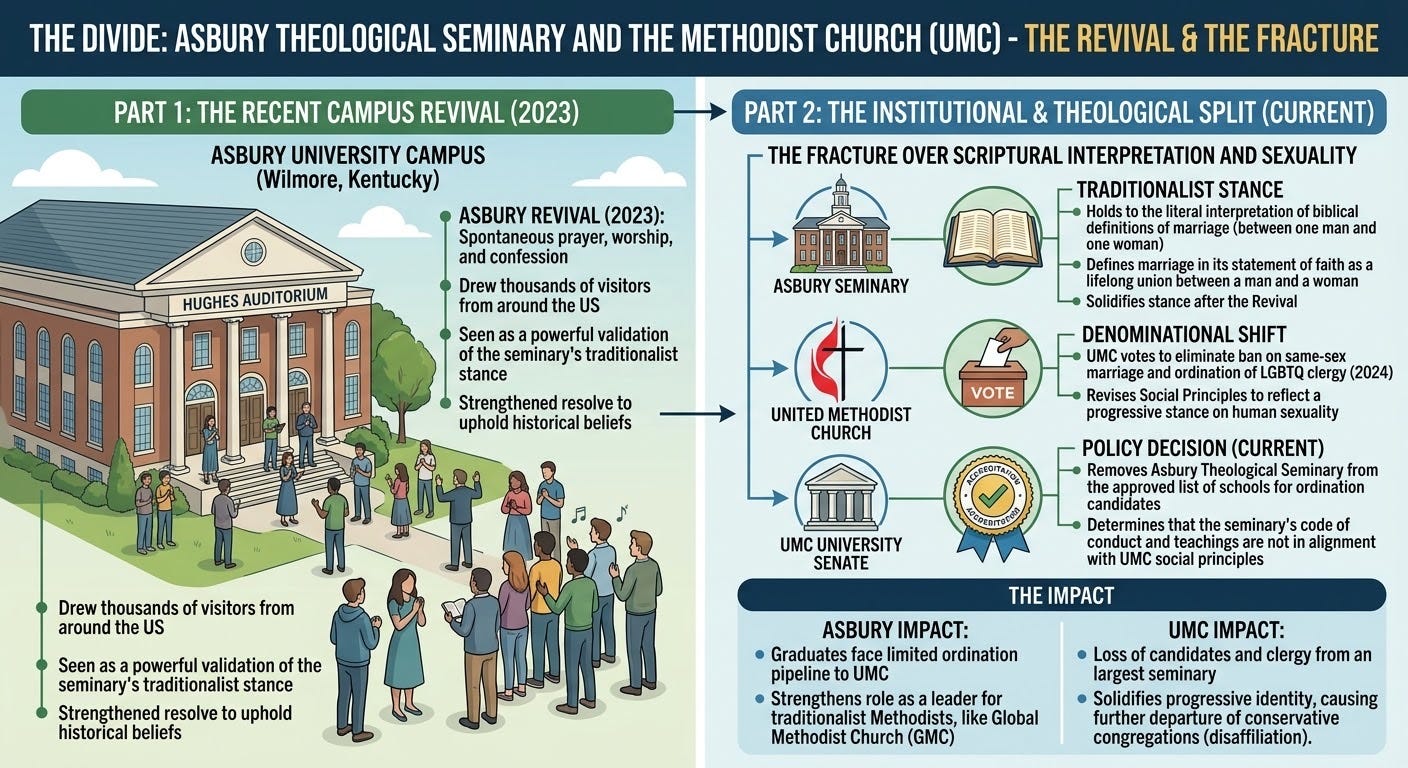
Traditionalist scholars at Asbury ground their arguments in a literal, historic rendering of both Old and New Testament passages. They point to the creation narratives in Genesis, the holiness codes in Leviticus, and the specific prohibitions outlined in the Pauline epistles—such as Romans 1 and 1 Corinthians 6—as timeless moral frameworks. In this view, scriptural authority is absolute and unchanging; human sexuality must conform to the text, rather than the text being reinterpreted to fit modern social norms.
Mainline progressives within the UMC operate from a different hermeneutical framework. They argue that ancient prohibitions must be understood within their original socio-cultural contexts, which lacked contemporary concepts of consensual same-sex partnerships and build a complete hermeneutic around this recent conclusion.
A Solidified Resolve
What made the latest campus gathering distinct was its absolute rejection of modern religious showmanship. In an era where large churches rely on stadium lighting, high-definition screens, and celebrity pastors, the Asbury event featured none of it. The stage held only a wooden pulpit, a piano, and an acoustic guitar. There were no projection screens, no light shows, and no professional worship leaders. When prominent Christian influencers arrived with cameras and microphones, student organizers asked them to put their equipment away. The focus remained entirely on peer-led prayer, public confession, and acoustic singing.
Rather than prompting a reassessment or a compromise to preserve its status with the main church, the memory of the recent revival appears to have solidified the school’s resolve. The administration framed the event as validation that their traditionalist stance enjoys spiritual approval, rendering the loss of denominational credentials secondary to their historic identity.
The institutional math behind the split shows how much the territory has shifted. Asbury is the eighth-largest seminary in the United States, educating nearly 900 full-time students across more than 75 different denominations. Only about 9 percent of its current student body identifies as United Methodist, a steep decline from past decades when the school supplied more newly ordained ministers to the church than almost any official denominational seminary. The loss of these candidates comes at a moment when the denomination’s total membership has dropped to less than 4 million, down from 11 million a few generations ago.
The fallout stretches far beyond the state of Kentucky. For decades, mainline Protestant seminaries balanced a broad coalition of progressive and conservative students under one roof. The complete removal of Asbury from the approved list signals that the period of internal compromise has ended, forcing institutions to choose between strict progressive alignment or complete separation. Wheat and tares, sheep and goats. Conservative graduates will increasingly look to alternative structures, such as the newly formed Global Methodist Church, while the main denomination consolidates with a different theological identity.
The traffic on US-68 has long since cleared, and the wooden pews of Hughes Auditorium sit empty on a quiet Tuesday night. The young men and women walking out of the seminary with their diplomas face a starkly divided job market. Their credentials no longer carry currency in the historic mainline pulpits their predecessors occupied for generations. They exit into an American religious environment stripped of institutional buffers, where the definition of a sacred text requires picking a side. But that is what true Christianity has always been about.
