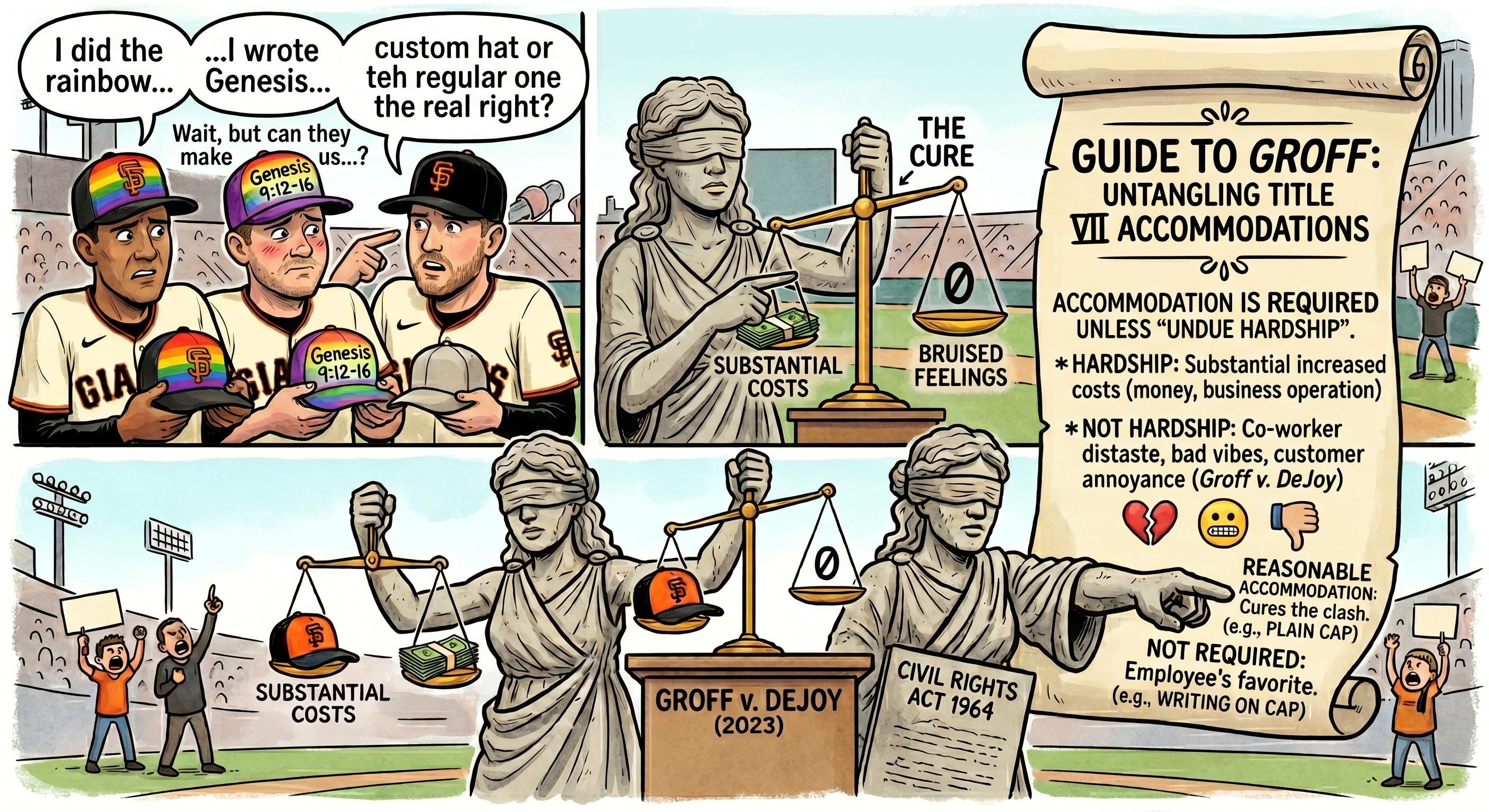
The vice president of the United States found a free Tuesday and spent part of it posting about a baseball hat. A sitting governor’s press shop fired back. A state senator told him to go chill in a cave. This is the republic now, a knife fight over millinery conducted in real time by people who are supposed to be running things, and not one of them, not a single soul in the whole shrieking thread, paused to ask the only question a lawyer cares about. What does the law actually say. Does it say the same thing when you flip the script.
The facts first, since they got trampled in the stampede. On June 12 the Giants threw their annual Pride Night against the Cubs. Most of the roster wore a cap with the SF logo recolored as a rainbow. Three pitchers, Landen Roupp and JT Brubaker and Ryan Walker, took a marker to the cap and wrote a Bible reference, Genesis 9:12-16, the covenant verse where God hangs the rainbow in the sky. A fourth, Sam Hentges, skipped the themed cap and wore the plain one.1 The league warned the three with the markers and made a point of saying the warning had nothing to do with scripture. The rule bans any writing on the equipment, and they have dropped the same warning on caps that said “Dad” and “Happy Mother’s Day.”2
Three different men, three different moves, and the cable circus mashed them into one outrage because outrage scales better than distinctions. The distinctions are the whole case.
Kill the “First Amendment” argument before it embarrasses you
I say this as someone who has seen the First Amendment waved at more judges than I can count. It is not your friend here. Reach for it and you hand the other side a clean win.
The First Amendment leashes the government. The Giants are a private company throwing a private party with private property they bought and paid for. When the state tries to force a citizen to mouth a belief, the Constitution shows up swinging, and thank God for that. West Virginia State Board of Education v. Barnette is the one I would frame and hang on the wall. A schoolkid cannot be marched into a flag salute against his conscience, because no official “high or petty” gets to decree what is orthodox in faith or politics.3 Wooley v. Maynard let a man cover up New Hampshire’s motto on his plate.4 303 Creative v. Elenis let a designer refuse to build a message she didn’t believe.5
Every one of those is a citizen versus the state. A clubhouse is not the state. I adore Barnette. I have quoted it in rooms where it changed the temperature. It still does not reach a private employer telling a private employee what to wear to work. Argue the Constitution here and you lose in front of any judge who passed the bar, and you deserve to. The players have a right. It lives somewhere else.
The statute nobody on cable mentioned
Here is where the actual fight happens, and it is dull enough that nobody on television will ever explain it to you, which is precisely why they keep you ignorant and angry.
Title VII of the Civil Rights Act of 1964 makes an employer accommodate a worker’s sincere religious belief unless that accommodation is an undue hardship on the business.6 For fifty years that promise was a fraud, because Trans World Airlines v. Hardison let any employer wriggle out by claiming more than a trivial cost.7 Anything past pocket change counted as hardship. The protection was a velvet rope in front of an open door.
That con ended in 2023, and it ended 9 to 0. In Groff v. DeJoy the Supreme Court torched the trivial-cost dodge and held that an employer now has to prove “substantial increased costs in relation to the conduct of its particular business.”8 Read what the Court said does not count, because this is the ballgame. A coworker who finds your faith distasteful is not a hardship. Bruised feelings are not a hardship. Bad vibes in the clubhouse are not a hardship. The pain has to land on the actual running of the business and it has to be real money.9
The Court also said the worker does not have to perform the right ritual to get protected. In EEOC v. Abercrombie & Fitch a store refused to hire a young woman in a headscarf, and the Court said an employer cannot weaponize a religious practice against a worker even when nobody filed the magic paperwork.10
And for the Giants, Title VII is the basement, not the ceiling. California stacks more on top. The state’s Fair Employment and Housing Act demands accommodation of religious dress and observance and imports the meaner “significant difficulty or expense” test from disability law.11 A team that plays its home games in San Francisco lives under both. Now let me walk you through the three pitchers the way I would walk a jury, one exhibit at a time.
Exhibit A: the guy who just wore his hat
The easy one. Not close. I would take this to verdict in my sleep.
Hentges wore the standard cap. He wrecked nothing. He broke no rule. He asked the front office for nothing it couldn’t hand him in the time it takes to say no problem. Swapping a plain cap for a themed one is the lightest lift in the entire law of accommodation. Costs nothing to print. Costs nothing to manage.
And we are not theorizing, because this already ran as a live experiment. In 2022 five Tampa Bay Rays pitchers peeled the rainbow logo off their caps on Pride Night and wore the standard version. Jason Adam and Jalen Beeks and Brooks Raley and Jeffrey Springs and Ryan Thompson, all of them, faith-based, accommodated, no drama.12 The manager said the club supported the guys who wore it and the guys who didn’t, “to the best of our capabilities.”13 The capability turned out to be 100 percent. The earth kept spinning.
That history guts any hardship defense. After Groff, a team cannot stand up and weep about substantial cost over a swap its own league already pulled off for free. The only injury on the table is that some fans are mad, and Groff says in black and white that angry fans and grumbling coworkers do not clear the bar.14
Now flip it, because a principle that won’t flip is just a prejudice with a lawyer. The Rangers are running a Faith and Family Night this very week.15 Say a player there refuses to wear a cross on his cap because he is an atheist, or a Jew, or just a man who does not want a church logo on his skull at the office. I defend him with the same statute and the same breath. If you stood and cheered Hentges but you would fire that man, you do not believe in conscience. You believe in your team’s gift shop.
Exhibit B: the guy who said “no, thanks”
Same case, same win.
A religious objection to endorsing a message is the exact thing Title VII was built to shield. The objection is satisfied the instant the man is no longer forced to wear what he cannot in good faith endorse. He owes management no sermon, and under Abercrombie they cannot hold his beliefs against him.15 Taking off a patch burdens nobody. It is the absence of a patch.
This also happens to be the oldest idea in the tradition I write from. Liberty of conscience includes the freedom “to worship or not to worship,” to “profess, practice and promulgate” or to keep your mouth shut.16 The freedom to abstain is conscience stripped to the bone. A man asking only to be left out of a sentence he never wrote is making the smallest demand a worker can make on a boss, and the law has a soft spot for small demands.
Exhibit C: the guys with the marker
The three who wrote Genesis 9 on the cap have the weakest hand of the three. Not because scripture is worth less. Because of the shape of the right they actually hold. (Keep in mind that I’m just doing a cold legal analysis here, not implying that the three worthies who wrote the verse on their hats aren’t sincere, or judging their faith that led them to the decision. Also, keep in mind that lawyers always see the “worst case scenario” where someone winds up in court and has to fight about their baseball hat. Hopefully this situation never escalates to that level and remains an interesting situation that helps us learn the law a little more.)
Title VII buys you a reasonable accommodation. It does not buy you your favorite one. The conflict the statute cares about is the clash between the believer and a message he cannot affirm. That clash is fully cured by taking the cap off or wearing the plain one. Writing your own verse onto the team’s property is not required to unburden your conscience. It is a bonus round. The law does not owe you the bonus round.
And the marker runs face-first into a rule that is genuinely neutral. The league bans every message on the cap and enforces it against “Dad” and Mother’s Day notes and family names.17 A content-neutral uniform rule, applied evenhandedly, is the kind of rule employers usually get to keep. The league warned instead of disciplining, and it said the trouble was the writing and not the verse.18 On those facts the league holds the stronger cards.
Flip this one too, and here’s what happens. A teammate scrawls “love is love” across the same cap on the same night. In a content-neutral rulebook, that marker and the Genesis marker are the identical infraction. If the rule is good against the slogan you can’t stand, it is good against the verse you treasure. I have watched whole crowds fall in love with “the rules” the precise moment the rules gag somebody they dislike, then lose all affection the second the rules so much as brush a friend. That is not principle. That is a mob holding a rulebook it never read.
The irony writes itself. The marker was supposed to be the bold testimony, and in law, unfortunately, it is the brittle one. The decision to wear the regular cap was supposed to be the timid move, and in law it is the bulletproof one. The men who said the least are standing on the most.
The Golden Rule, minus the sanctimony
Lawful and honorable resistance to coerced conscience “the citizen’s duty,” and it is rooted in the Golden Rule, the plain wish to be treated as you’d treat the other guy.19 Strip the stained glass off it and you get a rule any trial lawyer already knows in his bones. Defend the conscience you would want defended.
So here is the verdict, and it reads the same whether the marker spells scripture or a slogan you would never sign. The law protects a person who declines. It protects the pitcher who wears the regular cap instead of the special one. It runs a bit cold on the pitcher who writes, not because his faith counts for less, but because he grabbed for a right bigger than the one he had.
A team free to throw a party is also free to let one man wear his regular cap. That is not a heavy thing to grant. The Rays granted it three years ago and nobody’s season collapsed into the sea. It is the accommodation that it the strongest to request if one of these cases ever went to court.
I can write this because we’re not a denomination, not an institution guarding its brand, not a donor with a phone number. ReligiousLiberty.TV is an independent newsroom on the law of conscience, and paid subscribers are the reason it stays that way. If this is the read you wish you got from the people paid to cover it, come fund the version that actually tells you the truth.
This does not constitute legal advice for you. Talk to a lawyer about your particular situation.
-
Sean Campbell, “A’s Host Pride Night Tonight as Giants’ Hat Controversy Hits National Stage,” Sacramento Bee / AOL, 17 June 2026, https://www.aol.com/articles/host-pride-night-tonight-giants-183538000.html. ↩
-
Campbell, “A’s Host Pride Night”; “MLB Warned Players About Altering Pride Night Caps,” U.S. News & World Report / Associated Press, 17 June 2026, https://www.usnews.com/news/politics/articles/2026-06-17/mlb-warned-players-about-altering-pride-night-caps-and-republicans-took-notice-heres-what-to-know. ↩
-
West Virginia State Board of Education v. Barnette, 319 U.S. 624, 642 (1943). ↩
-
Wooley v. Maynard, 430 U.S. 705 (1977). ↩
-
303 Creative LLC v. Elenis, 600 U.S. 570 (2023). ↩
-
42 U.S.C. § 2000e(j). ↩
-
Trans World Airlines, Inc. v. Hardison, 432 U.S. 63 (1977). ↩
-
Groff v. DeJoy, 600 U.S. 447, 470 (2023). ↩
-
Groff, 600 U.S. at 471-72. ↩
-
EEOC v. Abercrombie & Fitch Stores, Inc., 575 U.S. 768 (2015). ↩
-
Cal. Gov. Code § 12940(l). ↩
-
“Five Tampa Bay Rays Players Decline to Wear Pride Logos on Jerseys and Caps,” NPR, 6 June 2022, https://www.npr.org/2022/06/06/1103303679/tampa-bay-rays-rainbow-logo-pride-night. ↩
-
“Five Tampa Bay Rays Players Decline to Wear LGBTQ+ Logo,” CBS Sports, 7 June 2022, https://www.cbssports.com/mlb/news/five-tampa-bay-rays-players-decline-to-wear-lgbtq-logo-on-uniform-during-pride-night-celebration/. ↩
-
Groff, 600 U.S. at 472. ↩
-
International Religious Liberty Association, Declaration of Principles. ↩
-
Campbell, “A’s Host Pride Night.” ↩
-
“MLB Warned Players About Altering Pride Night Caps,” AP. ↩
-
International Religious Liberty Association, Declaration of Principles. ↩
