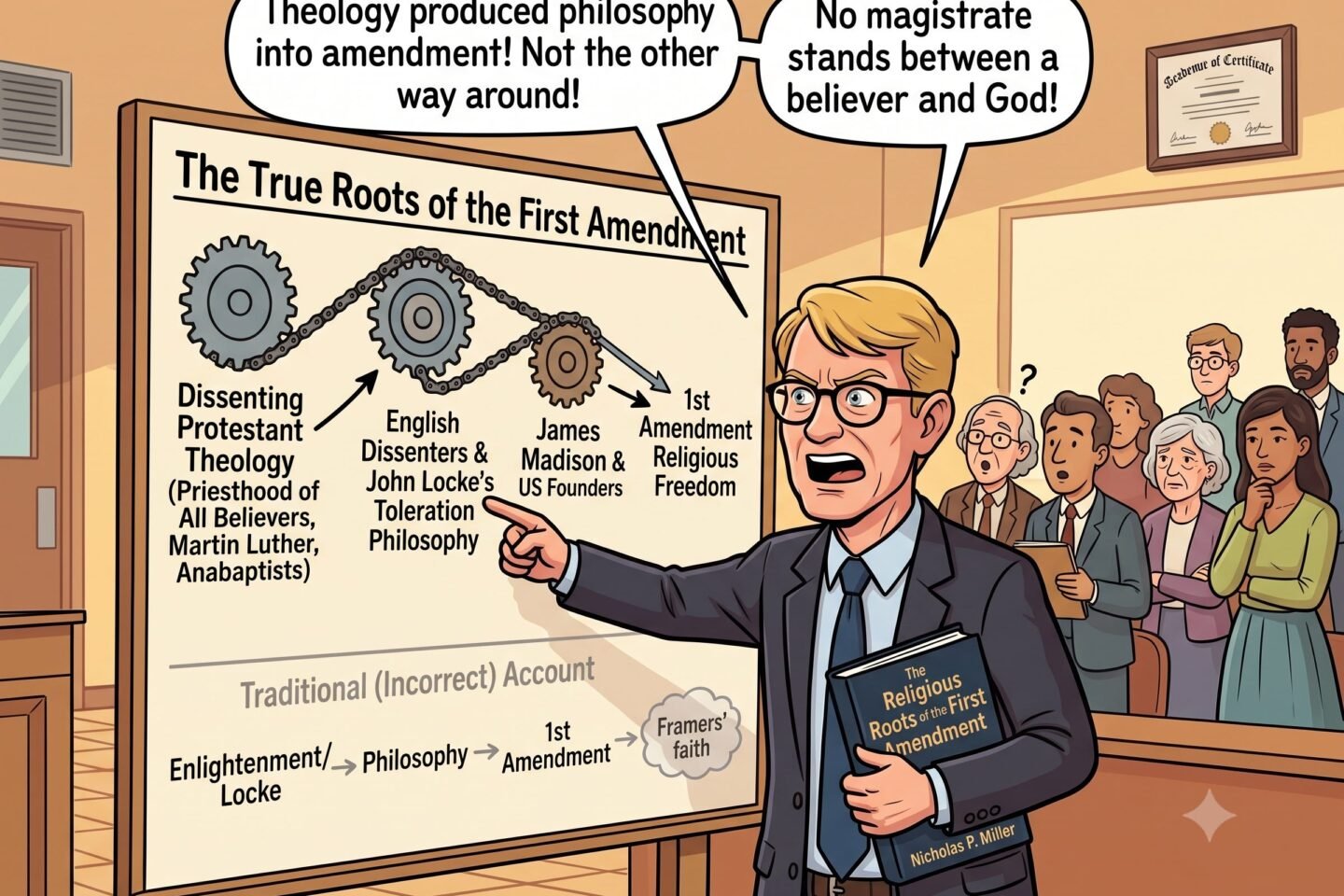
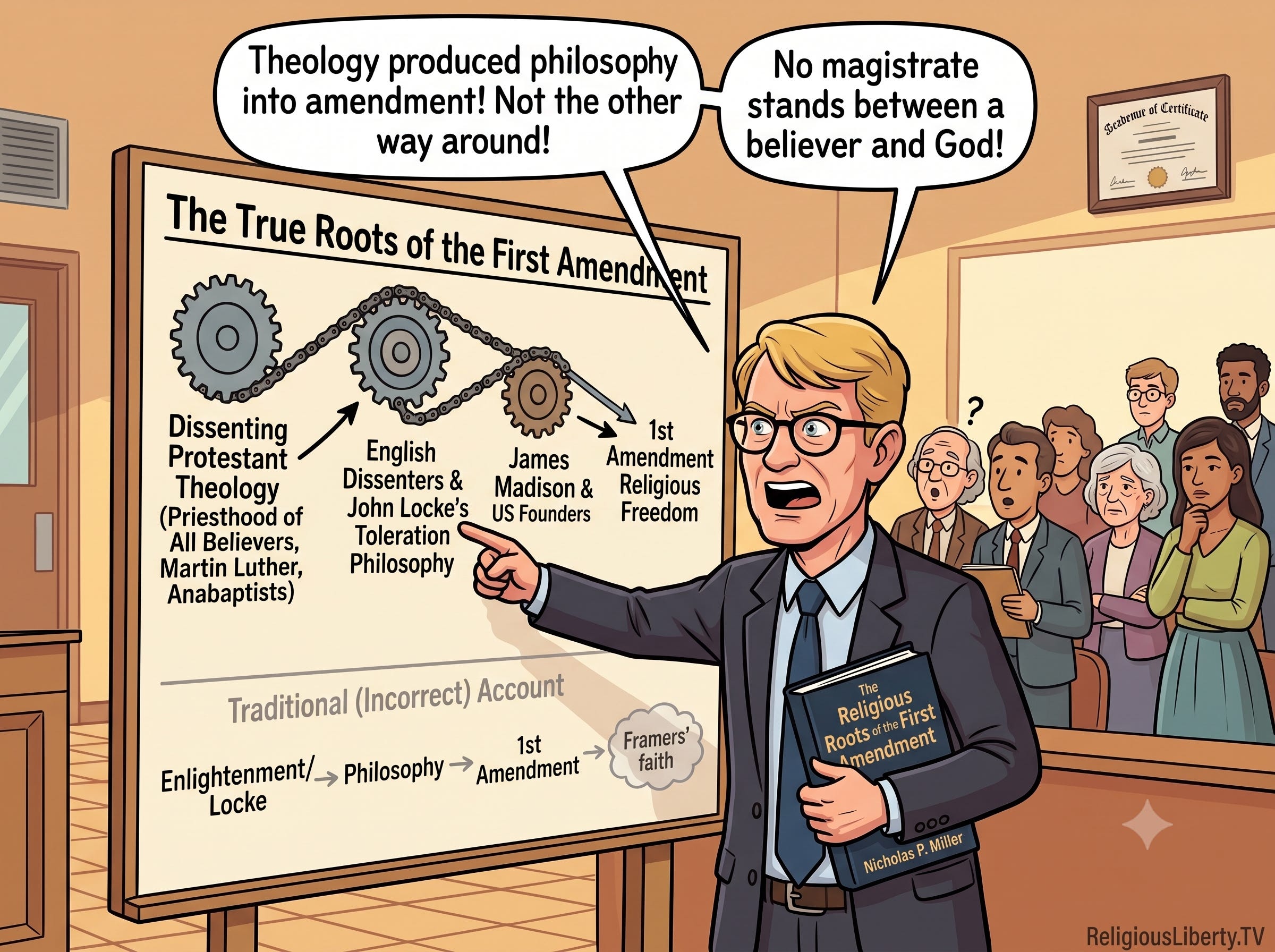
 Philosophy -> 1st Amendment -> Framers’ faith". Miller, with a determined expression, is emphasizing his argument with two speech bubbles: "Theology produced philosophy into amendment! Not the other way around!" and "No magistrate stands between a believer and God!". A diverse crowd of attendees listens with a mix of concentration and skepticism. The image presents a detailed visual argument that religious principles were the primary catalyst for American religious liberty. The image is watermarked "ReligiousLiberty.TV".","title":null,"type":"image/png","href":null,"belowTheFold":false,"topImage":true,"internalRedirect":"https://religiouslibertytv.substack.com/i/208998808?img=https%3A%2F%2Fsubstack-post-media.s3.amazonaws.com%2Fpublic%2Fimages%2F82985d63-a64a-4c04-85fd-9c049bc84e51_2400x1792.png","isProcessing":false,"align":null,"offset":false}” class=”sizing-normal” alt=”This detailed political-style cartoon illustrates a lecture hall presentation. Scholar Nicholas P. Miller, identifiable by the book he holds ("The Religious Roots of the First Amendment"), presents a new historical argument. The large whiteboard behind him is divided, with a top section labeled "The True Roots of the First Amendment" featuring a gear diagram. The lineage traces from "Dissenting Protestant Theology (Priesthood of All Believers, Martin Luther, Anabaptists)," through "English Dissenters & John Locke’s Toleration Philosophy," to "James Madison & US Founders," culminating in "1st Amendment Religious Freedom." A bottom section labeled "Traditional (Incorrect) Account" shows a simplified, linear flow: "Enlightenment/Locke -> Philosophy -> 1st Amendment -> Framers’ faith". Miller, with a determined expression, is emphasizing his argument with two speech bubbles: "Theology produced philosophy into amendment! Not the other way around!" and "No magistrate stands between a believer and God!". A diverse crowd of attendees listens with a mix of concentration and skepticism. The image presents a detailed visual argument that religious principles were the primary catalyst for American religious liberty. The image is watermarked "ReligiousLiberty.TV".” title=”This detailed political-style cartoon illustrates a lecture hall presentation. Scholar Nicholas P. Miller, identifiable by the book he holds ("The Religious Roots of the First Amendment"), presents a new historical argument. The large whiteboard behind him is divided, with a top section labeled "The True Roots of the First Amendment" featuring a gear diagram. The lineage traces from "Dissenting Protestant Theology (Priesthood of All Believers, Martin Luther, Anabaptists)," through "English Dissenters & John Locke’s Toleration Philosophy," to "James Madison & US Founders," culminating in "1st Amendment Religious Freedom." A bottom section labeled "Traditional (Incorrect) Account" shows a simplified, linear flow: "Enlightenment/Locke -> Philosophy -> 1st Amendment -> Framers’ faith". Miller, with a determined expression, is emphasizing his argument with two speech bubbles: "Theology produced philosophy into amendment! Not the other way around!" and "No magistrate stands between a believer and God!". A diverse crowd of attendees listens with a mix of concentration and skepticism. The image presents a detailed visual argument that religious principles were the primary catalyst for American religious liberty. The image is watermarked "ReligiousLiberty.TV".” srcset=”https://substackcdn.com/image/fetch/$s_!_V5O!,w_424,c_limit,f_auto,q_auto:good,fl_progressive:steep/https%3A%2F%2Fsubstack-post-media.s3.amazonaws.com%2Fpublic%2Fimages%2F82985d63-a64a-4c04-85fd-9c049bc84e51_2400x1792.png 424w, https://substackcdn.com/image/fetch/$s_!_V5O!,w_848,c_limit,f_auto,q_auto:good,fl_progressive:steep/https%3A%2F%2Fsubstack-post-media.s3.amazonaws.com%2Fpublic%2Fimages%2F82985d63-a64a-4c04-85fd-9c049bc84e51_2400x1792.png 848w, https://substackcdn.com/image/fetch/$s_!_V5O!,w_1272,c_limit,f_auto,q_auto:good,fl_progressive:steep/https%3A%2F%2Fsubstack-post-media.s3.amazonaws.com%2Fpublic%2Fimages%2F82985d63-a64a-4c04-85fd-9c049bc84e51_2400x1792.png 1272w, https://substackcdn.com/image/fetch/$s_!_V5O!,w_1456,c_limit,f_auto,q_auto:good,fl_progressive:steep/https%3A%2F%2Fsubstack-post-media.s3.amazonaws.com%2Fpublic%2Fimages%2F82985d63-a64a-4c04-85fd-9c049bc84e51_2400x1792.png 1456w” sizes=”100vw” fetchpriority=”high”>
By Michael Peabody, Esq. –
In November 1769, magistrates in Culpeper County, Virginia, warned a young Scottish immigrant named James Ireland that preaching without an Anglican license would land him in jail. He preached anyway, and the authorities kept their word. Ireland spent the next five months behind bars, and from his cell window he kept right on preaching to the crowds that gathered in the street below, undeterred by opponents who tried to smoke him out by burning pepper and brimstone at the window, poison his food, and once even attempted to blow up his cell with gunpowder. His crime was never violence or sedition. It was answering to God rather than to a bishop’s license. Ireland’s ordeal became the most retold instance of a pattern that kept recurring in that same county.
By January 1774, five or six more Baptist preachers sat in the Culpeper jail for the identical offense, and a young Virginia planter named James Madison wrote to a college friend in Philadelphia that “not less than five or six well meaning men” were in close jail there for publishing their religious sentiments, which in the main, Madison added dryly, were very orthodox. He did not forget the lesson those jail cells taught him.
Historians remember what followed in Virginia as the American founding. Few remember it as what Ireland and Madison’s jailed neighbors would have called it: theology, still working out its own argument.
Nicholas P. Miller has spent the past two decades building a scholarly case around that recognition, and his argument runs backward from how the subject is usually taught. Theology produced the philosophy that produced the amendment, not the other way around.
Most accounts of the founding concede, almost as an aside, that the framers were personally religious men. That concession costs the secular narrative nothing, because it treats faith as biography rather than argument. Madison prayed and Witherspoon preached, the story goes, but the actual intellectual machinery behind the Constitution still runs through Locke, Montesquieu and the vocabulary of natural rights, with religion supplying color rather than content.
Miller’s argument is sharper than that. Dissenting Protestant theology, in his account, supplied the actual premises behind American disestablishment, several of which historians have long credited to Locke alone. Among scholars currently working on the religious history of the First Amendment, he is the closest thing to a specialist in that particular reversal.
Miller’s book, The Religious Roots of the First Amendment: Dissenting Protestants and the Separation of Church and State (Oxford University Press, 2012, with a foreword by Mark Noll), supplies the first half of that chain, theology into philosophy, tracing a line from Luther’s early insistence that conscience answers to Scripture alone, through the Anabaptists who extended the same logic to civil government, into English dissent, and on to America through seven figures: William Penn, John Locke, Elisha Williams, Isaac Backus, William Livingston, John Witherspoon and James Madison. Locke is the hinge.
Miller argues that Locke’s own case for toleration, usually taught as the secular headwater of American religious liberty, was itself downstream of this Protestant milieu rather than an independent discovery of reason. Madison, tutored at Princeton by Witherspoon and pressed in Virginia by Baptist preachers speaking this same theological vocabulary, supplies the second half of the chain, philosophy into amendment, the half that standard accounts already acknowledge. What they miss is the half before it.
That reversal changes what separation of church and state was for. If the religion clauses are products of Enlightenment skepticism toward religion’s public claims, separation trends naturally toward exclusion: religion becomes private sentiment, its reasoning inadmissible in public life, and the state’s proper posture toward it is managed suspicion.
Miller’s dissenting Protestants wanted something narrower and, in their own terms, more urgent. Their case for keeping the state out was theological, not skeptical: coerced belief was, on their own terms, no belief at all, and a civil magistrate lacked the competence to judge conscience in the first place.
Disestablishment (the term for when states stopped designating their “official churches”) on that reading is a demand made by believers, for religious reasons, that the state keep its hands off a domain it cannot govern, not a judgment by the state that religion has no proper claim on public life.
That distinction still surfaces in current Establishment Clause litigation, where one side treats the clause as license to remove religious reasoning from public institutions and the other treats it as protection for religious conscience against a state increasingly willing to treat traditional belief as a suspect category.
Miller’s history does not settle that argument. It does undercut the assumption, common among secularists, that the historical record is simply on their side.
Historians who still favor the Enlightenment-centered account have a reply available: even a theologically motivated founder produced the same religiously neutral state that a purely Lockean one would have, and the framers’ subjective reasoning may matter less to constitutional interpretation than the text and structure they left behind. Miller’s answer is that motive shapes meaning, and a clause written to protect conscience from coercion reads differently than one written to protect the state from religion.
Reviewers of Miller’s book zeroed in on the same reversal as the book’s real contribution and its most exposed flank. Mark Y. Hanley, writing in Church History, and an unsigned review in the Journal of Ecclesiastical History both credited Miller with restoring theology to a debate that had been dominated by secular intellectual history. Both reviews also cautioned that the case for reversing the causal order holds up better for some of the seven figures than others. A joint review essay in Politics and Religion grouped the book with two other studies of founding-era religion and judged it a useful counterweight to purely philosophical accounts. John Ragosta reviewed it for the American Historical Review, Mark McGarvie for the Journal of American History, Andrew Murphy for the Journal of American Studies, and Daniel Dreisbach for The Historian. All four described it as a serious, well-documented addition to the literature on dissenting Protestants and disestablishment. None treated it as a book that upends existing scholarship.
The book has since become a standard citation in dissertations and articles that map the intellectual history of religious toleration in early America. A 2025 Lehigh University dissertation on church-state ambiguity in colonial Pennsylvania, for instance, places it in the same historiographical line as William G. McLoughlin’s work on Baptist dissent, Thomas Kidd’s history of religion in the Revolution, and John Ragosta’s own study of Virginia’s dissenters. Miller has continued to extend the same reversal in later work, including a 2025 paper for Andrews University’s faculty archive applying it to Adventist self-understanding, and in talks this year on Adventist political identity and Christian nationalism sponsored by the Religion Department of Loma Linda University. The theme running through all of it is the claim that opened his book fifteen years ago: theology first, philosophy second, constitutional text last.
Miller holds a law degree from Columbia and a doctorate in American religious and legal history from Notre Dame, where the history department recognized his dissertation as its best of 2010. He practiced church-state law before moving into academia, and was listed as counsel on the brief for the respondents in Mitchell v. Helms, 530 U.S. 793 (2000), the parents and taxpayers who argued that a federal program lending instructional materials to religious schools violated the Establishment Clause. Michael W. McConnell argued that side of the case orally; the Court ruled 6-3 the other way.
Miller later spent eight years as public affairs and religious liberty director for the Seventh-day Adventist Church’s Lake Union Conference, and he still holds a research appointment at Andrews University, where he directed the International Religious Liberty Institute for more than 15 years. He now teaches as professor of law and religion at Washington Adventist University’s Honors College in Takoma Park, Maryland, where he co-directs the Center for Law and Public Policy, and he is a fellow of the Nootbaar Institute on Law, Religion, and Ethics at Pepperdine’s Caruso School of Law.
Citations
Miller, Nicholas P. The Religious Roots of the First Amendment: Dissenting Protestants and the Separation of Church and State. New York: Oxford University Press, 2012.
-
Amazon: https://www.amazon.com/Religious-Roots-First-Amendment-Protestants/dp/0199858365
-
Oxford University Press: https://academic.oup.com/book/8716
Hanley, Mark Y. Review of The Religious Roots of the First Amendment, by Nicholas P. Miller. Church History 83, no. 2 (June 2014): 469-471. https://www.cambridge.org/core/journals/church-history/article/abs/religious-roots-of-the-first-amendment-by-nicholas-p-miller-new-york-oxford-university-press-2012-xviii-250-pp-3500-cloth/F3C124E425E0EA10D3523240321A0024
Review of The Religious Roots of the First Amendment, by Nicholas P. Miller. Journal of Ecclesiastical History 64, no. 4 (October 2013): 857-858. https://www.cambridge.org/core/journals/journal-of-ecclesiastical-history/article/abs/religious-roots-of-the-first-amendment-dissenting-protestants-and-the-separation-of-church-and-state-by-nicholas-p-miller-foreword-mark-noll-pp-xix242-new-yorkoxford-oxford-university-press-2012-2250-978-0-19-985836-1/3B8B278BE559DFCF9E00710C4CDB48AE
Review essay including The Religious Roots of the First Amendment, by Nicholas P. Miller. Politics and Religion 6, no. 2 (June 2013): 435-445. https://www.cambridge.org/core/journals/politics-and-religion/article/abs/stretching-the-parameters-of-religion-in-the-revolutionary-era-the-religious-beliefs-of-americas-founders-reason-revelation-and-revolution-by-gregg-l-frazer-lawrence-ks-university-press-of-kansas-2012-xii-299-pp-3495-cloth-the-religious-roots-of-the-first-amendment-by-nicholas-p-miller-new-york-ny-oxford-university-press-2012-xviii-242-pp-3500-cloth-conceived-in-doubt-religion-and-politics-in-the-new-american-nation-by-amanda-porterfield-chicago-il-the-university-of-chicago-press-2012-xi-252-pp-4000-cloth/EB81A036412EB902C23BF04346901B93
Ragosta, John. Review of The Religious Roots of the First Amendment, by Nicholas P. Miller. American Historical Review 119 (2014). Full review not located online; quoted in Oxford University Press promotional material and reproduced on the book’s Amazon listing above. Issue and page numbers unconfirmed.
McGarvie, Mark. Review of The Religious Roots of the First Amendment, by Nicholas P. Miller. Journal of American History. Full review not located online; quoted in the same promotional material. Volume, issue and page numbers unconfirmed.
Murphy, Andrew. Review of The Religious Roots of the First Amendment, by Nicholas P. Miller. Journal of American Studies. Full review not located online; quoted in the same promotional material. Volume, issue and page numbers unconfirmed.
Dreisbach, Daniel. Review of The Religious Roots of the First Amendment, by Nicholas P. Miller. The Historian. Full review not located online; quoted in the same promotional material. Volume, issue and page numbers unconfirmed.
Dodge, Samuel. “Paradoxes of Toleration: The Ambiguities of Church and State in Colonial and Revolutionary Pennsylvania.” PhD diss., Lehigh University, 2025. https://preserve.lehigh.edu/system/files/derivatives/coverpage/440259.pdf
Pepperdine Caruso School of Law. “Pepperdine Caruso Law Hosts Third Annual Nootbaar Fellows Workshop and Conference on ‘Charting the Future of Church and State.’” https://law.pepperdine.edu/newsroom/articles/pepperdine-caruso-law-hosts-third-annual-nootbaar-fellows-workshop-conference-future-church-state.htm
Washington Adventist University. “Cultivating Freedom: Dr. Nicholas Miller’s Pursuits in Law, Religion, and Liberty.” https://www.wau.edu/cultivating-freedom-dr-nicholas-millers-pursuits-in-law-religion-and-liberty/
Andrews University. Faculty profile, Nicholas P. Miller. https://www.andrews.edu/sem/contact/faculty/nicholas-miller.html
Mitchell v. Helms, 530 U.S. 793 (2000). Case record via Justia, listing Nicholas P. Miller as counsel on the brief for respondents. https://supreme.justia.com/cases/federal/us/530/793/
Lake Union Herald. “Parting Conversation with Lake Union Public Affairs and Religious Liberty Director.” https://www.lakeunionherald.org/archive/articles/parting-conversation-with-lake-union-public-affairs-and-religious-liberty-director