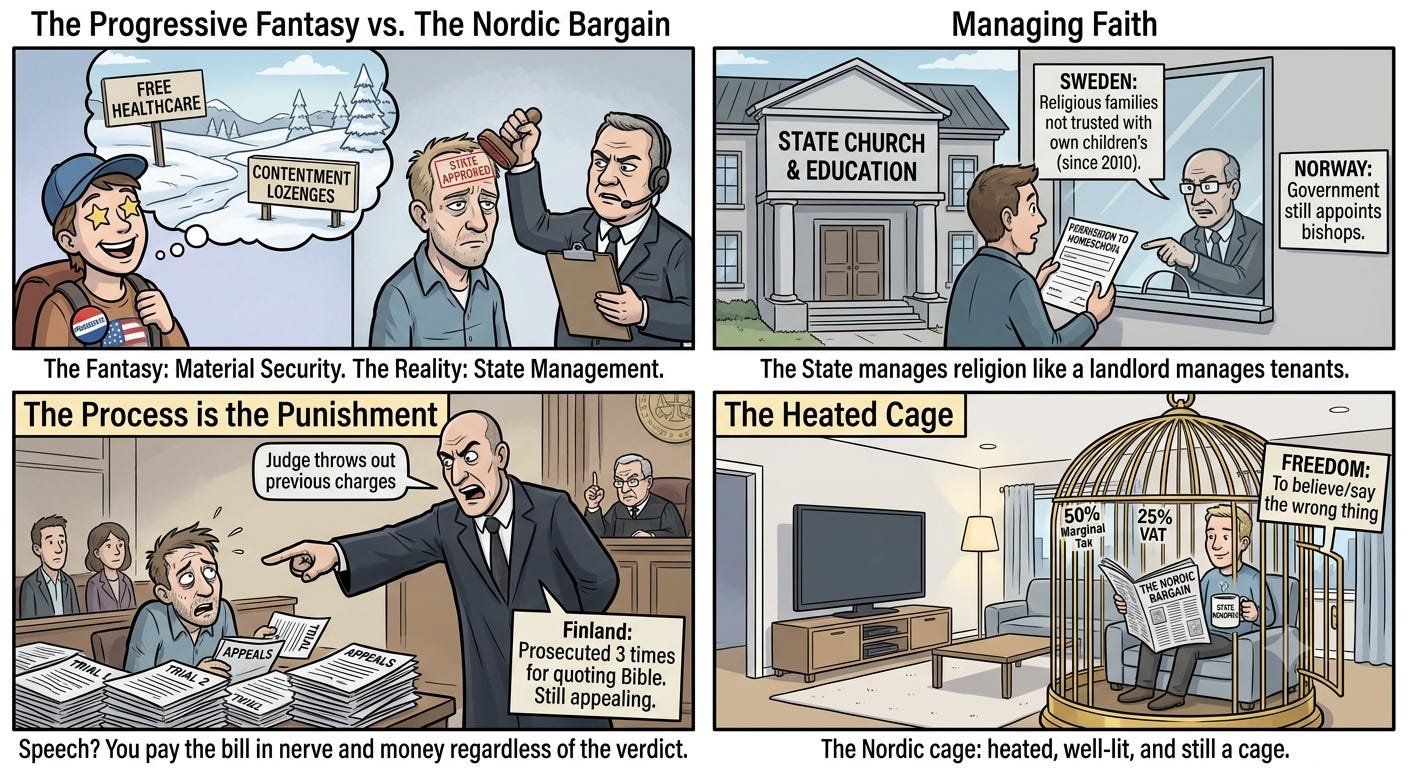
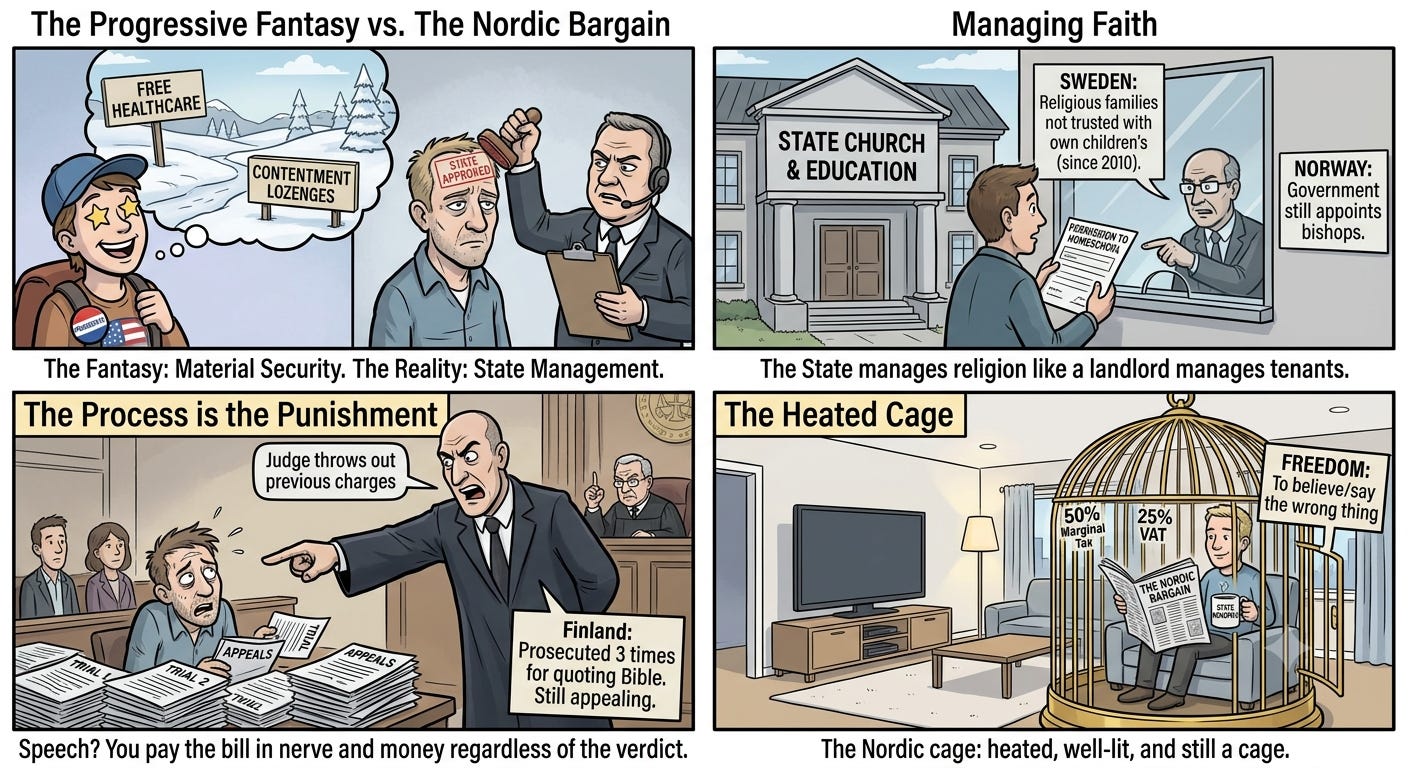
Somewhere in the frozen civic imagination of the American progressive there lives a fantasy Scandinavia, a land of free healthcare, free love and free thought, where the state hands out contentment like lozenges and nobody has ever raised his voice in anger. It is a lovely place. It does not exist.
What exists instead is a set of small, orderly nations that have solved poverty and inequality about as well as any society in human history, and in the process built a legal architecture that treats faith, speech and money as things the government issues permits for. Call it the Nordic bargain: material security purchased with a smaller self.
Start with God, since the Nordic states did. Denmark kept a blasphemy statute on the books until 2017. It used the law too, hauling a man into court for filming himself burn a Quran, right up until parliament admitted the whole business belonged in a museum next to the Viking swords. Norway’s church and state stayed formally married until a divorce finalized only in 2017, a divorce that still leaves the government appointing bishops and reserving the throne for a Lutheran. Sweden, further along the secular road, has all but outlawed homeschooling since 2010, on the theory that religious and minority families cannot be trusted with their own children’s education without a municipal permission slip. In each case the state did not simply decline to establish religion, the American solution. It managed religion, the way a landlord manages tenants.
Speech fares no better. Sweden convicted a Pentecostal pastor, Ake Green, over a sermon on sexuality, a conviction his own Supreme Court eventually threw out, though only after the machinery of the state had already done its work of intimidation. Finland spent nearly five years and three trials prosecuting a sitting member of parliament, Paivi Rasanen, for quoting the Bible in a pamphlet and a tweet. She won, every time, unanimously. The prosecutor appealed anyway, all the way to the Supreme Court. That is the tell. In America the First Amendment stops the government at the door. In Scandinavia the government gets in, argues its case, loses and tries again on appeal, and the citizen pays the bill in nerve and money regardless of the verdict.
Then there is the ledger, where the Nordic bargain is most honest about its terms. Marginal income tax rates north of 50 percent in Sweden and Denmark, value-added taxes near 25 percent across the region, and state monopolies on wine and liquor sales in Sweden, Norway and Finland that would have gotten a colonial governor tarred and feathered. None of this makes Danes or Swedes poor. It makes them dependent, a different condition entirely, and one the Nordic citizen has apparently decided he can live with, since he keeps voting for it.
None of this argues that Americans have it better on every axis. Nordic murder rates are a fraction of ours, Nordic prisons do not resemble ours, and nobody in Stockholm goes bankrupt from a hospital bill. But freedom, the specific kind the First Amendment was built to protect, is not a comfort metric. It is a measure of how much room a citizen has to believe the wrong thing, say the wrong thing and keep his or her own money, without asking permission first. By that measure, the cage in Scandinavia is heated, well lit and still a cage.
