
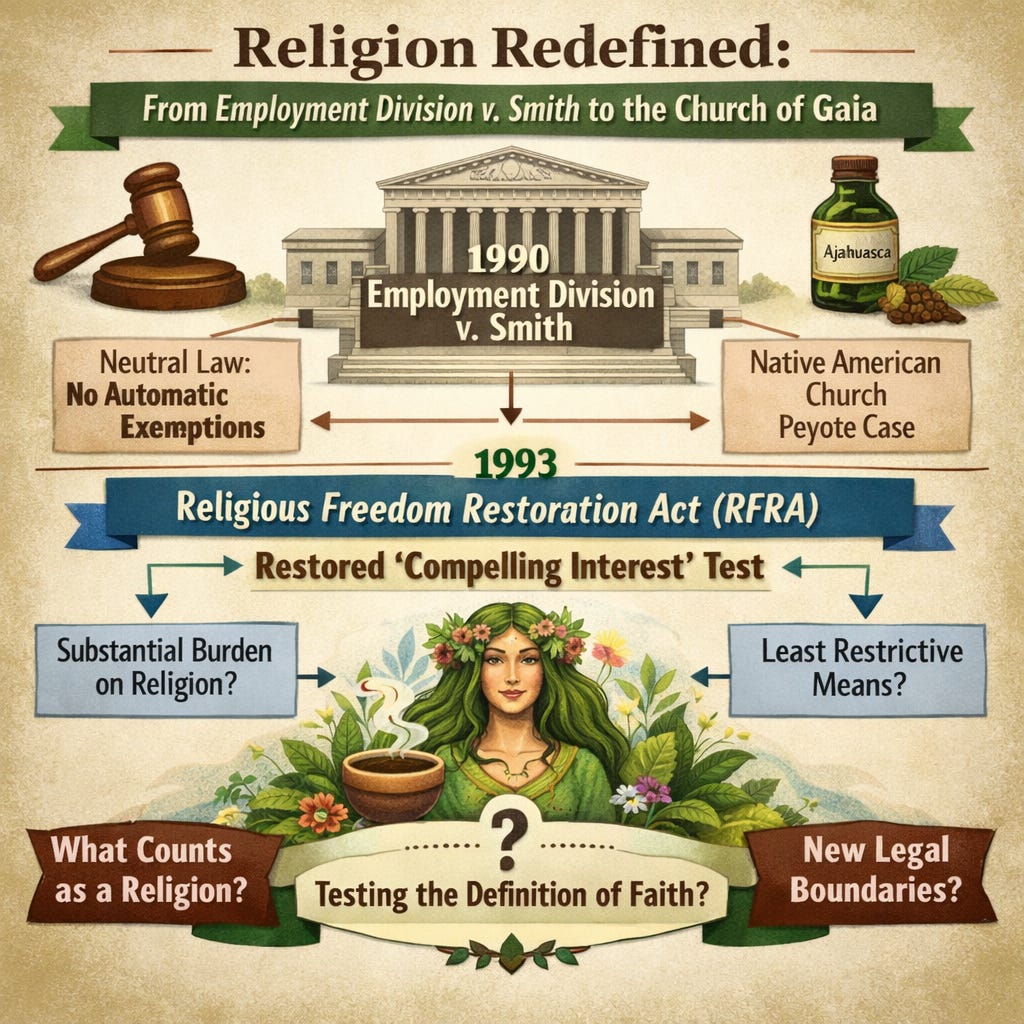
Church of Gaia, based in Spokane, says ayahuasca is a sacrament in an earth-centered faith. In May 2025, it reported that the DEA approved a petition for a religious exemption under the Religious Freedom Restoration Act (RFRA). RFRA exists because Congress reacted to Employment Division v. Smith, a Supreme Court case decided April 17, 1990, involving peyote use in the Native American Church. Smith held that neutral, generally applicable laws usually do not require religious exemptions under the First Amendment. RFRA restored a tougher test for federal action: if government substantially burdens religious exercise, it must prove a compelling interest and use the least restrictive means. A later case, Gonzales v. O Centro (2006), applied RFRA to a sacramental tea containing DMT.
On its website, the Church of Gaia describes a faith centered on reverence for Earth and “sacred plants,” with ayahuasca treated as a sacrament. In May 2025, the Spokane group said the Drug Enforcement Administration approved a petition for a religious exemption under the Religious Freedom Restoration Act, letting the church possess and use ayahuasca within the terms of an agreement.
This story matters now because the same legal framework that governs Church of Gaia’s exemption traces back to a Supreme Court decision from April 17, 1990, Employment Division, Department of Human Resources of Oregon v. Smith. That case narrowed when the Free Exercise Clause requires religious exemptions from generally applicable laws, and Congress responded three years later by passing RFRA.
Employment Division v. Smith is where the modern federal “religion versus drug law” debate changed shape. RFRA is Congress’s attempt to push it back in the other direction. Church of Gaia sits inside that push and is using it in an area that forces the government to ask hard questions about sincerity, safeguards, and what it can review without judging theology.
What Smith held and why it still matters
Smith began as an unemployment case, not a criminal prosecution. Two members of the Native American Church, Alfred Smith and Galen Black, were fired for ingesting peyote for sacramental purposes. Oregon denied them unemployment benefits under its “misconduct” rule.
The Supreme Court held that the Free Exercise Clause did not require Oregon to create an exemption from a neutral, generally applicable ban on peyote, even when the law burdened sacramental use. In the Court’s syllabus, the opinion states that the Free Exercise Clause “does not relieve an individual of the obligation to comply” with a law that incidentally forbids religious conduct, so long as the law is not aimed at religion and is otherwise constitutional.
That approach changed the practical baseline. Before Smith, many free exercise cases used a form of balancing, often described as requiring the government to justify a substantial burden on religious exercise with a compelling interest. Smith rejected applying that kind of case-by-case balancing to broad criminal prohibitions.
For new or unfamiliar religious movements, Smith had a second-order effect. It reduced the constitutional pressure on governments to carve out exemptions. That meant religious claimants often had to seek relief through legislatures or statutes, rather than relying only on the First Amendment.
RFRA was Congress’s direct response to Smith
RFRA became law on November 16, 1993. Congress wrote into the statute that, in Smith, the Supreme Court “virtually eliminated the requirement” that government justify burdens imposed by neutral laws. Congress also stated RFRA’s purpose: “to restore the compelling interest test” and to provide “a claim or defense” when government substantially burdens religious exercise.
In practice, RFRA sets up a structured inquiry in federal cases:
-
Has the federal government substantially burdened a person’s exercise of religion.
-
If yes, can the government prove that applying the burden to that person furthers a compelling governmental interest.
-
If yes, is the burden the least restrictive means of furthering that interest.
That structure, not the Free Exercise Clause alone, is what modern federal ayahuasca exemption fights usually run on.
RFRA’s reach was later narrowed against states and cities
RFRA did not stay as broad as Congress intended. In City of Boerne v. Flores, decided June 25, 1997, the Supreme Court held that RFRA exceeded Congress’s enforcement power as applied to state and local governments.
The result is a split world that matters for churches like Gaia:
Federal level: RFRA applies to federal agencies and federal law, including the Controlled Substances Act.
State and local level: RFRA does not automatically apply unless a state has its own RFRA or similar protections, or unless another federal law applies.
Church of Gaia’s exemption claim is federal. That is why RFRA is the centerpiece.
How RFRA became the key for “plant sacrament” cases
The Supreme Court’s 2006 decision in Gonzales v. O Centro Espírita Beneficente União do Vegetal is the modern landmark for sacramental tea under RFRA. That case involved hoasca, a tea used by the UDV church that contains DMT, like ayahuasca.
O Centro matters because it shows what RFRA demands from the federal government in a controlled substances setting. The Court required the government to justify applying the ban to the specific religious claimant, not merely point to broad interests in uniform drug enforcement.
That decision did not create an automatic pass for all sacramental drug use. It did, however, reinforce that RFRA can compel individualized analysis, even in Schedule I contexts, and that courts will examine whether the government’s approach is actually the least restrictive means.
Where Church of Gaia fits in this legal lineage
Press coverage in Spokane described Church of Gaia’s approval as a first-of-its-kind outcome through the DEA’s administrative process rather than through litigation. The church’s own materials describe the outcome as a “Petition for Religious Exemption” approved under RFRA.
That procedural route matters because it changes who does the first pass on the RFRA analysis. In a lawsuit, a judge quickly becomes the referee. In a petition process, the agency builds the record first, and disputes may arrive in court later.
When the claimed religious practice involves a controlled substance, the practical questions tend to look less like theology and more like administration:
-
How is the sacrament sourced.
-
How is it stored and tracked.
-
Who has access.
-
How participants are screened.
-
How the group reduces diversion risk.
-
How the group documents compliance.
Those questions can feel like the state judging a religion, but legally they can also be framed as the government testing whether its interests can be met through narrower, safer conditions rather than a flat ban. That is the “least restrictive means” concept in real life.
How this “stretches the definition of religion” in government settings
Church of Gaia’s beliefs are not the central legal test. Under the First Amendment, courts avoid deciding whether a belief is “true.” Under RFRA, the core statutory trigger is whether a person’s exercise of religion is substantially burdened.
Still, a petition like this pressures the system in three ways.
First, it forces agencies to take seriously newer forms of religious identity. Gaia presents itself as earth-centered and plant-centered, and places a psychoactive sacrament at the center of worship. That combination is unfamiliar to many regulators, yet RFRA does not limit protection to older or mainstream traditions. The government’s job becomes distinguishing sincere religious exercise from pretext without becoming an arbiter of doctrine.
Second, it narrows the distance between “religion” and “wellness” in legal paperwork. Critics of the psychedelic church trend argue that some groups use religious labels to evade drug laws. Supporters argue that the United States has long protected minority faith practices that appear unfamiliar to outsiders. National reporting has described a broader boom of psychedelic churches, with only a small number operating with clear federal protection.
Third, it puts the definition of “burden” under a microscope. A church that treats a substance as sacramental can argue that prohibition strikes at the heart of worship, not a peripheral practice. That is often where RFRA cases become evidence-heavy and fact-specific.
Key moment of conflict: Smith’s “neutral law” rule versus RFRA’s “compelling interest” rule
The clash between Smith and RFRA is not abstract. It shows up as two different default settings.
Smith default: If a law is neutral and generally applicable, the Constitution usually does not require a religious exemption.
RFRA default for the federal government: If federal action substantially burdens religious exercise, the government must satisfy a demanding test and must do so as applied to the claimant.
That difference is why a federal exemption process exists at all for ayahuasca churches. Without RFRA, many claimants would be left arguing for discretionary enforcement choices, narrow agency policies, or constitutional theories that are harder after Smith.
Broader implications for religious liberty and administrative government
Church of Gaia’s exemption story illustrates how religious liberty disputes often shift from courtroom doctrine to agency procedure. If petitions become more common, agencies will face pressure to state clear standards and to apply them consistently across groups with very different theological narratives, organizational structures, and safety protocols.
It also highlights a modern reality: in federal law, RFRA often does more day-to-day work than the Free Exercise Clause in disputes with federal agencies. That is not only true in controlled substances cases. It is also visible in other major RFRA litigation, including Burwell v. Hobby Lobby Stores, Inc., where the Court applied RFRA to a federal regulatory mandate and focused on “least restrictive means.”
What to expect next
The concrete next step to watch is whether more groups pursue petition-based RFRA exemptions with the DEA and whether any denials lead to lawsuits challenging the agency’s reasoning or pace of decision making.
Analysis
Smith told religious claimants that the Constitution will not always give them an exemption from a neutral law. That approach favors uniform rules and limits case-by-case balancing. It also shifts many disputes away from judges and toward lawmakers.
Congress responded with RFRA because it wanted more protection than Smith offered, at least against the federal government. RFRA reintroduced a demanding test that asks whether the government can achieve its goals while burdening religion less.
That test becomes concrete in controlled substance cases. The government can point to safety and diversion risks. The claimant can respond with specific controls. The case then turns on evidence, not on whether the belief system is familiar.
For a group like Church of Gaia, the hardest part is maintaining a record that shows sincerity and disciplined compliance. If it does, RFRA can force the government to justify why conditions are not enough and why a total ban is necessary.
Like, share, and subscribe
If you want more updates on religious liberty cases and primary-source links, like this article, share it, and subscribe to the ReligiousLiberty.TV substack. Subscribing gives you access to breaking news and case information published on the blog.
URL:

Legal disclaimer
This does not constitute legal advice. You should talk to a licensed attorney about your specific situation.
Works Cited
“Employment Division, Department of Human Resources of Oregon, et al. v. Smith et al., 494 U.S. 872 (1990).” Library of Congress, U.S. Reports, decided 17 Apr. 1990. https://tile.loc.gov/storage-services/service/ll/usrep/usrep494/usrep494872/usrep494872.pdf. Accessed 19 Feb. 2026.
“42 U.S. Code § 2000bb, Congressional findings and declaration of purposes.” Legal Information Institute, Cornell Law School, enacted 16 Nov. 1993. https://www.law.cornell.edu/uscode/text/42/2000bb. Accessed 19 Feb. 2026.
“City of Boerne v. Flores, 521 U.S. 507 (1997).” Oyez, decided 25 June 1997. https://www.oyez.org/cases/1996/95-2074. Accessed 19 Feb. 2026.
“City of Boerne v. Flores, 521 U.S. 507 (1997).” Justia U.S. Supreme Court, decided 25 June 1997. https://supreme.justia.com/cases/federal/us/521/507/. Accessed 19 Feb. 2026.
“Gonzales v. O Centro Espírita Beneficente União do Vegetal, 546 U.S. 418 (2006).” Oyez, decided 21 Feb. 2006. https://www.oyez.org/cases/2005/04-1084. Accessed 19 Feb. 2026.
“Gonzales v. O Centro Espírita Beneficente União do Vegetal.” Justia U.S. Supreme Court, decided 21 Feb. 2006. https://supreme.justia.com/cases/federal/us/546/418/. Accessed 19 Feb. 2026.
Stephens, Tod. “Spokane psychedelic church gets first approval of its kind to possess and partake of ayahuasca.” The Spokesman-Review, 23 May 2025. https://www.spokesman.com/stories/2025/may/23/spokane-psychedelic-church-gets-first-approval-of-/. Accessed 19 Feb. 2026.
“Welcome.” Church of Gaia, statement on DEA petition approval under RFRA, accessed 19 Feb. 2026.
. Accessed 19 Feb. 2026.
“Inside the US’s psychedelic church boom, where taking drugs is legal.” The Guardian, 25 Dec. 2025. https://www.theguardian.com/society/2025/dec/25/psychedelic-church-drugs-legal. Accessed 19 Feb. 2026.
Potential SEO tags
Church of Gaia, Employment Division v. Smith, Religious Freedom Restoration Act, ayahuasca church, DEA religious exemption